CH and HW dependence after repairs

Dave will have no problem making a few suggestions in the morning.
Printable, I assume you mean :wink:

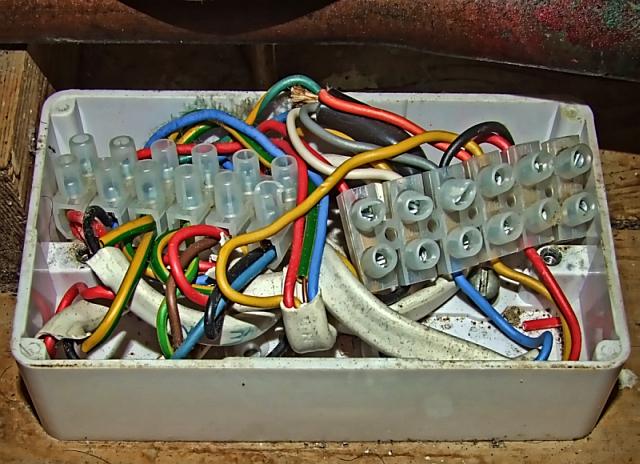
That is a right mess and is going to be difficult to decipher just from a picture. When I mentioned labelling the leads, I was thinking more of you finding out what each lead connected to and then adding the info to the picture using paint or something similar.

If it was me, I would rip the box out and install a Honeywell Wiring box - the simple version with just one strip of terminals in it - and then rewire to the standard method.

You will have to identify the wires before you can do anything :shock: :?

Here are some hints to make it easer. They assume the wiring is correct.

turn power off before testing

Cylinder thermostat
Wire A. Connects to valve grey
Wire B. Connects to valve orange
Wire C. Connects to programmer HW ON

Disconnect these leads at the junction box. Set meter to ohms or continuity. There should be a short circuit between Wire C and Wire B when the cylinder stat is at max. There should be a short circuit between Wire C and Wire A when the cylinder stat is at min.

Room Thermostat
Wire D. Connects to valve white
Wire E. Connects to programmer CH ON
Wire F (may not be present, depends on stat). Connect to a Neutral

Disconnect these wires.

Turn room stat to min.
There should be an open circuit between wires D and E. There should be a resistance between D and F

Turn room stat to max.
These should be a short circuit between D and E and a resistance between D and F and E and F

Programmer
Wire G. Connects HW ON to Wire C from cylinder stat
Wire H. Connects HW OFF to Wire A from valve grey.
Wire I. Connects CH ON to Wire E (room stat)

Boiler
Switched live connects to valve orange.

Pump
Brown connects to valve orange and boiler switched live.

That should just leave you with the power supply connection to identify. The only thing which is powered directly will be the Programmer L and N terminals.
 
Many thanks! I was already figuring out from the diagrams what connects to what (although reluctant to trace it in the spaghetti) - but your clear step-by-step explanation made it a lot easier, and I even don't find it that scary any more :)

I will probably consider re-installing with a proper wiring box, and will surely get a multimeter next weekend to complete the tests.

Any suggestions how to test the 3-point valve in similar simple ways as the stats? Both the mechanical/hydraulic part, and the electrics in the powerhead?

Thanks :!:
 
Any suggestions how to test the 3-point valve in similar simple ways as the stats? Both the mechanical/hydraulic part, and the electrics in the powerhead?
Patience! I was coming to that when you had the terminals identified. :wink:

Basically you test the valve by by-passing the things which control it - thermostats and programmer.

If you want to have a go, here's what you do.

Power OFF
Programmer CH OFF and HW OFF
CH stat to min, HW stat to min
Disconnect White, grey and orange wires (write down where they connect to)
Power ON
Turn HW ON at programmer - boiler should not run
Turn HW stat up - boiler should run and pipe from valve to cylinder get hot
Turn stat down - boiler should go off.
Power OFF
Connect white wire to a permanent 240v supply
Power ON
Turn CH ON
Turn HW stat up boiler should run; valve HW pipe get hot
Turn CH stat up boiler should continue to run; valve HW and CH pipe get hot (and radiators).
Power OFF
Reconnect orange wire to correct terminal
Power ON
Boiler should run and both valve pipes get hot.
Turn Cylinder stat down. Boiler should run and only CH pipe get hot
Turn HW OFF. Boiler should run and CH pipe get hot.

If it passes all those tests, the valve is OK.

Turn power off and reconnect white and grey wires to correct terminals
 
hi all not posted for a couple of weeks


just my take on this, DIA is right it doesn't look to bad to work out but it would be easier if we could see the left hand terminal block a little more overhead
right the left hand block of 6 from left to right
1 permanent live
2 neutral
3 earth
4 earth
5 pump live (from boiler)
6 pump neutral (from boiler)

right hand block left to right
1 ch on from programmer to room stat
2 ch call from room stat to 3 port white
3 hw off from programmer/sat from cylinder to 3 port grey
4 hw call from cylinder stat/boiler switched live/3 port orange
5 hw on from programmer to cylinder stat common
6 unused

but persuming its wired correctly my money is on a dodgy micro switch in the accuator (its not switching the white to orange when fully open}

which is why the heating only works on HW demand

Matt
 
@D_Hailsham: Thanks again -

This makes sense, although it's a definite weekend job - requires at least one 'helper' from the household (a) to keep checking if boiler is running and shout from garage (oh, we forget mobile phones can be used for that :) ), and (b) to keep shutting the entire power supply of the house on- and off- at the main fuse (I am not sure I know another easier or safer way - given the messy wiring).

We never mentioned the pump: is it powered in parallel with the boiler - should it always come on when the boiler does? Can it be used as an 'indicator' of the boiler running? (Or are there scenarios where one is on and the other - off?)

On second thought - about 'Power Off' - on the schematic diagram there is a 'Main Isolator', a dual switch that cuts both L and N. What should it look like and where is it located? (There is a switch on the wall next to the porgrammer, which looks jist like a light switch - could that be a 'master' power switch?).

I am nearly there (in terms of understanding), now I need some disruption time and a multimeter. Then I could probably answer on my own the stupid questions I'm asking :)
 
@matt1e: Thanks, this brings me closer to the tests.

I could take another photo with the blocks better visible from above, but I think with the suggestions you already made, the wiring diagram in hand, and tracing at least the visible cables to devices (plus some logic :)) I should be able to make sense of it all.

If it turns out to be the 'fully open' micro switch, is it easily replaceable (without soldering or something), or the 'lazy man' solution would be to buy a complete powerhead? (I think in the latter case I will preempt other components coming of age?)

Thx -
 
Thanks again -

We never mentioned the pump: is it powered in parallel with the boiler - should it always come on when the boiler does? Can it be used as an 'indicator' of the boiler running? (Or are there scenarios where one is on and the other - off?)

yes sometimes it is, unless the boiler needs an over-run in which case the pump is connected to dedicated terminals in the boiler and allows the pump to run on for 10 mins or so after the boiler shuts down {which answers the second part of your question)

On second thought - about 'Power Off' - on the schematic diagram there is a 'Main Isolator', a dual switch that cuts both L and N. What should it look like and where is it located? (There is a switch on the wall next to the porgrammer, which looks jist like a light switch - could that be a 'master' power switch?).

yes it could and most likely does but don't take that as fact You need to test that the circuit is dead to prove

I am nearly there (in terms of understanding), now I need some disruption time and a multimeter.

It would be a big help!
but to prove that it is the microswitch
1 power everything down
2 place a temperary link between orange and white (terms 2 and 4 on the right hand side block)
3 turn off hw and ch on programmer
4 turn down the room stat
5 restore power, turn CH only on then turn up the room stat
the boiler and pump should fire up and the 3 port valve should travel fully over to the central heating position
6 turn down the room stat (or switch off at programmer ) and the boiler should shut down, the pump may run on for a while and the 3port will stay at the ch position {unless you switch off at the spur)

but there are a few tests you should do first to see if the 3port/controls are wired correctly and the valve is positioning itself correctly do these first you don't need a multimeter for them I'm afraid I'm off out now but others on here will point you in the right direction

matt

ps don't forget to remove the link when you are done or your central heating will be permanently linked to the Hot water
 

This was deeply informative and very helpful - thanks!

your welcome :D , i am watching this with interest.I have recently come across a similar problem, i would say you are doing very well so far.
trying to understand all this stuff isn't easy :wink:
i assume DIA was joking when he said your wiring was actually quite clear.( which i thought, was a cracker).
 
@Newgas: Sorry if I sounded somewhat sarcastic :roll: (I was - for which I apologise. When you're pulling your hair out facing a porblem, even best-intended jokes can be misinterpreted and are generally..not helpful).

What was 'clear' to him was clear to me, too - the valve wires have unique colours that no other component uses, so no prizes for guessing those. The rest are all red, green and yellow - too many of those to belong to a single source. That, together with the messy look, petrified me.

As you saw in subsequent posts, things started to become clearer (it helps that I have the original manufacturer diagrams), and with the guidance generously provided, it won't be so difficult to resolve.

Cheerz
 
@Newgas: Sorry if I sounded somewhat sarcastic :roll: (I was - for which I apologise. When you're pulling your hair out facing a porblem, even best-intended jokes can be misinterpreted and are generally..not helpful).

What was 'clear' to him was clear to me, too - the valve wires have unique colours that no other component uses, so no prizes for guessing those. The rest are all red, green and yellow - too many of those to belong to a single source. That, together with the messy look, petrified me.

As you saw in subsequent posts, things started to become clearer (it helps that I have the original manufacturer diagrams), and with the guidance generously provided, it won't be so difficult to resolve.

Cheerz
if you've got the energy can you expand on this. just for reference thanks :wink:
 
All the MV wires are in the black cable, from where they are connected you can tell the cylinder stat, and the room stat.

The room stat cable will then tell you T4 in the programmer, the grey wire will tell you T1 and and the common in the cylinder stat will tell you T3 in the programmer.

The orange is boiler and pump, that just leave the L<N< & E. :lol:

And I haven't posted because Dave is the Best, and if several people have a go it gets confusing for the OP. :wink:
 
hi nyamago here are some walk about tests you can do without a multimeter, hope you don't mind walking lol

1 turn off power to the system by the spur
2 set both the HW and CH to off at the programmer
3 turn down both the room and cylinder stats and turn the boiler stat up

in this state everything should be off and the 3 port valve should be at rest at the hot water position

4 turn on power and select hot water only then go to the cylinder stat, and turn it up

the boiler should fire ,the pump should run and the valve should stay where it is

5 now turn the cyl stat back down and the boiler should stop but the pump may or may not if the pump runs on then put the kettle on make a cuppa and wait for it to stop then ignore what ever thhe pump does from now on regarding these tests as it is controlled by the boiler and not the heating controls (don't know if all the flamingos had pump overrun though}

6 now turn on the CH at the programmer (leave HW on) go back to the cyl stat and turn it back up- the result should be the same as in step 4

7 now go turn the room stat up and go back to the 3port valve

the valve should now be at the mid position , the boiler should be firing and the pump should be running

8 now reach over, turn the cyl stat down and watch the 3port, it should now be motoring over to the heating only position

this is the point (traveling from mid to heating only) where in a heathy system there is a momentary loss of supply to the boiler ie it will switch off when the cyl stat is satisfied,if the valve is at mid position (CH calling) then the valve will motor on to block the HW port then toggle the micro switch connected between white and orange to restore power to the boiler s/live

9 go check the boiler it should now be firing if not then either the microswitch has failed or the orange from the 3port has a bad connection

10 now select HW off on the programmer and go back to the cyl stat and turn it up

this should make no difference to the state of the valve it should stay in the heating position

10 go back to the programmer and turn HW back on

the valve should return to mid position and the boiler should be firing

11 now turn CH off at programmer

the valve should now have returned to the hot water only position and the boiler should be firing

12 Reset your stats for normal use not forgetting the boiler stat

if all the tests are ok (apart from 9) then the wiring is ok with the possible connection of the valve orange but it will more than likely be the valve accuator at fault you can use the test i discribed earlier to test the microswitch thats enclosed in it if you like

matt
 
I Don't know the Flamingo or whether it has an over-run stat, but I very much doubt it.

I found 2 ways to start the heating:
(a) Turn on a hot water tap anywhere in the house and waste a couple of litres of hot water - this kick-starts the circulation pump.
(b) Turn up the cylinder thermostat - to above 70 deg., nearly 80 - does the same. (But water gets too hot with all that follows in terms of comfort, economy and overheating risks).
 

If you need to find a tradesperson to get your job done, please try our local search below, or if you are doing it yourself you can find suppliers local to you.

Select the supplier or trade you require, enter your location to begin your search.


Are you a trade or supplier? You can create your listing free at DIYnot Local
 
Back
Top