- Joined
- 26 May 2025
- Messages
- 1
- Reaction score
- 0
- Country

Hi all,
I have a brick outbuilding (single skin) immediately to the side/behind our house. Approx 3m x 2.8m. Mine and our neighbour's outbuildings are connected. It has a thick concrete slab roof. I think concrete lintels laid side by side then topped with concrete poured on top and dry coated with bitumen tarp. Typical of 1950s.
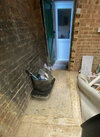
The concrete slab has a lean to that connects to above my back door (and does the same on the neighbour's side too). The outbuilding itself has two doors and originally a smaller section of it was used to store coal (you can see the staining on the brickwork in that section). There was a small wall in this corner which kept the coal in one section and left a larger area of the building. The previous owner has removed this wall. You can see where it was on the brickwork and also on the concrete floor.
There is electric and water in the outbuilding. The previous owner has also put in a window and lights and plastered the ceiling. I would like to insulate it, put plasterboard, plaster, paint and put some flooring down in order to make it a more usable space or perhaps have it as an office. Lots of neighbours seem to have done similar with theirs. However, I am wondering: when the small wall that confined the coal area was removed, should there have been additional supports put in place on account of the weight of the concrete roof? Or with these constructions is the weight of the roof evenly distributed across the four walls of the building? Will upload some better pics later.
The felt on the roof probably needs some attention in places but that is for another thread.
Any thoughts?
I have a brick outbuilding (single skin) immediately to the side/behind our house. Approx 3m x 2.8m. Mine and our neighbour's outbuildings are connected. It has a thick concrete slab roof. I think concrete lintels laid side by side then topped with concrete poured on top and dry coated with bitumen tarp. Typical of 1950s.
The concrete slab has a lean to that connects to above my back door (and does the same on the neighbour's side too). The outbuilding itself has two doors and originally a smaller section of it was used to store coal (you can see the staining on the brickwork in that section). There was a small wall in this corner which kept the coal in one section and left a larger area of the building. The previous owner has removed this wall. You can see where it was on the brickwork and also on the concrete floor.
There is electric and water in the outbuilding. The previous owner has also put in a window and lights and plastered the ceiling. I would like to insulate it, put plasterboard, plaster, paint and put some flooring down in order to make it a more usable space or perhaps have it as an office. Lots of neighbours seem to have done similar with theirs. However, I am wondering: when the small wall that confined the coal area was removed, should there have been additional supports put in place on account of the weight of the concrete roof? Or with these constructions is the weight of the roof evenly distributed across the four walls of the building? Will upload some better pics later.
The felt on the roof probably needs some attention in places but that is for another thread.
Any thoughts?