Could someone help me calculate maximum demand for my house?

Joined
25 Aug 2016
Messages
1,407
Reaction score
367
Country
United Kingdom
Hi all, I'm applying to my dno to have my cutout fuse upgraded to 80a ahead of having am evse installed and they want to know the maximum demand.

Both consumer units contain all the following circuits and I've listed the mcb or rcbo size too.

Cooker circuit b40
Downstairs sockets b32
Garage sockets b16
Upstairs lights/garage lights b6
Shower b40
Upstairs sockets b32
Kitchen sockets b32
Air conditioning b16
Pv/solar 32a rcbo

That's all the currently connected circuits and the evse will be added on a 40a rcbo.

I know you apply diversity to the circuits due to not everything being in full use all the time but I don't know how to do all the maths.

Is there any other information required to calculate maximum demand such as number of outlets/sockets on each circuit etc.?

Thanks,
Chris.
 
I good question, in my own house I have solar, and as a result I have the solar software showing me what I am using.

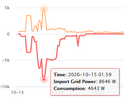
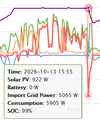
There is a particular time of the day which is critical, 00:30 to 05:30 when I have off-peak so I run dish-washer, washing machine, tumble drier, and charge batteries. 1792151255226.pngand one can see I have peaked to 4643 kW = 20 amps, using the shower is likely the largest load, 1792151462930.pngbit misleading as shows 5.905 kW but the shower uses more like 8 kW and it is the fact some things show direct and some go to a server so there is a slight time shift, which results in a spot error.

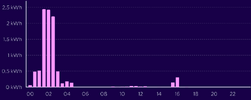
1792151836179.png Smart meter used ½ hour blocks so also not that accurate, so the blip over 16 hours shows 0.308 kWh which since in kWh not kW shows very little.

So in real terms, an EV will use 7 kW = 31 amps approx, so the question is what will be used at the same time, with something like Octopus Go your off-peak is 00:30 to 05:30 and the question is what else will be used at that time?

So if we assume by 00:30 you will be in bed, for me there are only three items I could use in those hours, dish-washer, washing machine, tumble drier, unlikely I will take a shower then or cook a meal. So I can't set the time to switch on, I have to set a delay, in either ½ hour or 1 hour slots, depending on how far in advance I am setting them, each has some form of heating, but in the main heating water for a short time, so the chance that two heating elements will turn on together is slim, but possible, but fact is I have never blown the 60 amp DNO fuse, and looking at use over the years since solar and off-peak, I have not seen the software show anywhere near 13.8 kW = 60 amps even when charging my batteries at 4 kW, so your EV will take around 13 amp more than my batteries, so it seems unlikely it will ever exceed 60 amps.

I can understand the DNO asking on a new build, but on existing they should realise the 60 amp existing fuse has never ruptured so adding another 31 amps at night with an 80 fuse, it would be highly unlikely that the 80 amps will every be exceeded.

Theory with two electric showers and a battery I could exceed 60 amps, but I never have.
 
The calculator on tradecalcs.co.uk shows a max demand of 139a so I've supplied that figure to national grid and I'll see what they come back with, so far they emailed this morning asking for a photo of the cut out.

I understand that a 60a fuse would be fine as the evse ct clamp will reduce the load if it sees it getting close but if I can have it upgraded to 80a or 100a so I can avoid that situation then I will, I want to be able to use the full capacity of the evse if and when I need to ideally.

Thanks,
Chris
 
Technically 60A but upgrade to 100A as the demand for electricity is only going to increase.
 
I get what your saying John, that max demand does include the new load from the new charger which is 40a as diversity isn't applied to it.

I also can't find what diversity rating would be applied to our solar install so if you assume that's 0 too then that would be 72a that diversity can't be applied to.

I understand nothing is ran at max all the time, especially as we're a 2 adult 1 child house but I had to supply a figure and the only calculator that was reasonably quick to use without going around adding up all the light bulb wattages and socket outlets was the one I mentioned above.
 
I also can't find what diversity rating would be applied to our solar install
You won't, as no such thing exists.

There are a selection of items regarding diversity in the On Site Guide, Appendix A, that states assumptions such as 66% for lighting circuits, 100% for the first and 40% for other socket outlets and so on.
Before it was in the OSG, all of that appeared in the wiring regulations. It has been used extensively in all kinds of training materials, books, courses, online calculators and the rest.
It hasn't been revised in any meaningful way since it first appeared, which was in 1934. Yes, 92 years ago.
There is zero evidence to suggest it was ever valid, or where the information originally came from. Highly likely it was made up figures by someone or other and shoved in there so that electricians could have something to use.

The nonsense in another table about lighting outlets being assumed to be 100W each has recently been slightly amended to suggest that LED and CFL lamps will use less, but the bulk of that table hasn't changed since it was created in 1981 - and once again, no evidence to suggest it was ever valid or appropriate.

Using these 'calculators' based on junk created nearly a century ago just ensures that actual demand is massively overstated.


the new load from the new charger which is 40a as diversity isn't applied to it.
EVSEs are 32 amps maximum, and in most cases will have load monitoring so that the EV load current will be reduced when other parts of the installation are over a set threshold.
They are often installed on 40A MCBs / RCBOs , but that is to avoid operating a 32A device at it's full load current for hours at a time which can cause overheating.

I also can't find what diversity rating would be applied to our solar install
Solar is a generation source which in terms of a grid supply will reduce the demand. At the same time it allows an installation to use more current than would normally be available from the grid which has implications for the rating of consumer units and the devices in them.


Some other things to consider:
Long ago, a typical modest house had a 3 way fusebox.
One 5A lighting circuit for all of the lights in the house.
One 30A ring circuit for all of the socket outlets.
The third circuit was 30A for a cooker.

Then that house was rewired, and a shiny new consumer unit was installed with many more circuits.
Now there are two lighting circuits of 6A each for upstairs and downstairs
and three 32A rings for downstairs, upstairs and the kitchen.
The cooker circuit is still there, now 32A.

Using any of these calculators or the slop in the OSG on the old and new installations above will basically double the total demand in the 'new' installation.
However the number of lights, outlets and other items has not changed at all.
 

If you need to find a tradesperson to get your job done, please try our local search below, or if you are doing it yourself you can find suppliers local to you.

Select the supplier or trade you require, enter your location to begin your search.


Are you a trade or supplier? You can create your listing free at DIYnot Local

 
Back
Top