Hi All,
Had a good search and can't seem to find an answer to my specific question.
So, plumber gave me a quote for a Direct Unvented Cylinder install in an airing cupboard at the weekebd,
Pretty straight forward as the D2 can go straight through the wall and discharge outside (albeit 700mm slate rubble).
However he said it would have to be 28mm.
Length is 2m max, only one or two bends, D1 = G1/2/15mm so should be 22mm from the tundish right?
However, he said as I've got two PRV's, it has to go up a pipe size to 28mm.
So there is one PRV on the cylinder, and one PRV on the Combination valve.
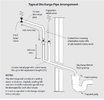
All the diagrams on the gledhill manuals (for the pre-plumbs) for show these two coming together in 15mm and sharing a tundish. See Pic.
The supplied tundish is 15mm inlet and 22mm outlet.
Now 3.59 states
"Where a single common discharge pipeserves more than one system, it should beat least one pipe size larger than the largest individual discharge pipe (D2) to be connected."
which is what I think the plumber was referring to. However, to my mind, both these PRV's are on the same system. I think 3.59 might refer to a situation where perhaps you have two separate cylinders, or central heating and cylinder. i.e. to separate systems.
In my case, both PRVs are guarding the same system, the same body of water, at the same pressure. In an over pressure situation, one or the other will release, but not both at the same time. The moment one blows, the other would be brought back from the brink so to speak. Even in the highly highly unlikely event that both PRVs blew at exactly the same moment, they'd then only discharge half the amount of water each.
Thus I'm thinking that 22mm is ok for D2.
Correct? or am I missing something?
Had a good search and can't seem to find an answer to my specific question.
So, plumber gave me a quote for a Direct Unvented Cylinder install in an airing cupboard at the weekebd,
Pretty straight forward as the D2 can go straight through the wall and discharge outside (albeit 700mm slate rubble).
However he said it would have to be 28mm.
Length is 2m max, only one or two bends, D1 = G1/2/15mm so should be 22mm from the tundish right?
However, he said as I've got two PRV's, it has to go up a pipe size to 28mm.
So there is one PRV on the cylinder, and one PRV on the Combination valve.
All the diagrams on the gledhill manuals (for the pre-plumbs) for show these two coming together in 15mm and sharing a tundish. See Pic.
The supplied tundish is 15mm inlet and 22mm outlet.
Now 3.59 states
"Where a single common discharge pipeserves more than one system, it should beat least one pipe size larger than the largest individual discharge pipe (D2) to be connected."
which is what I think the plumber was referring to. However, to my mind, both these PRV's are on the same system. I think 3.59 might refer to a situation where perhaps you have two separate cylinders, or central heating and cylinder. i.e. to separate systems.
In my case, both PRVs are guarding the same system, the same body of water, at the same pressure. In an over pressure situation, one or the other will release, but not both at the same time. The moment one blows, the other would be brought back from the brink so to speak. Even in the highly highly unlikely event that both PRVs blew at exactly the same moment, they'd then only discharge half the amount of water each.
Thus I'm thinking that 22mm is ok for D2.
Correct? or am I missing something?