• Looking for a smarter way to manage your heating this winter? We’ve been testing the new Aqara Radiator Thermostat W600 to see how quiet, accurate and easy it is to use around the home. Click here read our review.

DIY radiator fan?

80mm case fans can be had for a couple of pounds on Aliexpress, but the power supply would be a little more messy/complicated.
Any experiences/ideas would be very welcome.

You can get very similar mains powered fans for a few pounds.

You would need to construct or find a safe enclosure.
 
I have Hive TRVs, thermometers, boiler ebusd and monitor everything in Home Assistant. It informed me that a couple of TRVs are in a warm spot so the room can be 2 degrees lower than the setting. With the difference being weather dependant this cannot be corrected with an offset. I put some USB powered fans near the TRVs to stir the air which was enough to cool them down to true value. Main objective met.

But I was surprised with one radiator, when the small increase in convection produced a noticeable shift on the boiler's graphs, suggesting it was able to get significant amount of additional heat out for a particular water temperature.
 
I was mulling this recently.
FIrst - nobody has spelled out I don't think - is that you need more water going through the radiator if you have a fan, otherwise it'll cool down and you won't get more heat out.
Heating systems aren't ever balanced. I've been round a few with a surface thermometer, and never found one close to being balanced. I tried to balance my own like that, and gave up. As long as they have enough flow for all rads to to heat up, let the TRV deal with it.
If you have one rad, say a towel rail, near the pump wide open, the system won't work, but I've not met anyone using more than experience and educated guesswork to get it going.
I've put a few plinth heaters in, like the Myson ones with a fan which comes on when the pipe gets warm. They belt heat out even on lowest fan setting. Those use a cross flow fan which can be silent
Natural convection is pretty slow; I'd expect any fan to be significantly effective. Your test implies otherwise.
Always wondered about using a Seeebeck/Peltier panel to generate the power from the heat difference. The delta T is probably too low though.
Hotter: https://scienceimproved.com/heat-powered-thermoelectric-wood-stove-fan-review/.

If you want to knock up some electronics with thermostattery etc, several of us could draw something out for you.

You have a few controls interacting, so working anything out accurately would be a bit of a stretch.
 
Last edited:
I was mulling this recently.
FIrst - nobody has spelled out I don't think - is that you need more water going through the radiator if you have a fan, otherwise it'll cool down and you won't get more heat out.
If all else remains the same, the "potential" energy in the water entering the radiator remains the same. Increasing the temperature drop across the radiator with a fan means that more energy has been taken out of the water. This is different to increasing temperature drop through reduced water flow.

Heating systems aren't ever balanced. I've been round a few with a surface thermometer, and never found one close to being balanced. I tried to balance my own like that, and gave up. As long as they have enough flow for all rads to to heat up, let the TRV deal with it.
Balancing is inevitably imprecise. I agree with your "so long as". If a room has a TRV turned high but stays cold there is probably a room that gets warm with the TRV turned low. That's the time to give them a tweak (within limits, see below). I have adjusted mine by looking at heat on demand behaviour from my Hive TRVs.

If you have one rad, say a towel rail, near the pump wide open, the system won't work, but I've not met anyone using more than experience and educated guesswork to get it going.
I don't think necessarily so. A heating system is such that the boiler puts power into the water and the radiators release that power into the air. If input and output power are not the same, the water must buffer the difference so its temperature will go up or down until they are the same. The towel rail only has a limited power output, irrespective of the quantity of water flowing through it so the surplus must find another way out. Until the power has not reached the places you want it to reach before the boiler has reached maximum temperature.

What happened in my system is that I set water temperature quite low by setting the pump such that return does not go above 55 at 70 degree flow limit. Typically, return runs between 40-50 and flow doesn't usually go above 65 before the TRVs are satisfied. At around zero outside, one radiator struggled to warm the room. It just happened that the TRV was seeing the desired temperature so it was happy. I put the fan in to primarily make the TRV see the actual temperature. But the air flow also happened to make the radiator work better and the room warmed more readily. Balancing the system differently could not have improved delivery and without the fan, only turning the water temperature up could work.

If you want to knock up some electronics with thermostattery etc, several of us could draw something out for you.
Controlling a fan is simple. But it is not practical to run them off batteries so the usual problem is that power sockets are too far away.
 
Heating systems aren't ever balanced. I've been round a few with a surface thermometer, and never found one close to being balanced. I tried to balance my own like that, and gave up. As long as they have enough flow for all rads to to heat up, let the TRV deal with it.
If you have one rad, say a towel rail, near the pump wide open, the system won't work, but I've not met anyone using more than experience and educated guesswork to get it going.
I balanced my mother's radiators by reading the temperature reported by the TRV, if the current exceeded the target, which as first set up they all did, then I closed the lock shield a tad. And all but living room, the rooms were then spot on the setting. Living room it was sun through the bay window causing the problem, not the central heating.
I've put a few plinth heaters in, like the Myson ones with a fan which comes on when the pipe gets warm. They belt heat out even on lowest fan setting. Those use a cross flow fan which can be silent
The Myson has a completely different method of control, better in series not parallel as you do not throttle them back with a lock-shield valve, I had the output go into a standard radiator in the same room, so it did have a lock-shield valve, but having two radiators in series caused enough resistance to flow, to prevent it starving other radiators.
I put the fan in to primarily make the TRV see the actual temperature.
This was basic to the idea in the room where I tried to use a fan. It was a long radiator, and fan opposite end to the TRV, and I used the thermostat I had for the brewing to turn on the fan, the sensor at the TRV end which was the return. I opened the lock shield a bit more than it should have been, but the sequence of events were, heating turned on, return pipe got to over 25ºC, fan started, return temperature dropped, fan stopped, and the cycle would repeat.

Tried opening the lock shield more until fully open, and still this on/off sequence. Next was a smaller fan, the only one which worked with any sort of success, was a small USB fan, which was so small hardly worth having.

One problem is the speed of the TRV, they exercise on Saturday midday, and to fully open then fully close, then return to setting, it would take around 3.5 minutes, and this does not include the time for the heat to reach sensors. So on boiler turn on the radiator could over heat unless the lock-shield set spot on.

So heating turned on at 7 am, ready for carers to arrive a 8 am, but set the TRV to 20ºC and at 8 am still only showing 19ºC if lucky, so would set TRV to 22ºC until 8 am, then go back down to 20ºC, seems the built in anti-hysteresis was OTT, by 9 am all radiators just warm, so if the sun came through the bay window it did not have to cool much to be cold.

Once I had realised I had to set the sequance on the TRV this way to defeat the OTT anti-hysteresis I found I did not need the fan, so that was abandoned, the biggest problem was the hall, there was no TRV on the hall radiator, and attempts to set the lock-shield to match the wall thermostat failed. Fitting a TRV to the hall radiator transformed the control.

It took some tweaking, the aim was, after the front door had been opened, and mother taken in or out in her wheel chair, we wanted a rapid recovery of the hall temperture, but before the wall thermostat turned off, wanted the TRV to have nearly fully closed so only on warm days would the wall thermostat turn off, so that the boiler modulated fully before the hall got warm enough for the wall thermostat to turn it off.

It work spot on, however tried to repeat the setting here with a non modulating oil boiler and it was a failure, the old Energenie TRV heads the batteries lasted well, but found the Kasa head in comparision eats the batteries, the eQ-3 heads are claimed to fail open, and since bluetooth one needs to be close to check battery is OK, so a few discharged batteries can mess everything up, with radiators heating up that should no.

Found with this house, cold room is because the central heating not running, TRV living room at the moment shows 22ºC, wife's bedroom TRV however shows 17.5ºC, the living room wall thermostat shows 23.3ºC and the hall wall thermostat shows 21.5ºC so neither of the wall-thermostats are likely to start up boiler to get wife's bedroom warm. Not that it is needed today, but the only way to get that boiler to run when she needs heat, is for the TRV heat to be linked, which it is that room has a Wiser TRV head.

But since her room and the office are likely the coldest rooms in the house, it is important that when only her room needs to heat, the other TRV heads in the house are closed. Can't stop pipes warming wall and floor, but can ensure radiators don't turn on unless, required, so office and dinning room not being used at the moment so TRV heads set to 12ºC, my bedroom turns down at around 9 am and does not turn up again until 10 pm, and living room turns down at midnight until 7 am, every room has its own schedule, and in the main this works well, meaning more central heating water available for the rooms which are in use. And for the rooms with Wi-Fi linked TRV heads (5 rooms bluetooth only) a simple command hey google turn living room to 22ºC does the job. Although 5 TRV heads are linked to Wi-Fi, only 1 is linked to boiler.

I do not regret getting the 5 eQ-3 bluetooth heads, at £15 each in 2019 that was good valve, but I think these maybe reused in the flat under the main house, but can't make my mind up on if Wiser or Kasa to replace them, there are also disadvantaged with linked to boiler, but looking at battery life before I decide.

 
If all else remains the same, the "potential" energy in the water entering the radiator remains the same. Increasing the temperature drop across the radiator with a fan means that more energy has been taken out of the water. This is different to increasing temperature drop through reduced water flow.
Sorry but you don't know what you're talking about.
There is no surplus.
You go on to contradict yourself.
I don't think necessarily so.
You wouldn't know, no time to elaborate but you don't understand. I used to be interested in this stuff and be willing to educate, but I've moved on, sorry. Suggest you do a bit more reading of the fundamentals.

The towel rail only has a limited power output, irrespective of the quantity of water flowing through it so the surplus must find another way out.
Crap / irrelevant. Its most important property has nothing whatseover to do with dissipation.
Controlling a fan is simple.
Depends how you want to control it.
Three term PID control? Do you even know what that is?
PWM modulated?
Just on - off?
But it is not practical to run them off batteries
Who said batteries.... nobody.
I balanced my mother's radiators
Good for you, I bet it's one in a thousand who is as capable as you, though. Solution - leave the doors open!
The Myson has a completely different method of control,
I've seen two, so I don't know which you mean, there may be others. One was proportional. I've used them as a morning boost, on their own timed zone, in parallel with flow restrictors acting as "lockshields".
 
Last edited:
Shame that doesn't include moving on from making condescending posts on forums.
Factual. You find it condescending, that's your problem..
I understand more than the poster and am able to put him straight. C'est la vie.
It's not condescending to say he's wrong.


The Myson I had control was by fan speed, there was no restriction to water flow.
Unless you put a valve in....... like a normal rad.
 
Unless you put a valve in....... like a normal rad.
Not really, the original Myson needs to keep incoming pipe over a set temperature, or it will not run. The original had a manual speed control and room thermostat, and once the room thermostat turns off, hot water returns to the boiler, this was OK before the modulating boiler, but with the modulating boiler it turns boiler output down.

So better piped in series, not parallel, the latter models have an auto 5 speed fan, the iVector, and can have two matrixes one for heating and one for cooling. But the building management system is rather expensive, so not really for the domestic market.

Had one in last house, and no need to have geo-fencing, as it would reheat from cold so fast.
 
You wouldn't know, no time to elaborate but you don't understand. I used to be interested in this stuff and be willing to educate, but I've moved on, sorry. Suggest you do a bit more reading of the fundamentals.
There is a massive contradiction in this statement alone. If you are not interested what are you doing here?
 
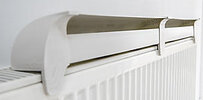
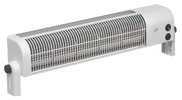
I have seem the units for sale for years, radfan.jpgradbooster.jpg but the question is, how do you measure success or failure?

Even the boiler (assuming gas) does not give a fixed output, but relies on the return water temperature to adjust its output.

I have in last 10 years, lived in three houses, and each one has been different. But I have learnt a few things.
1) A TRV is slow, a radiator can heat up before the TRV has had time to close, so the setting of the lock shield valve is very important.
2) Unless there is a fan, a room can have a huge variation in temperature in different areas of the room.
3) The sun through windows can really mess things up, and heat a room far faster than a radiator can cool.
4) Monitor the return water, don't want hot return water turning down a boiler too soon.

This house, having a wall thermostat in the hall, was a mistake, however I tried to set it and the hall radiator TRV and lock shield, doors being open or closed, had far too much affect on when the boiler runs.
 

If you need to find a tradesperson to get your job done, please try our local search below, or if you are doing it yourself you can find suppliers local to you.

Select the supplier or trade you require, enter your location to begin your search.


Are you a trade or supplier? You can create your listing free at DIYnot Local

 
Back
Top