I'm hoping someone can help me, I'm coming to the end of an extension project and I'm having trouble figuring out how to squeeze the waste pipes of a new en-suite into the drain. I hope my explanation isn't too long...
The drain has been extended from the existing drain by the builder who completed the basic building works and I've been doing everything since then. And I'm now finally at the point of adding a ground floor (this is a bungalow) en-suite into one of the existing rooms.
After studying Part H of building regs (this is all under building control) I can see that following all the rules and gaining the right drop on the shower is going to be tricky as the drain is now pretty close to the surface after being routed round/under the extension. And if I have to join the shower into the base of a new stack 450mm above the invert I'll have to raise the shower on a 250-300mm platform. Which isn't too nice (I'd have to add a step too).
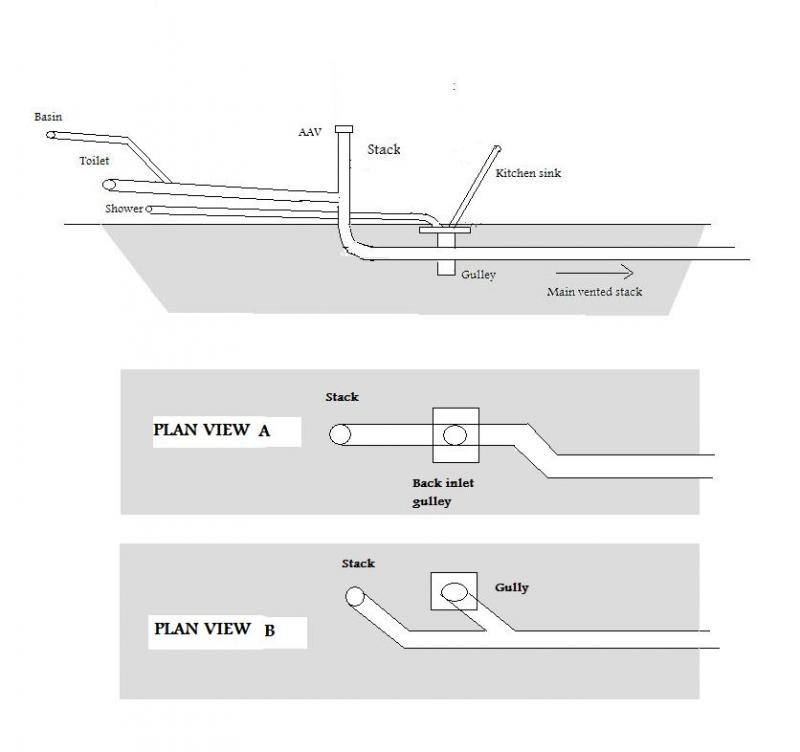
So, I had a bit of a brain wave last night, I suddenly thought if I branched the drain to both feed the stack (for the toilet + kitchen waste) and a new bottle gully, do I suddenly lose the 450mm rule for the shower (the toilet is still just high enough)? This picture might help! :
http://media.diynot.com/119000_118176_28620_26512846_thumb.jpg
(the drain on the right, just up to where the stack would be, is already laid, the rest will be new. There will also be a hand basin, not marked, which could either join the toilet waste or go to the gully, either would be fine)
Am I missing something? That solution seems too easy, although I think I worry too much!
This would be great as I'd only need to raise the shower slightly, and it would also solve another problem I spotted which was the raised shower and toilet having to join the stack at about the same height, which got tricky with the joints.
My final question is, does this have to be a vented stack or can it be a stub? Everything is ground level and within limits, and it does join into a drain with an existing vented stack. However, that's around 10m away, does that cause problems? I'd rather not have to vent it as I have a velux above this (within 3m) so I think I'd need to have the stack 900mm above that!
Thanks for persevering until the end!
David.
The drain has been extended from the existing drain by the builder who completed the basic building works and I've been doing everything since then. And I'm now finally at the point of adding a ground floor (this is a bungalow) en-suite into one of the existing rooms.
After studying Part H of building regs (this is all under building control) I can see that following all the rules and gaining the right drop on the shower is going to be tricky as the drain is now pretty close to the surface after being routed round/under the extension. And if I have to join the shower into the base of a new stack 450mm above the invert I'll have to raise the shower on a 250-300mm platform. Which isn't too nice (I'd have to add a step too).
So, I had a bit of a brain wave last night, I suddenly thought if I branched the drain to both feed the stack (for the toilet + kitchen waste) and a new bottle gully, do I suddenly lose the 450mm rule for the shower (the toilet is still just high enough)? This picture might help! :
http://media.diynot.com/119000_118176_28620_26512846_thumb.jpg
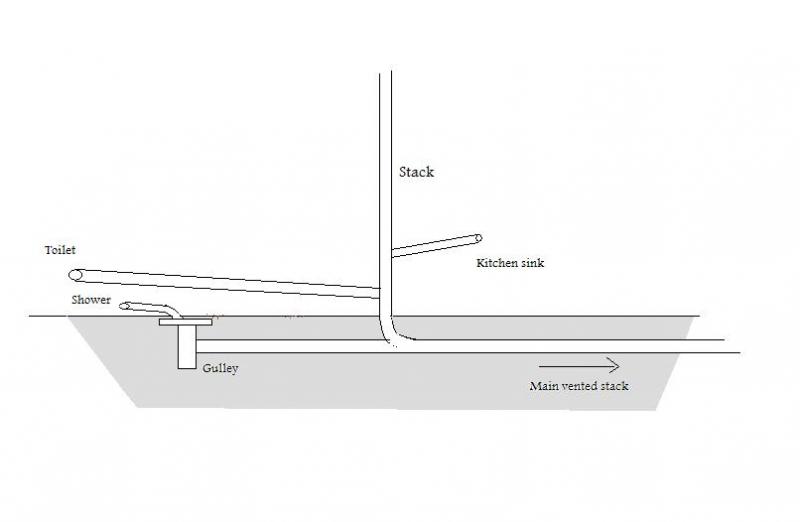
(the drain on the right, just up to where the stack would be, is already laid, the rest will be new. There will also be a hand basin, not marked, which could either join the toilet waste or go to the gully, either would be fine)
Am I missing something? That solution seems too easy, although I think I worry too much!
This would be great as I'd only need to raise the shower slightly, and it would also solve another problem I spotted which was the raised shower and toilet having to join the stack at about the same height, which got tricky with the joints.
My final question is, does this have to be a vented stack or can it be a stub? Everything is ground level and within limits, and it does join into a drain with an existing vented stack. However, that's around 10m away, does that cause problems? I'd rather not have to vent it as I have a velux above this (within 3m) so I think I'd need to have the stack 900mm above that!
Thanks for persevering until the end!
David.