• Looking for a smarter way to manage your heating this winter? We’ve been testing the new Aqara Radiator Thermostat W600 to see how quiet, accurate and easy it is to use around the home. Click here read our review.

Edwardian cupboard plaster

CLS

Joined
17 Jun 2005
Messages
8
Reaction score
0
Location
Derby
Country
United Kingdom
Hi,
The inside of the fireplace cupboard has always smelt musty and damp since we’ve lived in the house.
The plaster up to about 600mm has blown.
I have taken out a piece of old carpet and the floor is concrete and is not damp.
I have removed the blown plaster where possible.
I’m wondering if it’s actually worth removing the old skirting and then putting in dry rods before making good again?

Thanks
IMG_4826.jpeg
 
Lime plaster?
The fact it's a cupboard will stop the warm air so will get cold causing condensation.

You need to test with plastic to see if it's a damp wall or condensation
 
  • Thanks
Reactions: CLS
Is it next to a chimney? Is the chimney ventilated top and bottom?

Is this on the ground floor? What is on the other side of the wall?
 
If that was my house and cupboard, I'd hack out everything behind the cupboard doors including at least to 1ft above the damaged plasterwork and treat the brickwork with a good masonry mould defeater. Then after allowing everything substantial drying time, give the walls a sand & cement render before a skim of finish plaster. I would also replace the solid doors for the louvered type to allow air circulation to avoid the cycle all over again.
 
  • Thanks
Reactions: CLS
Is it next to a chimney? Is the chimney ventilated top and bottom?

Is this on the ground floor? What is on the other side of the wall?
It’s ground floor, chimney wall left side and outside wall.
Theres a gap in the left corner when I can see the chimney brick foundation.
Thinking of sealing this gap.
Thanks
 
Poster #4,
Why would the "chimney" need ventilating? A dormant chimney breast flue would need ventilating top & bottom - but what if there is a solid fuel fire or an appliance active in the fireplace: what then?
And why your concern with the chimney flue when the majority of the pic shows a blown back wall?
 
OP,
Is the floor in that room solid or suspended?
Is the outside wall solid or cavity?
The defect in the cupboard floor appears to be almost irrelevant to the issue of blown plaster.
Whatever remedial work is done in that cupboard there's always the elec installation to be aware of?
Why not remove the skirting & then post pics? A pic showing the whole wall & c/breast would also help?
 
It’s ground floor, chimney wall left side and outside wall.
Theres a gap in the left corner when I can see the chimney brick foundation.
Thinking of sealing this gap.
Thanks

Fireplaces generally have a hearthstone which is laid on the ground or rubble fill. Neither the stone nor the base of the chimneybreast are likely to have a DPC, thus damp creeps in. When the fireplace was in use, that did not matter, because frequent fires would help dry out the moisture, and airflow up the chimney would carry away the water vapour. Neither of those factors applies any more. Furthermore, disused flues that are unventilated are prone to condensation from the warm, moist air in the house. Adding sealant will not remove moisture. Ventilation can.

An opening at the top, plus an airbrick into the room at the base, will often be enough. But bricked-up fireplaces often have a mass of damp rubble hidden inside where the builders couldn't be bothered to barrow it out. As it is in contact with the damp hearthstone and brickwork, you need to remove it. You will see when you make your initial ventilation opening. You may also find damp rubble that builders hid under the floor.

For best results, open up the fireplace enough to break up the hearthstone and dig out the rubble, below floor level. You can then make an opening in the base of the chimneybreast enabling it to ventilate from the subfloor void. This will have the added advantage of drying out moisture in the void, and you will not need an airbrick and draught in the room.

This is not difficult or complicated, but the time and effort is more suitable to a DIYer who has the long-term benefit to his home in mind.

You mention it's an outside wall, so check outside for water coming from a leaking gutter or downpipe, earth or paving piled up against the brickwork, broken drain, or other source.

 
Thanks for the replies.
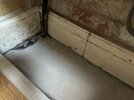
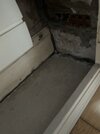
Just to add that the skirting is bone dry and the plaster was dry also, although blown.

Floor is concrete slab that is dry.
The left side is the chimney breast wall where’s there’s a gap.
Right side shows the air vent now not in use due to an extension.
 

Attachments

  • IMG_4831.jpeg
    IMG_4831.jpeg
    217.3 KB · Views: 29
  • IMG_4832.jpeg
    IMG_4832.jpeg
    156.1 KB · Views: 33
Can you turn the flash on please

And stand back to show some wider views
 
If that skirting was in my house, I'd burn it just in case it had been infected with mould spores. Spores can lay dormant for a long time and then break through when a hint of dampness occurs. Replace with any flat smooth timber because it won't be seen in a closed cupboard, but first get that wall sorted out.
 
  • Thanks
Reactions: CLS
It may be dry at present in the fine weather but must be getter damp during wet weather .Pics of chimney and roof might be helpful.
 
  • Thanks
Reactions: CLS

If you need to find a tradesperson to get your job done, please try our local search below, or if you are doing it yourself you can find suppliers local to you.

Select the supplier or trade you require, enter your location to begin your search.


Are you a trade or supplier? You can create your listing free at DIYnot Local

 
Back
Top