Fixing 1950's Floor/Concreate/Asphalt

Joined
2 Feb 2015
Messages
21
Reaction score
3
Location
Staffordshire
Country
United Kingdom
I have a 1950's house. I had a leak in my kitchen, where the mains water pipe comes up into the house before the stop tap. We had to bring up the floor and follow the mains pipe down through the concrete floor and find the clay/ceramic service pipe that houses the copper pipes that goes to the street stop tap and mains water provider. We had to replace about 50cm of copper that had been eaten by the concrete over the last 70 years. Had someone out, thats all fixed.

The issue is the house, like a lot during this time, has a concrete floor supported by an Aspalt/tarmac layer that acts as a dampproof membrane and, by the looks of it, used to level the floor.
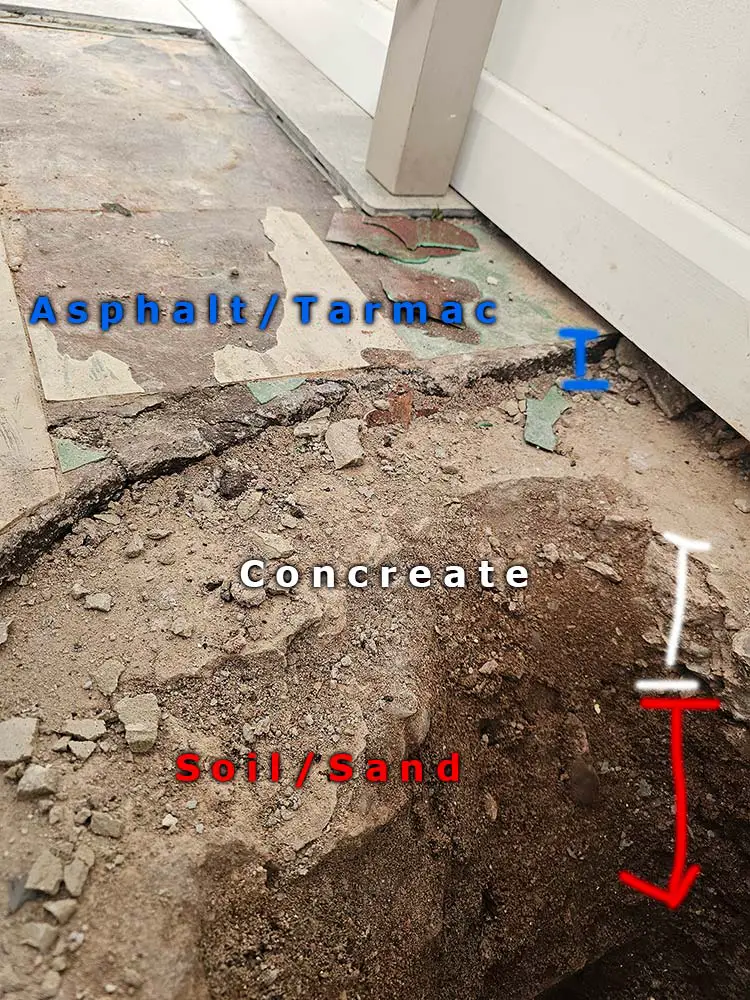
floor.jpg


My question is how best to repair the Asphalt? Is there a product I can paint down on the concrete, or a screed? My thoughts are that tarmac expands and contracts as I've seen in other areas of the house where we had channels put into the floor for Electric supply to kitchen island etc. The solution they used was to chase the tarmac to leave expansion but unsure of what product they put down? Maybe some sort of flexible waterproof screed?

Any ideas?
 
Those are asbestos tiles?
Go careful with those.

I'd just dig out tidy. Square off the edges.
Gravel.
Sand
Plastic
4 inches of concrete

To make up the top layer in not sure.
I'd use wood.
 
Asbestos tiles, Bloody hell, I hope not; I assumed it was some old-fashioned Lino. You can see when I had the floor done they primed them in some fashion and just tiled over them. That might explain why they did that; I pulled a few up, thinking they were lazy. I won't mess with them any more.

Regarding the floor, you'd put plastic down in the area before the concrete to stop the rising damp, thus mitigating the Asphalt removal in that area?

My concern is that the top layer moves a little. I assume this is because it is asphalt (like any tarmac expands and contracts with heat and cold). So, I should leave a gap for expansion, but what do I put in the gab so there's no void since I'm tiling over. I don't want something dropping where its hallow and breaking the tile. Some sort of foam board or cork maybe?
 
Sand and cement with a visqueen sheet under it to the level of the asphalt then top it off with ardex DPM1c epoxy or similar making sure you overlap it to the asphalt
 
No need to bother with expansion gaps or anything then? Just coat it with DPM Epoxy. Can I tile directly on that?
 
Sand and cement with a visqueen sheet under it to the level of the asphalt then top it off with ardex DPM1c epoxy or similar making sure you overlap it to the asphalt

So, I have a secondary problem. I have tiles in my kitchen that are lifting in the same room as the leak. Since lifting the floor up due to this water leak I've come to realise that I think the problem is due to the channels that were cut into the floor for Plumbing and drains. The channel is about 5 inch wide, and filled in with new concrete/cement.

It doesn't look like these channels were primed or damp-proofed. The asphalt comes up to the channel, and then whatever product they used to fill the channel (looks cement based). I think the damp must be rising through the channel, then the sulphates in the cement and mould eating the tile adhesive, making them lift.

So, the solution must be pretty similar: coat it in damp proof, overlap the asphalt, and complete the seal.

My question I'll probably just fix the tiles as they pop. Is there a product I can put down that can be sealed and reused as required. I found black jack that will cover the concrete but will it be safe to overlap the Asphalt?

Can anyone recommend a product?
 
Update: for anyone who comes across this problem. I phoned Ardex directly to ask for technical help. They arranged for a floor specialist to call me back.

He said the asphalt is temperature-sensitive and expands and contracts at a different rate than the concrete. He said any fresh concrete that had been laid for my kitchen services buried in the ground would also expand at a different rate. He said you've got small movements that over time make the tiles pop.

He said if your using porcelain tiles (as we are) and are planning to continue to use them you don't need to worry about rising damp.

He said concrete in your floor then on the top layer use Ardex NA up to the asphalt. It will bond to the concrete and asphalt, giving you some damp-proofing qualities as it is moisture tolerant. He said its also flexible with lots of flexural strength. Then on top of that use a flexible tile adhesive like Ardex X7. That should take care of any movement with both products being flexible.

I noticed the X7 is also suitable outside with a pools etc. so it must have added damp-proof qualities, not that it will be an issue with Porcelain.
 
Last edited:
From further reading, it would appear Ardex NA is some sort of super product that we bond with most things, including Bitumen. So I'm tempted to paint down some blackjack first. Even though I've been told I don't need it, I figure extra protection can't be a bad idea?
 
I finally got around to fixing the floor after putting it off for ages because a few tiles had started popping. I wanted to make sure I understood the root cause before doing anything and gave time for the floor to dry out. What I eventually figured out was that when the kitchen was renovated, the service channels cut into the floor for pipes and electrics had effectively broken the original DPM. The asphalt layer on top of the concrete was the DPM, and a slow water leak over who‑knows‑how‑long made the problem worse.

The porcelain tiles themselves didn’t let moisture through, but the tile adhesive that had been used wasn’t suitable for damp conditions. If a cement‑based adhesive had been used, I probably wouldn’t have had the issue.

Instead of going with Ardex, I found there were plenty of equivalent products. I was recommended Stopgap F77 (liquid DPM) and Stopgap 1200 (self‑levelling compound). They’re cheaper than the Ardex range but just as good, and like Ardex NA, they bond to pretty much anything. I later discovered Mapei do a similar system that’s even cheaper and works just as well.

I cleaned up the whole area, knocking out any loose material and removing any asphalt that had lifted. The reaction between the old tile adhesive and the asphalt actually helped debond it, so I cut everything back to where it was sound. That left me with some very old, dusty concrete. Stopgap 1200 is meant to handle that sort of surface, but since I’d already gone to all this effort, I figured it wouldn’t hurt to use an SBR primer first — it’s cheap and gives peace of mind. So I primed the floor.

I spoke with a Stopgap specialist who advised using a “sandwich” system: a layer of 1200, then F77, then a final layer of 1200. I didn’t have a huge area to cover, so I split the bag of 1200 in half, weighing everything out on scales. That worked fine. I used all the F77, making sure to roll it up the sides of the remaining asphalt to create a proper waterproof seal. Then I used the second half of the 1200, but it wasn’t quite enough to bring the floor level, so I ended up needing another bag.

Once that was done, everything looked spot‑on. I used the recommended tile adhesive and laid fresh tiles — which, ironically, turned out to be harder than fixing the floor itself.

Attached an image of the f77 layer to show how I painted it up the side. And the floor back down.


20250624_094049.jpg 20250626_132835.jpg
 
Last edited:

If you need to find a tradesperson to get your job done, please try our local search below, or if you are doing it yourself you can find suppliers local to you.

Select the supplier or trade you require, enter your location to begin your search.


Are you a trade or supplier? You can create your listing free at DIYnot Local

 
Back
Top