
• Looking for a smarter way to manage your heating this winter? We’ve been testing the new Aqara Radiator Thermostat W600 to see how quiet, accurate and easy it is to use around the home. Click here read our review.

Giant Notch In Joist

Joined
2 Jul 2025
Messages
6
Reaction score
0
Country
United Kingdom
Looking for some advice about joist strength.

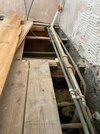
The old bathroom is being replaced by a walk-in shower and when the floor boards have been lifted to re-arrange central heating pipes etc found that a previous bathroom installer (1965 house and last bathroom installation was 20 years ago so it might have been done even before that!) have notched the joists to fit the basin waste by 2.5" and 4.5" respectively (8 inch total joist depth).

My understanding is that since it's close to the wall it's less a risk of failing (and has been ok for 20 years!) but the nearest joist in the picture will be the main load-bearing member for the walk-in shower so it needs to be good and not flex etc.

Does it look ok or is there a recommended way to increase strength?
 

Attachments

  • chop from joist.jpeg
    chop from joist.jpeg
    348.1 KB · Views: 99
5 mins in here shows you how to sister the joists.


Yes, I've seen videos about sister joists but in my case there is only a small section of the joist sticking out from the wall and probably insufficient to make a satisfactory connection for the sister so I doubt if that will work.
 
Do you have a local fabrication company. Ask them to make you a couple of 10mm steel plates that you can bolt either side of the joist.
 
If its been like that for years then dont worry....it aint going anywhere.....
I don't expect it to collapse but an 1800 x 900mm shower tray is going in and the joist with the biggest notch will support the edge of the tray on it's long axis away from the wall so I'm concenred about flexing etc.

I'll get some bracket made as per jj4091 idea.

thanks for the replies
 
I wouldn't bother. Measure the distance across the top of the joist, in line with the direction of run of the joist (the open width of the notch) when your weight is directly over the joist and again when your weight is entirely over the neighbouring joist

I think you'll have to use a micrometer to detect any flex indicating that the gap is closing up, ie the movement in it is miniscule; there is a clear, shallow diagonal path from joist top, room side of notch, to joist bottom nearest bearing on wall; the person who notched that joist has mostly cut off part of the joist that contributes little if anything to the load bearing capacity

By this I mean when we place a weight on a joist somewhere in its span, the forces of compression and tension that support the weight come from a triangle whose top point is at the weight and whose bottom is the bottom of the joist. Areas above the triangle contribute diminishingly little the further from the triangle they are

1760775711496.png


When you add in the load spreading from the floorboards, the tray, the historical lack of failure in service etc, all i'd do in this case is just put a sheet of 18mm ply or 22mm waterproof chipboard down as the floor boarding/base to the tray, glue and screw it down to the joists both sides of the notch. The joist is then notionally sistered on its top and the pipes are passing through a joist hole, not a notch and the ply helps resist any minimal forces from dynamic loads that would seek to close the notch/flex the joist. It would also be a more stable base for your tray, which will be bonded down and further reinforce
 
Last edited:
thank you Robin - thats exactly the type of info I was looking for - much appreciated!
 
the person who notched that joist has mostly cut off part of the joist that contributes little if anything to the load bearing capacity
Interesting comment, on an evenly loaded floor half the load is carried at each end of the joist which is resisted by whatever the shear resistance of the joist is, the nearer a point load is to that end the greater the shear force. Since more than half the joist has been cut away the shear resistance of the joist has halved. Fortunately the shear resistance of a full joist tends to be several times larger than required so halving the size is generally not to be an issue
 
Last edited:
What is the span of the joist? Common in bathrooms for it to be fairly small so a big notch of less consequence than when the joist is working hard. Easiest strengthening approach if you're still worried is to replace the floor boards with a piece of ply well screwed down which will restore some compression resistance to the top of the joist
 
Last edited:
the span of the joists is 2650mm.

an added complication of the situation is that the plan is to make the shower tray level with the rest of the bathroom floor and this means removing the floorboards entirely where the (22mm AKW Tufform) tray will sit. the tray sits directly on the joists (after shimming and additional noggins).

comments are greatly appreciated
 
If you have a multi tool, trim the notch square and hammer in a block of wood. Top half is in compression.
 

If you need to find a tradesperson to get your job done, please try our local search below, or if you are doing it yourself you can find suppliers local to you.

Select the supplier or trade you require, enter your location to begin your search.


Are you a trade or supplier? You can create your listing free at DIYnot Local

 
Back
Top