Insulation help on a Victorian house

Joined
16 Jan 2007
Messages
78
Reaction score
0
Location
Aberdeenshire
Country
United Kingdom
Hi.

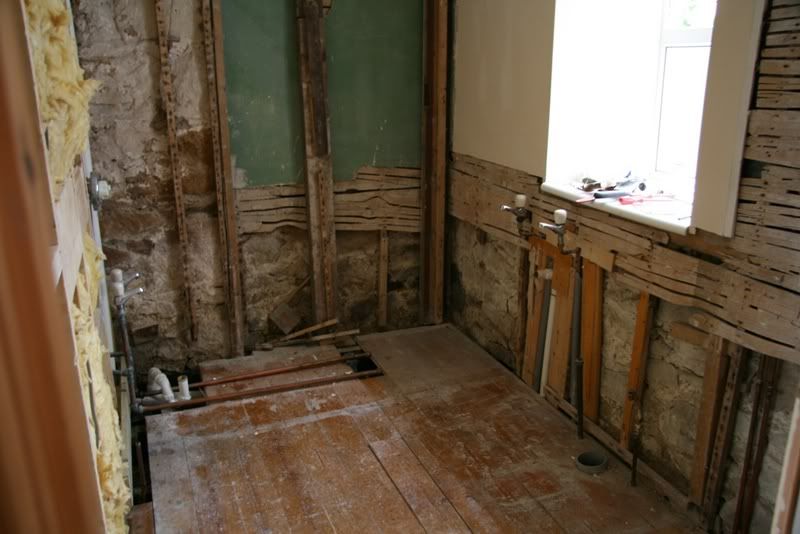
This is the current state of play in my bathroom.

It did have lath and plaster surrounding the wall at the back and has still go it around the window on the right (but covered in plasterboard).

As there is no insulation, I was thinking on how to get it instulated before I re-platerboard it and tile.

The walls are 600mm thick (!!) and there is only about 25mm gap between the lath and plater and the inside of the soild walls.

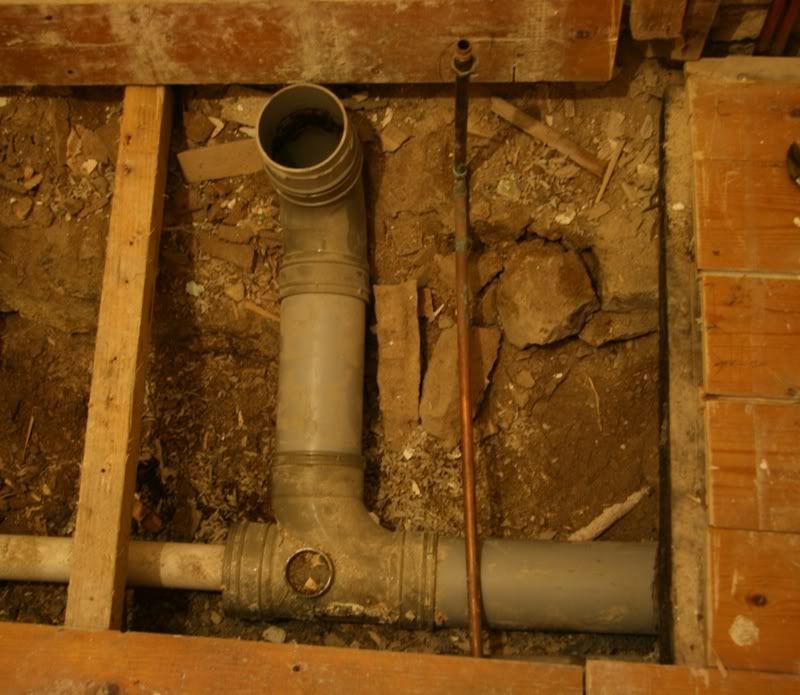
The floor is approx 20mm floorboards, then its just the rubble (as shown in the picture). Should I not lay a clear plastic sheet, to prevent any damp in the future?

Any advise would be appreciated. :D

Cheers,
Robin.

Picture169.jpg


Picture180.jpg
 
Looking at the walls, it appears to me that someone has put cladding over the old walls in the past. I'd take all that off and go back to clean brick. look carefully for any signs of damp and correct it.

You can use a modern lathing and plasterboard drywall, with fibreglass bats behind it. You will need the plasterboard to have a moisture-proof membrane, but you can get it backed with aluminium foil which will do the trick.

As for the floor, shovel out loose rubble as much as you can. Especially any bits of wood,which cn promote fungal growth. Make sure you have plenty of airbricks to ventilate the void. If you have time and inclination, you can put down a dpm and a concrete layer (the concrete is mostly to hold it down) which will greatly reduce the amount of damp coming up from the ground. It is possible to lay insulation between the joists when you have the floor up, or from underneath if you have room. Staple garden netting to the underside of the hoists to hold it up.

The joist supports should have a slate or other damp-proof material to prevent them getting damp. Timber should not be in contact with the ground.

Have a careful look for damp while you are down there, and any gaps that vermin could get through.

Insulate all pipes thoroughly. The foam insulation for pipes which are in unheated spaces is amazingly thick.
 
Many thanks for that excellent reply.
thumbsup.gif


I take it you mean by cladding as the white sort of plaster that is covering the brick? I'll certainly do what you have said.

I take it that the fibreglass bats will replace the wooden ones that is currently there? I'll surely get all of that from my local plaster merchant?

What about insulation between the new platerboard and the solid wall? I have thought that damp could attack the insulation in the future.

I never thought about clearing out the old rubble.....in fact I've been sweeping up under the floor! Oppps!! Oh well, up comes the floor again! :roll:

I did think why the timber joists were sitting on the ground and not protected. Again I'll sort that out. :)

I have a few air bricks around the floor area, which I found out when I lifted the floor. That will save putting more in! Phew!

Yeh, the mice have got into the floor in the past as I cleared 14 bodies from an area of only 25 square feet! They have made a nice mess of the lagging, so I'll be replacing all of that anyway. In fact, I've found over 30 mice lying under the floor boards since I started ripping up the floors thoughout the house! :evil:

I've read about insulation of the floor on this website, but got a bit confused. Should the insulation be touching the underside of the timber floor, floating in-between the timber floor and rubble floor, or touching the rubble floor?
 
By cladding I meant that the end wall, facing us, appears to have studs which are on top of old L&P.and there seems to be a green painted section of wall behind the studs. So i think the studs were put up after the house was built.

Fibreglass bats are rectangles of fibreglass insulation, rather like you put in a loft, but a bit denser and hold their shape. You could use loft insulation and cut it to size,though. This is the insulation between the brickwork and the plasterboard.

The studs you can either use wooden ones, well-treated with preservative and dried off outside; or you can get galvanised lathing which is fireproof and will not rot or support insects or mice.

Because you will be using foil-backed plasterboard, there should not be any condensation moisture from the bathroom getting to the brickwork. If it is damp, look for damaged pointing, downpipes or gutters, and fix them.

You will need an extractor fan in the bathroom, preferably wired to come on with the lights and stay on for 20 minutes after they have been turned off. Some people have a psychological aversion to ventilating bathrooms and will not turn on fans or open windows.

The floor insulation lies between the joists, not touching the subfloor. There must be an unobstructed passage of air from one side of the house to the other. old houses usually have fewer airbricks than are now considered necessary, especially if there have been extensions or alterations that obstruct them. Old airbricks are usually choked with rubble,dust and cobwebs, so clean them out.

Sweeping rubble under the floorboards is an old builders trick,you should be ashamed of yourself :wink:

If the joists are truly lying on the ground :roll: you should dig out and put down some concrete and use metal brackets with a dpc. Older houses more often have dwarf walls for the joists to stand on.
 
Once again, thanks for the time to reply! I've learned a lot!!! :D

lol, yeh go on and admit you've done the who sweeping things under the floor! :P :wink:

Yeh, the studs that lie over the top of the old green painted L+P is infact 2 pieces, nailed together! Rough or what!!!! You can't see it clearly in that picture, but the stud on the right hand side is actually a frame from a door, as the latch is still on it! :? :?

Yes, all of the joists are touching the ground, as you see in the last picture. They are sitting on a raised section of floor, just as you said.
I'll get some jacks in and dig out and reset the joists in a protective sheet, with concrete.

I never reliesed that batt's were just simple insulation. I know what you mean now. I just wasn't sure regarding any ventelation requirements just like the floor and roof.

As for the extractor fan, I'll be drilling into the wall (some 600mm thick!) to get a 117mm hole. Thats going to be fun. :cry: :cry:
Thats on the list of jobs to do, before the bath gets nailed down. I've just to sort out the flooring / pipework first before getting onto the lights / fan.

Oh and whats dpc? I worked out that dpm was a Damp Proof Membrane. I guess that dpc was a typo? Is DPM just simply some sort of heavy duty plastic sheeting, without holes? Something like felt for a shed roof, but stronger.
 
dpc is damp-proof-course, a term usually used when building walls. you can use DPM. a special thick plastic sheet that will stretch enough to accomodate slight settlement. You must prepare the surface so it does not get punctured, and must not walk on it once laid.You can get tape to join seams. You can tuck it up at the edges and lay concrete into it as a "tray" when laying a slab, but the edges must be supported.

If your joist supports are not on a damp-proofed base, you can put a dpc into the supports themselves. In your case you may find it better to build a slab, with thickened parts under the joist supports. It willprobably be easier to take theoldjoists out to do it :(
 
I just read about the stuff in the Screwfix thats sitting beside me!
Guess thats more on the shopping list. :(

As for removing the joist, that means taking down internal partitions - no way!!! I'll just battle the hard way with the edges and have to protect the joist supports in the middle as best as possible. (Sitting on large stones). Even after 120 years, the joists are still in very good nick, esp round the edges.

We were supposed to be moved in last month, but after finding so much niggly and problematic things, this is another house project that has went over schedule, although the budget hasn't went over much!
 

If you need to find a tradesperson to get your job done, please try our local search below, or if you are doing it yourself you can find suppliers local to you.

Select the supplier or trade you require, enter your location to begin your search.


Are you a trade or supplier? You can create your listing free at DIYnot Local

 
Back
Top