Hi,
Looking for some guidance on a kitchen renovation/damp proofing diy project, ......
as it stands:
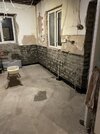
A new chemical DPC has been injected, and high-level external floor levels lowered.
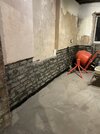
Walls hacked off and tanked.
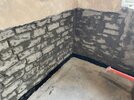
The existing concrete floor was cut back sufficiently to expose the DPM and enable tanking below the floor level, as the DPM did not consistently reach the floor height (looked like it had been ripped in some areas).
I also applied liquid DPM in this area (rush of **** to the brain, I think, as the tanking already doing the same job. might regret this!)
Floor concreted back in.
I planned on tanking the joint between the floor and the wall, but may have created an issue with the liquid DPM???
I am now looking at creating a perimeter stud wall all round with Celotex insulation/vapour control/plasterboard. Did consider the insulated plasterboard, but with lots of fixing points/power points required in the room, decided on the stud option as i can also square/plumb things up. Happy to reconsider, though, if better options?
As far as the hacked off area of render, is it possible to fix Celotex over the tanking, bringing it out to the render depth rather than re-render?
This will all be hidden behind studs, so I thought it would be easier to foam adhesive the Celotex on.
Any help appreciated
Looking for some guidance on a kitchen renovation/damp proofing diy project, ......
as it stands:
A new chemical DPC has been injected, and high-level external floor levels lowered.
Walls hacked off and tanked.
The existing concrete floor was cut back sufficiently to expose the DPM and enable tanking below the floor level, as the DPM did not consistently reach the floor height (looked like it had been ripped in some areas).
I also applied liquid DPM in this area (rush of **** to the brain, I think, as the tanking already doing the same job. might regret this!)
Floor concreted back in.
I planned on tanking the joint between the floor and the wall, but may have created an issue with the liquid DPM???
I am now looking at creating a perimeter stud wall all round with Celotex insulation/vapour control/plasterboard. Did consider the insulated plasterboard, but with lots of fixing points/power points required in the room, decided on the stud option as i can also square/plumb things up. Happy to reconsider, though, if better options?
As far as the hacked off area of render, is it possible to fix Celotex over the tanking, bringing it out to the render depth rather than re-render?
This will all be hidden behind studs, so I thought it would be easier to foam adhesive the Celotex on.
Any help appreciated