• Looking for a smarter way to manage your heating this winter? We’ve been testing the new Aqara Radiator Thermostat W600 to see how quiet, accurate and easy it is to use around the home. Click here read our review.

Is loose fill insulation a good idea and other issues for old attic

Joined
1 Feb 2013
Messages
54
Reaction score
2
Location
Kent
Country
United Kingdom
I'm a free holder, owner occupier, of a top floor flat, split level (two attics), in an old building. There is work needs doing on a chimney stack that is causing water damage (main attic which is ~40sq m) and there is a problem with water ingress from the flashing above the lower attic (above bathroom ~6sq m of level floor with a section that slopes down as well) when wind drives rain against the back of the building. These issues will likely not be fixed until next spring and I mention them as it may affect what is the best course of action to get at least some insulation between the joists for this winter. Currently there is none.

As I think that more than 10 photos (maximum per post) are required I will upload 9 of the rear attic in this post and others later.

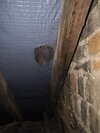
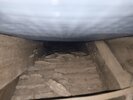
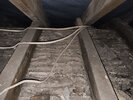
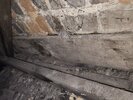
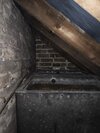
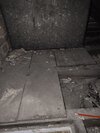
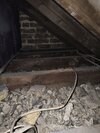
So these are 9 images of the little rear attic. As you can see there is an old metal water tank up there. I can't get rid of it, someone brought in an angle grinder but couldn't do it. It's worth noting at this point that I have a sparky coming in soon to rewire the lighting circuit (there is currently no earth) and have told him to set up the cabling so I can insulate it without the cables being a problem. So, my thoughts are to clear the debris that is up there and then poor loose fill insulation between the joists which are 29-32cm apart (inc inside and under the water tanks) before laying something like Thermafleece CosyWool perpendicular over the top . So then I need some sort of baffle to prevent the loose fill pouring down the slope but I'm unsure of how to approach doing that. Plus I don't know how to deal with the small area close to where the attic joins the back wall. Plus what is the best way to insulate the slope part? The beams that go down over the slope are 100cm so that gap is a little less. I hope I've explained myself well enough and will upload main attic pics in the near future.
 

Attachments

  • B Attic Felt 01.jpg
    B Attic Felt 01.jpg
    283.8 KB · Views: 23
  • B Attic Look Down Slope 01.jpg
    B Attic Look Down Slope 01.jpg
    149 KB · Views: 24
  • B Attic Look Down Slope 02.jpg
    B Attic Look Down Slope 02.jpg
    354.5 KB · Views: 29
  • B Attic Look Down Slope 03.jpg
    B Attic Look Down Slope 03.jpg
    423.4 KB · Views: 27
  • B Attic Towards Front from hatch 01.jpg
    B Attic Towards Front from hatch 01.jpg
    346.1 KB · Views: 28
  • B Attic Towards Front from hatch 02.jpg
    B Attic Towards Front from hatch 02.jpg
    418.4 KB · Views: 24
  • B Attic Towards Rear from hatch 01.jpg
    B Attic Towards Rear from hatch 01.jpg
    269.5 KB · Views: 22
  • B Attic Towards Rear from hatch 02.jpg
    B Attic Towards Rear from hatch 02.jpg
    340.9 KB · Views: 22
  • B Attic Towards Rear from hatch 03.jpg
    B Attic Towards Rear from hatch 03.jpg
    346.5 KB · Views: 25
Old lath plaster ceilings. You can vacuum dust and PVA those to firm up as it's a worry working about those as they can cave in.

Re insulation. Use the acoustic slab as that's more solid and you can get it up

I've seen those tanks cut up but I don't know how they did it. Maybe a mental nibbler. They are cheap enough.

Cables Id run in trunking tidy. Don't lay them all over the place as normal
 
A hack saw is slow and tedious, but will cut through a metal tank without deafening noise or sparks.

I agree with hoovering the dirt and broken nibs off the L&P. I can describe how to reinforce it. The work is slow and labour intensive but not difficult.
 
Old lath plaster ceilings. You can vacuum dust and PVA those to firm up as it's a worry working about those as they can cave in.

Re insulation. Use the acoustic slab as that's more solid and you can get it up

I've seen those tanks cut up but I don't know how they did it. Maybe a mental nibbler. They are cheap enough.

Cables Id run in trunking tidy. Don't lay them all over the place as normal
Let us assume that for whatever reasons the water tank is there to stay, at least until next April when I can afford to pay for it to be done, but I want some insulation up there for the winter.

When it comes to using PVA do you mean making a solution with water and giving it a few coats?

The hatch to the attic is tiny. I'm 8 stone and can barely get through it. A 5m hose on my Henry vacume may allow me to use it up there. I suspect that a dustpan and brush will have to suffice.

The insulation needs to go down the gap on the slope part of this attic. Do you mean use acoustic slab for that? Is that a rigid insulation board you mean? Will pouring loose fill under the boards that the water tank is supported by be worthless then?
 
You would need to vacuum dust prior to applying PVA.
Should find information online.

As for slope it's hard to see. Kingspan is good for that as you push in.


Also any asbestos up there. Some white material in photos?
 
None of the information I got 8 years ago when buying the place suggested there were any issues around asbestos. The sparkies I've had in to quote and the clearence companies I had in to quote and then clear the attics have not mentioned asbestos.

So you were not taking about Kingspan when you said 'acoustic slab'?
 
Actually, can anyone explain why I would use slab insulation rather than the stuff that comes in rolls?
 
I was thinking you would need to remove insulation when work starts for access. You can use the roll but it's a right pain lifting and storing.

If that is not a worry go for the roll
 
Cables Id run in trunking tidy. Don't lay them all over the place as normal
Careful; cable in conduit, under insulation is just about as far as you can get to the opposite end of the "things that affect current carrying capacity" spectrum as the present install method is
 
Last edited:
I should make it clear that the reason I am considering loose fill insulation is because of the gap between the joists varies from 29-33cm in both of the attics. In the main attic the joists overlap in the middle making cutting rolls of insulation to the right width rather problematic. At least I think it does as I've not done it before. ATM I'm planning on using Thermafleece CosyWool if I don't use loose fill.

How much compression can I get away with when laying between joists? Will a width of 33cm squeeze into a 29cm gap or is that going to reduce the effectivness? I have never used insulation before so I'm not sure how easy it is to cut a roll width down from 37cm to 33cm and then cut it down some more when it gets to where the joists overlap.

Regarding the electrical work, the sparky has said he would leave the cables: 'clipped to the sides of the joists using fire rated cable staples, so this will keep them tidy but also safe from falling in the event of a fire.' But I was thinking this would mean they will eventually be buried by a significant quantity of insulation. So maybe I tell him not to do that? Or don't have him do the job if it's a bad idea?
 
Will a width of 33cm squeeze into a 29cm gap

Yes, absolutely fine.

Regarding the electrical work, the sparky has said he would leave the cables: 'clipped to the sides of the joists using fire rated cable staples, so this will keep them tidy but also safe from falling in the event of a fire.' But I was thinking this would mean they will eventually be buried by a significant quantity of insulation. So maybe I tell him not to do that?

An electrician should be able to determine the right thing to do. If they are clipped to the joists, they are in less danger of overheating than if they are surrounded by insulation on all sides. If they are for lighting, they are in less danger of overheating than socket circuits, electric showers etc. Any decent electrician should be able to get this right.
 
Cross lay over the top I believe. 100mm depth between the joists and 170 or more over the top perpendicular.
 

If you need to find a tradesperson to get your job done, please try our local search below, or if you are doing it yourself you can find suppliers local to you.

Select the supplier or trade you require, enter your location to begin your search.


Are you a trade or supplier? You can create your listing free at DIYnot Local

 
Back
Top