
You are using an out of date browser. It may not display this or other websites correctly.
You should upgrade or use an alternative browser.
You should upgrade or use an alternative browser.
Locating FCUs in cupboards
- Thread starter spada01
- Start date

The unwritten rule is that they can be fixed to the solid parts of units (not the flimsy backs) Personally I don't like seeing them on newly installed kitchens, but acceptable on a retro fit (although 6 doesn't sound too retro !)
Be careful of location with regard to damage from saucepans etc
Be careful of location with regard to damage from saucepans etc
Possible overloading issues with the 13A FCU supplying two items that can potentially be over that.

Why?I'm going to end up with about 6 in a new kitchen
Are you in England or Wales?What are teh rules about putting these into cupboards and has anyone got any clever tips?
It's allowable, but what on earth is the point?What's are the rules on having one FCU feed a double unswitched socket that then feeds two appliances (e.g. dishwasher and washing machine). Presumably this is allowable?
If you're using fused plugs on the appliances then why have FCUs before the sockets?
Why?I'm going to end up with about 6 in a new kitchen
Are you in England or Wales?What are teh rules about putting these into cupboards and has anyone got any clever tips?
It's allowable, but what on earth is the point?What's are the rules on having one FCU feed a double unswitched socket that then feeds two appliances (e.g. dishwasher and washing machine). Presumably this is allowable?
If you're using fused plugs on the appliances then why have FCUs before the sockets?
I'm in England
From what I've read on these forums the regs say that appliances that are built in must have easily accessible switches to isolate the supply in case of fault etc. For built in microwaves, fridge/freezer, w/m and d/w I'd love to just plus them into sockets behind the items, but my understanding is that this wouldn't satisfy regulations. THerefore I'm looking at ways to provide a switch (if necessary) without ending up with 6 FCUs.
Please do correct me if my understanding of the regs is wrong?
When you applied for Building Regulations approval, what say would be the way you would comply with Part P?I'm in England
If you're going to put them in cupboards, where they'll be behind tins of beans, boxes of cornflakes, pans, plates etc then they aren't really accessible.From what I've read on these forums the regs say that appliances that are built in must have easily accessible switches to isolate the supply in case of fault etc.
If you put the sockets where you would put your FCUs then you've provided the same degree of compliance.For built in microwaves, fridge/freezer, w/m and d/w I'd love to just plus them into sockets behind the items, but my understanding is that this wouldn't satisfy regulations.
i.e. not really enough.
Just use switches. If you use a grid system they won't take up much room, you can get all sorts of finishes and you can get engraved switch modules. If you want to keep the fuses accessible then you can also use fuse modules and supply the appliances via flex outlets or 15A BS 546 sockets.THerefore I'm looking at ways to provide a switch (if necessary) without ending up with 6 FCUs.
H
holmslaw
..
There is no need to provide individual isolators, Just provide isolators for the whole circuit/circuits.
Convenience?
There is no need to provide individual isolators, Just provide isolators for the whole circuit/circuits.
Sorry - how is this done? The whole ring circuit obviously has an isolator, but what would I use to isolate the kitchen appliances that aren't plugged into accessible plugs?
One isolator to 2 gang socket for two appliances - seen it done when I was called out because the appliances had stopped working - overloaded the fuse in the spur.
Another one to watch with switches in cupboards - cupboard contents can knock the switch and switch it off, but by then you've forgotten the switch was there so you're looking in all the wrong places for why the applaince doesn't work.
PJ
Another one to watch with switches in cupboards - cupboard contents can knock the switch and switch it off, but by then you've forgotten the switch was there so you're looking in all the wrong places for why the applaince doesn't work.
PJ
There is no need to provide individual isolators, Just provide isolators for the whole circuit/circuits.
Same for an electrical shower!
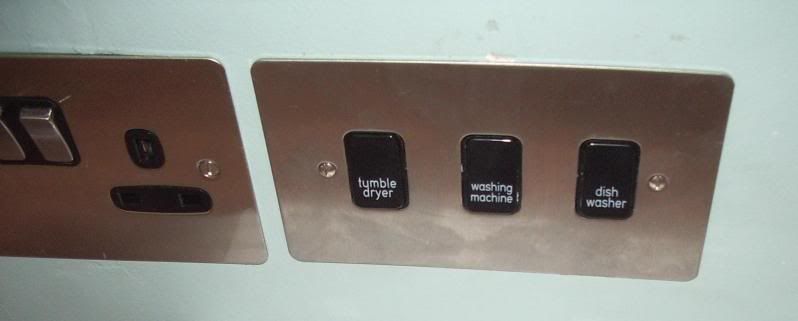
H
holmslaw
..
H
holmslaw
..

DIYnot Local
Staff member
If you need to find a tradesperson to get your job done, please try our local search below, or if you are doing it yourself you can find suppliers local to you.
Select the supplier or trade you require, enter your location to begin your search.
Please select a service and enter a location to continue...
Are you a trade or supplier? You can create your listing free at DIYnot Local
Similar threads

- Replies
- 4
- Views
- 3K