MPPT Recommendations to Charge 12V AGM Battery from 455W / 36V Solar Panel?

Joined
17 Oct 2018
Messages
103
Reaction score
8
Country
United Kingdom
Someone on Facebook gave me a free solar panel. It's brand new but the glass is fractured. I'm planning to superglue the cracks so that it can be used outside without corroding the panel.

I would like to use it off-grid in the garden with my old 12V AGM car battery.

The panel is a DMEGC DM455G12RT-B48HBB. I understand the max. watts are 455 and max. volts 36.

What's the cheapest MPPT I can use with this panel and 12v battery?
 
I've checked a lot of MPPT controllers on eBay, but the problem I'm finding is that their specs. state that they can only charge a 12v battery if the solar panel voltage is below about 25v and wattage below about 200w. For panels with a higher output, you can only charge a 24v battery.

My panel outputs 36v / 455W and I have an existing 12v battery I would like to use.
 
36 volts at 455 watts = 12.5 amps, so a bit more to what a zenor diode can handle.
1772986689983.png
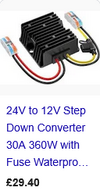
So somewhere somehow you need to have some way to reduce amps and volts. There are units to run CB's from a wagons 24 volt supply 1772986930254.png but what you are looking at is doing it on the cheap.

So I have two ex-car AGM batteries, plus the one on the car, but that hardly matters, and I have found the smart charger has set stages of 5 amp, 3 amp, 0.8 amp and 0.1 amp, and when old it may stay at 0.8 amp, but when new would switch on about once a day for ½ hour at 0.1 amp. So the battery needs very little to maintain it, so more looking at what is used.

So we can get a reasonable priced zeror at 10 amp,
1772987413872.png
at 14 volts. Back years ago I used a 2N3055 NPN transistor and what I did was take the excess rather than try to regulate output, and turn it into heat. I used a 12 volt voltage regulator and a red LED to boost the volts to around 13.8 volts. The regulator turned on the transistor, and the transistor was in series with a 36 watt bulb, so the heat shared between the two. But clearly very wasteful, so although one could design and build a simple regulator, same idea as used with early motorcycles, most the energy would be lost as heat.

So be it a resistor voltage divider or any other method, much depends on how much energy you want to gain, and how much you want to spend.

So a trade-off, amount spent to watt/hours gained.
 

If you need to find a tradesperson to get your job done, please try our local search below, or if you are doing it yourself you can find suppliers local to you.

Select the supplier or trade you require, enter your location to begin your search.


Are you a trade or supplier? You can create your listing free at DIYnot Local

 
Back
Top