Radiators and Valves

Joined
22 Nov 2007
Messages
100
Reaction score
0
Country
United Kingdom
Hi All

Hope you can help, I currently have 2 standard radiators, 600 x 600 2990 BTU output each, with lockshield and thermostatic valves on each.

Being a typical starry eyed DIY'r I would very much like to ditch this in favour of fitting a pair of designer radiators. I have done this before in another house but have a few things I'd like to check first.

1. The pipes that are chased into the wall, can I lag them prior to bonding and plaster being put on top? (I ask because the majority of the central heating system is laid into concrete without any lagging or covering so the heat efficiency is reduced significantly :-( hoping to get a small gain by lagging the pipes)

2. The valves, I have an option of 'normal' valves or a thermostatic valve pack. I assume in any case one of the valves will need to be a lockshield valve is that right? Would you recommend fitting a thermostatic valve over a 'normal' valve?

Thanks very much for your help in advance will be checking this thread regularly. :D
 
1 if the pipes are in the heated part of the house, you do not have to lag them as they will contribute to the heating of the room (in a very small way) but you ought to wrap them in protective barrier tape against corrosion. Pipes and cables buried in walls out of sight are liable to nail and drill damage.

2 yes one thermostatic valve and one lockshield.

unless the system is very new and clean it might be worthwhile giving it a chemical clean before you drain. be sure to use an inhibitor on refill.
 
Thanks for the reply John

Just so I can be sure, when you say a heated part of the house, the pipes will only be exposed to the living area where they come out of the wall for a very short section, then go into the valves, other than that they are burried in a concrete floor and will then progress to be chased into breeze block, can I pipe lag in there or just barrier tape?

Thanks for the advice on the valves will go TRV and Lockshield.

Oh and great idea on the chemical clean as the system has been in for about 6 years so could do with a clean and will condition on the refill, how do I pour in the cleaner to the system? It's a sealed pressurised system (I.e. no tank in the loft).

Thanks
 
I have never had a sealed system, but you can buy tubes of concentrated chemicals that you squirt in through a bleed vent hole using a gun like you use for silicone sealant.

I imagine it would be easier if you drain a bit of water out first to make room for it. If it was me I think I would unscrew the bleed valve plug with a radiator key.

when you are refilling it will be easier because you can pour it down the pipe where you took the rad valve off.

someone will be along later who has experience of sealed systems.
 
On my system I put a 'stalk' with an AAV next to the hot water cylinder, in the middle of this is a compression coupling. To add chemicals it's just a matter of letting the pressure off, draining a small amount of water and undoing the coupling before pouring in.

Another way is to make a 90 degree 'adaptor' with a 1/2" thread on one end and an open piece of 22mm pipe on the other. This screws into the hole left when you take a blanking plug out of a radiator.

Lastly as you say there are the injectable chemicals but these are more expensive than the 'pourable' equivalents.
 
AAV? Oh I think I have one of these on my system already! Has a small blled nipple type release on the top right?

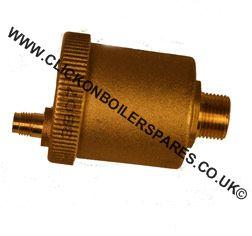
Not sure how mine comes apart it looks like this one:


Any ideas if this one comes apart?
 
That's the one, an automatic air vent.

They vary slightly in how they attach, and it ought to be at a high point in the system. If you unscrew it (the whole thing) you should be able to use a miniature funnel to add cleaner, inhibitor etc. Don't pour too quickly as it will need time to flow down.

Bear in mind that you'll need to support the pipe as you undo it so use two spanners not one! Also if it's a threaded fitting you'll probably need to use a little ptfe tape when you put it back on. If it's a compression fitting it'll probably seal ok without.
 
Oh yes I see what you mean... thanks very much thats a good idea to use that to pour the cleaner and conditioner in!

Should the valve on the top of the AAR be open constantly or should it be closed? Just checked and mine is closed, if I open it it starts to leak water.
 
The little cap is left open a turn or two in normal use, and is there so that you can close it to prevent water leaking out when the valve packs up :lol:

It would be a good idea to replace the AAV as it will not function with the cap screwed down.
 

If you need to find a tradesperson to get your job done, please try our local search below, or if you are doing it yourself you can find suppliers local to you.

Select the supplier or trade you require, enter your location to begin your search.


Are you a trade or supplier? You can create your listing free at DIYnot Local

 
Back
Top