• Looking for a smarter way to manage your heating this winter? We’ve been testing the new Aqara Radiator Thermostat W600 to see how quiet, accurate and easy it is to use around the home. Click here read our review.

Slow drainage issue after installing Insinkerator EC1000

Joined
1 Sep 2025
Messages
3
Reaction score
0
Country
United Kingdom
Hi all,

I’ve recently installed an Insinkerator EC1000 food waste disposer under my sink, but I’m still having very slow drainage issues.

Here are the details:
• All my waste pipes are 40mm.
• Clearance from sink bottom to waste outlet centre is over 280mm (so it should meet the spec).
• I’ve installed an Air Admittance Valve (AAV) after the P-trap, but even when I completely remove it and leave the pipe open, drainage is still very slow.
• I have two horizontal pipe runs before the waste goes into the wall:
- one is about 30 cm,
- the other is about 45 cm.
• Both pipes have some slope (I’ve checked).
• If water accumulates in the vertical pipe connected to the AAV, then when I switch on the disposer, the flow pushes water back into the small sink on the left side.

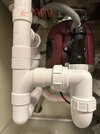
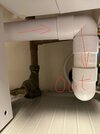
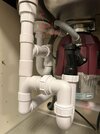
I’ve attached three pictures of my current setup:
1. Photo 1 – overall view of disposer + small sink waste connection.
2. Photo 2 – close-up of AAV position and connections after the P-trap.
3. Photo 3 – shows the final horizontal run to the wall outlet (with arrow marked “Out”).

My questions are:
1. Does my current layout have a design flaw that is restricting flow?
2. Could the issue be caused by the wall outlet (downstream restriction)?
3. Would adjusting slope, changing fittings (e.g. reducing bends), or relocating the AAV help?
4. Has anyone in the UK had similar issues with disposer installs and found a reliable fix?

Any advice would be really appreciated.

Thanks,
Jonathan
 

Attachments

  • Photo 1.jpg
    Photo 1.jpg
    137.8 KB · Views: 38
  • Photo 2.jpg
    Photo 2.jpg
    183.1 KB · Views: 35
  • Photo 3.jpg
    Photo 3.jpg
    124.7 KB · Views: 36
Firstly, sorry, but I think you've wasted your money. Food waste should go in the bin, (if the local Council don't provide a food waste collection, then it should go in the Landfill bin), the only things that go down the drain should be the 3 P's, Pee, Poo and (toilet) paper. Food waste will encourage Vermin and causes problems down the line as it doesn't dissolve very well. Dealt with one before where the Kitchen Sink and Downstairs Cloakroom Basin had be connected horizontally opposed into the Stack, discharge from the Sink and Waste Disposer was regularly blocking the basin connection, so had to reroute the basin waste externally to negate the issue.

As you've got the thing installed then I suspect you will want it to work. Given you're venting the pipework by removing the trap, and it's still slow, then there has to be some restriction in the pipework, be that the Fall is insufficient, a dip in the pipe or the fact its gunged up somewhere.

The number of Elbows wont help matters either, Swept bends would have been better, and a Cleaning eye where it turns to go out would have been an idea to deal with any blockages that (may) occur.

Where does it go once it passes through the wall?
 
Thanks for your reply. After passing through the wall, the waste pipe goes directly outside into a surface water gully (drain). So it shouldn’t be joining another internal waste line.
 
Surface water gully, as in takes rainwater? That needs checking to ensure it goes to a Combined Sewer, otherwise you've an illegal cross connection there.

I'd hazard a guess though, the issue is with the bends in the pipework, there are several and each one is slowing the flow down and causing a restriction. Only long term solution may be to redo the pipework, minimising the number of bends as much as possible and use 45's and swept bends instead of those elbows.

Currently you've the flow coming towards the front of the cupboard before it drops to go back on itself, I'd start by turning the Waste Disposer outlet 90deg to the right, and Tee that into the top of the horizontal run, then keep the upstream pipework from the sink as short as possible. That will then allow the flow from the sink to assist in washing the pipework downstream of where the Disposer joins in, as clean as possible.

Use a 45 to angle downwards, into a swept bend or ideally Tee with a cleaning eye looking at you where the run goes through the wall. You have an Anti vac Trap on the sink, if the waste run is set up right, you shouldn't need any additional AAV on that short a run.
 
Thanks again for the detailed advice. From your explanation, the main issue does look like the excessive number of bends and the current pipe layout. I understand your suggestion of turning the waste disposer outlet 90° to the right and teeing it directly into the horizontal run, and then keeping the upstream pipe from the main sink as short as possible so its discharge helps flush the line.


I have two follow-up questions:
  1. How should I best connect the small sink into this setup?
    • Should it join the same horizontal run before or after the disposer connection?
    • Is there a recommended fitting (e.g. a swept tee, double bowl kit, or other) to prevent backflow between the small sink and the disposer?
  2. Do I still need the AAV on this layout?
    • At present I have an AAV fitted after the P-trap, but if the run is short and the pipework is reconfigured with proper slope and swept bends, is an AAV still necessary, or can it be removed safely?
Thanks again for your advice, it’s much appreciated.
 
If it's set up right, backflow shouldn't be an issue. I'd actually look at swapping the P Trap for a S Trap on the small sink, see if that will allow you to use a swept bend on the end of the horizontal run, Vertical Outlet from S Trap may drop straight into that. This makes small sink at the head of the run, and flow from this will wash through the pipework. Waste Disposer can connect in downstream with a Tee.

45 bend on the other end, using a Spigot Bend might gain you some fall on the run, into a Tee, then out through the wall. Cleaning eye to blank off internal end of Tee.
 
I'm sorry to say that the slurry from a disposal unit will likely sit in a gulley and be a problem . I once went to a row of 6 houses where one drain run only took the kitchen - the whole lot -all 6 - drain run was solid with gunk from sinks alone -- no volume of water to flush it clear Rods were useless , had to be jetted. And a high end new build I was apprenticed on, blocked a shallow drain with the sludge.
 

If you need to find a tradesperson to get your job done, please try our local search below, or if you are doing it yourself you can find suppliers local to you.

Select the supplier or trade you require, enter your location to begin your search.


Are you a trade or supplier? You can create your listing free at DIYnot Local

 
Back
Top