I have solar (about 15 panels) and a fit account. Been in the house 7 years and it was there then so not sure how old it is. I would like to switch it to battery so i can use what we create. Any rough idea how much a decent battery would cost for a 4 bed detached, prob heavy use. Can i use my existing invertor? Im sure any company will tell me my gear is past its sell by and all needs replacing, but i dont want to spend several thousand if i dont need to. I get about 7-£800pa from fit payments so it is working even if not to its full potential. Ive never had it serviced and i know at least one panel is broken.

You are using an out of date browser. It may not display this or other websites correctly.
You should upgrade or use an alternative browser.
You should upgrade or use an alternative browser.
Solar battery
- Thread starter stender
- Start date

- Joined
- 27 Jan 2008
- Messages
- 29,739
- Reaction score
- 3,680
- Location
- Llanfair Caereinion, Nr Welshpool
- Country

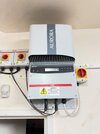
I looked at this manual to see if any reference to a battery. I found non, so it would seem any battery will need its own inverter, you can get batteries with their own inverters, however these need declaring to the DNO, so not really a DIY job.
New products seem to be released every day, so you may be able to add a battery independent of the solar panel inverter, but you really need to get some one in to do it. So they can raise the Flexi-orb or other certificate required, and get permission from the DNO.
New products seem to be released every day, so you may be able to add a battery independent of the solar panel inverter, but you really need to get some one in to do it. So they can raise the Flexi-orb or other certificate required, and get permission from the DNO.

- Joined
- 5 Oct 2026
- Messages
- 6
- Reaction score
- 3
- Country
stender, a couple of things that might save you replacing kit that's still working. Your FIT inverter probably can't take a battery, but it doesn't need to. An AC-coupled battery comes with its own inverter and sits alongside the solar, so the panels, the existing inverter and the generation meter stay as they are. That's the usual way to add storage to a FIT system. Tell your FIT supplier first, as they'll want the battery wired so the generation meter only ever records what the panels make.
On the DNO side, as ericmark says, it has to be declared, and what matters is the combined inverter rating. If the solar inverter plus the battery inverter come to 16 A per phase (about 3.68 kW) or less, it's normally fit and notify under G98. Most FIT systems are already close to that, so adding a battery often takes it over, and then it falls under G99 and the installer applies to the DNO before fitting. An export limit is sometimes set to help with that. Worth asking anyone who quotes how they'll handle it.
Alan P.
- Joined
- 27 Jan 2008
- Messages
- 29,739
- Reaction score
- 3,680
- Location
- Llanfair Caereinion, Nr Welshpool
- Country
My batteries are not big enough to ensure I only use off-peak, yesterday I ran out 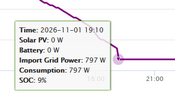 at 10 past 7 pm, and one has to consider size required, unlike the solar panels, there is a limited life, I started too small, at 3.2 kWh which would allow charge at 2 kW and discharge at 3 kW so with 6 kW of panels and a 5 kW inverter I was seeing export to grid but battery not fully charged, and also very easy to go over 3 kW so using grid rather than battery, I doubled up to 6.4 kWh, but at that time not being paid for export, and was seeing the battery being charged with off-peak, so not enough room for solar latter in the day, once I got export sorted, then the tariff selected was important, I pay less for off-peak to what I am paid for export, so I can fully charge battery with off-peak, and it does not matter if latter I am exporting, I am on an EV tariff.
But the solar panel tariffs, often you do not get more for export to what you pay for off-peak, and one would need to be your own power station control room to decide each day when and how much to import and export. This is not what I want to do.
It seems however, some inverters will allow you to pass over control to the supplier, the so called smart option, my inverter does not have this option, as to how important this is, will depend on what else you have, like heat pumps, and EV charging, and if the EV charging is the V2G EV type.
I have looked into the idea of non grid tied battery packs as well, and so many options it is mind boggling.
Use is another thing, washing machine, tumble drier, and dishwasher all have a delayed start function, I wanted the battery to be able to provide 5 kW so 3 kW machines would not draw from grid, then I set the three big machines to run at off-peak times, so it really does not matter.
I had a EPS system (like an UPS but not such a fast change over) set up to maintain my freezers and fridge, but a non grid tied battery pack would do the same and much cheaper. Also if I added a battery pack now, it could reduce the load on main batteries, likely tipping the balance so they do last all day, and I could in summer take it out with me.
So a lot to think about, as to if the plug-in solar will in fullness of time include batteries no one knows.
So step one is look at your house design, with my house, it would be easy to put a battery pack outside the kitchen window to supply kitchen with non grid tied power. My son is looking at the Tesla power wall, but the rules have been made tighter as to where they can go, the inverter with them is built in, but with mine, the inverter and battery are independent so I can have inverter in doors keeping house warm, and batteries outside.
Although I am an electrical engineer, I did not fit my own solar and batteries, I got a specialise to do that, and I am glad I did, as they gave some very good advice which I would not have considered myself.
at 10 past 7 pm, and one has to consider size required, unlike the solar panels, there is a limited life, I started too small, at 3.2 kWh which would allow charge at 2 kW and discharge at 3 kW so with 6 kW of panels and a 5 kW inverter I was seeing export to grid but battery not fully charged, and also very easy to go over 3 kW so using grid rather than battery, I doubled up to 6.4 kWh, but at that time not being paid for export, and was seeing the battery being charged with off-peak, so not enough room for solar latter in the day, once I got export sorted, then the tariff selected was important, I pay less for off-peak to what I am paid for export, so I can fully charge battery with off-peak, and it does not matter if latter I am exporting, I am on an EV tariff.But the solar panel tariffs, often you do not get more for export to what you pay for off-peak, and one would need to be your own power station control room to decide each day when and how much to import and export. This is not what I want to do.
It seems however, some inverters will allow you to pass over control to the supplier, the so called smart option, my inverter does not have this option, as to how important this is, will depend on what else you have, like heat pumps, and EV charging, and if the EV charging is the V2G EV type.
I have looked into the idea of non grid tied battery packs as well, and so many options it is mind boggling.
Use is another thing, washing machine, tumble drier, and dishwasher all have a delayed start function, I wanted the battery to be able to provide 5 kW so 3 kW machines would not draw from grid, then I set the three big machines to run at off-peak times, so it really does not matter.
I had a EPS system (like an UPS but not such a fast change over) set up to maintain my freezers and fridge, but a non grid tied battery pack would do the same and much cheaper. Also if I added a battery pack now, it could reduce the load on main batteries, likely tipping the balance so they do last all day, and I could in summer take it out with me.
So a lot to think about, as to if the plug-in solar will in fullness of time include batteries no one knows.
So step one is look at your house design, with my house, it would be easy to put a battery pack outside the kitchen window to supply kitchen with non grid tied power. My son is looking at the Tesla power wall, but the rules have been made tighter as to where they can go, the inverter with them is built in, but with mine, the inverter and battery are independent so I can have inverter in doors keeping house warm, and batteries outside.
Although I am an electrical engineer, I did not fit my own solar and batteries, I got a specialise to do that, and I am glad I did, as they gave some very good advice which I would not have considered myself.
Appreciate the response but its gone over my head tbh. I just wanted to run as much as i can on battery and charge them off the grid off peak and use grid when i need to. We are quite heavy users as washing machine and tumble dryer seem to be on everyday. We have 2 tall fridge freezers, dishwasher and 2 computers on all day and 3 tvs and a playstation on at once in evenings. Oven and airfryer, lights, boiler.
A battery would fit in my garage below the current inverter so space shouldnt be an issue. But if its separate to the grid does that mean it needs to be wired to what i want to use or does it connect to ring etc?
A battery would fit in my garage below the current inverter so space shouldnt be an issue. But if its separate to the grid does that mean it needs to be wired to what i want to use or does it connect to ring etc?
- Joined
- 27 Jan 2008
- Messages
- 29,739
- Reaction score
- 3,680
- Location
- Llanfair Caereinion, Nr Welshpool
- Country
I hope some one else will jump in. The question is more, DIY or get an installer. My inverter has two ways to power the home, one is grid tied, so it uses the wiring already in the house, the other EPS this is new wiring, and will keep running in a power cut.
There are two main aims, one is to stop importing when the solar output dips below what it is producing, and two is to allow use of off-peak, there is a third where it gives power in a power cut, but in the main the third needs some extra wiring.
Quick google and "A standalone 5 kW solar inverter in the UK typically costs between £400 and £1,100, depending on whether it is a basic on-grid string inverter or an advanced hybrid/off-grid model." At £500 these
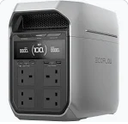 seem a good idea when you already have sorted out the second MPAN number for export, but weight limits size, and they can only just about give 3 kW. So they seem too small for you.
What one can't see with an internet hunt, is which are accepted for use in the UK, and often there are some little switches which need setting, called dip switches, so even as an electrical engineer I would get some one it to fit one for me.
There are two main aims, one is to stop importing when the solar output dips below what it is producing, and two is to allow use of off-peak, there is a third where it gives power in a power cut, but in the main the third needs some extra wiring.
Quick google and "A standalone 5 kW solar inverter in the UK typically costs between £400 and £1,100, depending on whether it is a basic on-grid string inverter or an advanced hybrid/off-grid model." At £500 these
What one can't see with an internet hunt, is which are accepted for use in the UK, and often there are some little switches which need setting, called dip switches, so even as an electrical engineer I would get some one it to fit one for me.
Yes i will get someone to fit, just want an idea on price first rather than potentially waste someones time if more than i want to pay.
I do want it to cover outages as well given all this prepper talk.
The unit in your image looks like a lightweight mobile jobby. What im expecting is a 4-5ft high thing. Seen the tesla battery and also seen modular ones that stack and you can stack an invertor on top.
I basically want to lower my bill as much as possible and have the cover if power lost. So use solar when there is some, and fill batteries during low rate and use during peak.

- Joined
- 22 Jan 2007
- Messages
- 24,714
- Reaction score
- 3,743
- Country
You really need on site advice from someone who knows about solar installations. As mentioned, if you need G99 certification then the DNO may refuse it, and finding that out first would be sensible. That would affect the price therefore it really isn't worth guessing.

DIYnot Local
Staff member
If you need to find a tradesperson to get your job done, please try our local search below, or if you are doing it yourself you can find suppliers local to you.
Select the supplier or trade you require, enter your location to begin your search.
Please select a service and enter a location to continue...
Are you a trade or supplier? You can create your listing free at DIYnot Local
Similar threads


- Replies
- 6
- Views
- 1K