• Looking for a smarter way to manage your heating this winter? We’ve been testing the new Aqara Radiator Thermostat W600 to see how quiet, accurate and easy it is to use around the home. Click here read our review.

Solar panel/system earthing help needed.

Joined
15 Feb 2009
Messages
134
Reaction score
27
Location
Norfolkshire
Country
United Kingdom
Hi, i am at the planning stage of a solar panel system & getting a lot of contradiction on earthing. The drawing is the plan & i would say earth ABCD earth off the incoming main as all will have 230'ish volts. But not sure on EFG & weather G is needed if connected to the main intake.
I am even more interested as i was chatting to next door with solar panels & his son got a shock whilst cleaning them. So, any help with EFG would be appreciated. Plus it would be nice to avoid possible ground loops & lightning problems. Thanks
solar earthing.JPG
 
I assume the changeover switch is to provide an EPS in the event of a power cut?

In which case your inverter and subsequently any circuits protected need to have an independent (rod) earth as you can’t rely on the DNO earth if there is a power cut.
 
I assume the changeover switch is to provide an EPS in the event of a power cut?

In which case your inverter and subsequently any circuits protected need to have an independent (rod) earth as you can’t rely on the DNO earth if there is a power cut.
The change over switch has an override on it to go to either mains or inverter, but with this switch the battery has priority & when the battery gets to a pre-set low voltage it then switches back to mains until it reaches a hi pre-set voltage, then back to battery.
 
In the main, the inverter does the change over, it is not the earth which is the problem, an earth rod can be simply added, it is the neutral which is the problem, when in Grid mode the neutral is not connected to earth, but in island mode it is, and the inverter to comply with G99 or G98 has to be configured depending on which, even as an electrical engineer, I did not install my own solar, there are a load of hoops to jump through.
 
In the main, the inverter does the change over, it is not the earth which is the problem, an earth rod can be simply added, it is the neutral which is the problem, when in Grid mode the neutral is not connected to earth, but in island mode it is, and the inverter to comply with G99 or G98 has to be configured depending on which, even as an electrical engineer, I did not install my own solar, there are a load of hoops to jump through.
We had a power cut a week or two back & it was with the pole & trany outside my place. The engineers got hear & there was smoke & sparks coming out the bottom of the pole. "I assume via the earth" It turns out the natural had failed at the top of the pole & i think it found the next shortest route. This maybe just unlucky, but then makes you wonder on ground loops with earth rods, ie could that poles earth found my solar earth.
 
We had a power cut a week or two back & it was with the pole & trany outside my place. The engineers got hear & there was smoke & sparks coming out the bottom of the pole. "I assume via the earth" It turns out the natural had failed at the top of the pole & i think it found the next shortest route. This maybe just unlucky, but then makes you wonder on ground loops with earth rods, ie could that poles earth found my solar earth.
Was the pole system earthed direct or through a reactor? I've been in military establishments where 19.5 ohm reactors (massive choke) are between the power generation house main earthing point and actual ground.
 
The point I was making, is at some point, be it at the transformer, or in the cable with TN-C-S or at the generator for the safety system to work, the neutral needs to be made into a neutral by linking it to earth, otherwise we are running an IT system, and our protective system use with a TN or TN system will not work.

With my solar panels, the inverter does this, and when the grid supply is lost, neutral is connected to earth, but this must not be the case when we have a grid supply, and not all countries have the same rules, and so there is a row of dip switches that need setting for the country it is used in, and with the UK there are two settings one for G99 the other for G98 and since I did not do the installation, I have no reason to even look at the switches. I just know they are there.
 
The point I was making, is at some point, be it at the transformer, or in the cable with TN-C-S or at the generator for the safety system to work, the neutral needs to be made into a neutral by linking it to earth, otherwise we are running an IT system, and our protective system use with a TN or TN system will not work.

With my solar panels, the inverter does this, and when the grid supply is lost, neutral is connected to earth, but this must not be the case when we have a grid supply, and not all countries have the same rules, and so there is a row of dip switches that need setting for the country it is used in, and with the UK there are two settings one for G99 the other for G98 and since I did not do the installation, I have no reason to even look at the switches. I just know they are there.
I know some invertor have a relay in them to connect & disconnect the neg/earth, but cant remember if this was on the mains or battery side. Bit of a minefield with solar & not dissimilar to the problems with boat electrics. We need a multi split page book to choose a system being fitted. There was this type of book for boiler wiring at one time.
 
not dissimilar to the problems with boat electrics
I seem to remember special grid tie inverters for boats, which could supplement the shore supply so once the limit of shore supply (often only 6 amp) was reached, then the inverter took up the slack, also problems with earthing, you don't want to erode away the sacrificial anodes too early, so common to find diodes in the earth to shore supply.

My own house inverter can be configured to work with a generator rather than grid supply (not both) so when a generator is running it will use that power first and charge batteries, reading the inverter instructions is interesting, so many options, and as inverters go mine is quite simple.

We now have inverters where we can give the supplier control, and as a result have far better tariffs, same applies to EV's, again giving the supplier control means we can have very cheap rates.

But I only pay peanuts now for electric power, and it is so easy to pay more for energy saving devices than they can save one, at least within a reasonable time, I fitted a tank jacket to reduce how much paid for domestic hot water, it will take a year to get the money back in savings, and jacket only cost £20. As to the iboost+, since off-peak costs 8.5p and export gets me 15p, a simple time switch would have saved me more.
 
I seem to remember special grid tie inverters for boats, which could supplement the shore supply so once the limit of shore supply (often only 6 amp) was reached, then the inverter took up the slack, also problems with earthing, you don't want to erode away the sacrificial anodes too early, so common to find diodes in the earth to shore supply.

My own house inverter can be configured to work with a generator rather than grid supply (not both) so when a generator is running it will use that power first and charge batteries, reading the inverter instructions is interesting, so many options, and as inverters go mine is quite simple.

We now have inverters where we can give the supplier control, and as a result have far better tariffs, same applies to EV's, again giving the supplier control means we can have very cheap rates.

But I only pay peanuts now for electric power, and it is so easy to pay more for energy saving devices than they can save one, at least within a reasonable time, I fitted a tank jacket to reduce how much paid for domestic hot water, it will take a year to get the money back in savings, and jacket only cost £20. As to the iboost+, since off-peak costs 8.5p and export gets me 15p, a simple time switch would have saved me more.
I'm with Eon & looking at a change to the Eon EV off peak when i have set this all up at 6.7p for 7 hours a night & then set the inverters to charge the battery's in these hours. I wont be feeding back & will start to look for alternatives to the iboost+
 
The change over switch
That switch is pointless and will cause problems.
The inverter already has built in switching between mains/solar and can also power the loads using both at the same time.

If you install that clunk-o-matic changeover thing, then you won't be able to use excess solar to power loads during the day when the battery is full or when solar power exceeds what charge power the battery requires, and every time you change to the battery only and back to the grid there will be a break in the supply which will mean internet router, oven clocks and the like will need to be reset. if you intend to actually use the battery to power things at night, then you will have to switch the 'auto' thing manually every time.

A more sensible solution:
sling the changeover switch away
connect the consumer unit to the inverter directly
mains input to the inverter must be through a suitable protective device, it can't be connected directly to the mains supply
incoming supply will require T1 surge protection if it hasn't already got that.
don't bother with any DNO supplied earth connection, make the whole lot TT all the time, you will need earth electrode(s) installing for that if you don't already have these.

all of this assumes you have sized the PV, battery and inverter appropriately for the loads in the building.

That inverter has 2 separate PV inputs, so it's also pointless to combine them into one before the inverter.
 
Interesting, when moving from British Gas to Octopus I did look at the tariffs, the published info for British Gas had shown them better than Scottish Power when we had the panels installed. But the failure of British Gas to ever pay for export, and the speed at which Octopus solved the problem, means I am not inclined to jump ship due to better tariffs offered, as had 12 months stuck with British Gas where to leave I had a £75 excess to pay, so it was not worth swapping until the contract ran out. I had the British Gas EV tariff, and when I looked at Octopus there were four tariffs which at first seems available, however, two require one to give Octopus access to your car charging system, and since I do not have an electric car, my EV's are two e-bikes, the intelligent option was not open to me. So the two tariffs were Go and Flux, the latter the peak rate is rather high, and I don't have a large enough battery to be sure I will not need power at that time in winter, also with BG I had found I was charging the battery overnight, which resulted in no space to accept solar power in the day, so when the EV tariff stopped I was actually paying less.

If the off-peak is less or equal to the export rate, then filling the battery overnight which results in exporting during the day is not a problem, but with Flux cost 17.1p off-peak and being paid 10.54p for most of the day, if the battery was big enough so you can export 4 pm to 7 pm then yes a massive 30.68p for export, but you would need to work out how to make the system take advantage of the rates offered, so the EV tariff of 8.5p off-peak, 15p export, and 30.17p peak is easier to set the solar to deal with, and once set you can forget about it.

Yes, there is the should one run the four power users, the dishwasher, washing machine, tumble drier and immersion heater during the day or during off-peak, taking into consideration noise and danger running overnight. But 8.5p to 15p is only 6.5p different, not really worth worrying about.

However, the E.ON
1751806493207.png
does not seem to say you must have and EV, I have failed to find what they pay for export. It seems to be 10p/kWh which is rather poor, so swings and roundabouts, and will you actually get it. BG seemed good on paper, but never got paid by them.

 

ericmark Must admit i wont be feeding back at the moment, so not to bothered on the day rates & concentrating on using as much as pos at night.​

This was forced on me, I could not get British Gas to sort out export payment.

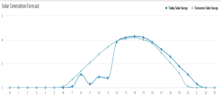
The problem is, you want the state of charge to be low enough to take the solar output. Typical curves with no off-peak.
1751874931356.png

And typical curve with off-peak.
1751875020024.png

On the first one from around 5:30 am to 8 am, I was using grid supply, in the second the grid supply was 1 am to around 3:30 am off-peak, but the state of charge did not drop below 82% so the solar was exported rather than being used to charge battery.
I do get a forecast, ⁣but1751875403109.png not that accurate, and the software does not allow me to set how much it charges the battery, I can set how fast, and for how long, but when I went from 3.2 kWh to 6.4 kWh battery size, it did allow solar to charge it at 4 kW instead of 2 kW, and it to discharge at 5 kW instead of 3 kW, and it lasted until off-peak started, which is what I wanted, but it also resulted in the battery still being charged when solar started, which is OK if being paid for export, but not when not being paid for export.

With no export payment, break even point was around 15 years, with export half that time at 7 years. In fact, way it is going more like 5 years.
1751880673206.png
Last months' production, to set how much to charge overnight to match that, is almost impossible. Export to grid
1751880921183.png
for same month, 12th was very low 3.7 kWh but the 4th was 26.7 kWh total for month 499.4 kWh exported at 15p/kWh = £74.91 why would one not want to get paid for export?
 
Last edited:

If you need to find a tradesperson to get your job done, please try our local search below, or if you are doing it yourself you can find suppliers local to you.

Select the supplier or trade you require, enter your location to begin your search.


Are you a trade or supplier? You can create your listing free at DIYnot Local

 
Back
Top