I am going to have to re-read a few times, the electronic TRV head does open and shut the TRV in steps, one hears the motor run for maybe 10 seconds as it is adjusting, every Saturday at noon the valve is exercised, and it takes around 4 minutes to fully open, then fully close, then return to setting, it does not sound a long time, but I know in my mothers house with a condensing boiler, the radiator could get stinking hot before the TRV closed, so I used the TRV report
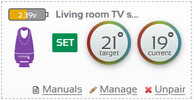
and if current exceeded target, I would close the lock shield valve a small amount, so the speed the radiator heated up was slow enough for the TRV to control it in time, to stop over shooting.
However the same idea here, does not work with a non condensing boiler, with micro bore, the lock shield valve is nearly wide open, I don't hear the TRV head motors running that often, and batteries do seem to last, so they are working, but clearly not the same as with mothers set up, hence the question.
I know with mother old house, when sold on her death, new owners did not want the electronic heads, so swapped back to mechanical heads, and now the lock shield valves already set up, it worked well, even with mechanical heads.
The problem with mechanical heads is no 20°C marking, so you have two devices, lock shield and TRV, and no idea which one needs setting.
With a mechanical head on a TRV, I note set at say 2.5 it will be fully open at 17°C and fully closed at 21°C but as to if the room settles at 17°C or 21°C or anywhere in-between seems to be down to room size and outside temperature, where with an electronic head set to 20°C it starts to close at 19.5°C and is fully closed by 20.5°C so room size and outside temperature have a lot less effect on room temperature.
Linked to boiler TRV heads may work fine with a radiator on an internal wall, but when the radiator is on an external wall, the wall cools the TRV head until the thermals have been established. So it will turn the boiler on prematurely, OK it will not run for long, once air starts to move, the TRV measures true room temperature, but still not desirable to have boiler fire up when not really required.
There are systems which can use a thermostat on an internal wall, the Drayton Wiser for example, but the cost becomes eye watering, so most of my TRV heads are not linked, and will only heat the room if the boiler is already running.
So the TRV heads are often set a little on the high side, want the room at 22°C but TRV head set to 24°C in my living room, as in the main the boiler will turn off before the room reaches 24°C anyway. This was not clearly the case with a condensing boiler, where rooms would be spot on what the TRV was set at.
So 11 pm the TRVs in living room turn down so boiler no longer heating that room, and at 9:30 pm the bedroom TRVs also turned up, giving 1.5 hours to heat bedrooms before the boiler turns off, the living room wall thermostat will also turn down at 11 pm, and the linked to boiler TRV in wife's bedroom will fire the boiler if her bedroom drops below 16°C.
The hall wall thermostat is really no longer used, but again if we were to light a fire in the living room, it would trigger the boiler to heat the rest of the house, set at around 17°C in the day, unless alternative heating in the living room, it will not fire the boiler. I was fitted to link to the Energenie TRV heads, but was found they would only follow if the Nest Gen 3 was manually adjusted, if temperature changed by programming, they failed to follow, hence the Wiser wall thermostat in living room.
Although the heating works, it is far from perfect, I have called it near enough engineering, but in real terms, it's not near enough, so tweaking is required.
So as well as settings, it is also what to expect, I know there will be some hysteresis, I can't expect my thermometer on table to read 20.5°C all day, it will raise and fall as the oil boiler cuts in and out, but how much should I expect?
I see flat under house, heating set to stop frost, at 13.2°C, my bedroom at 16.6°C and the living room at 20.1°C and boiler has just kicked in again, wall thermostat set to 20°C showing at 19.5°C, one TRV showing 20.9°C the other 18°C this is in the same room. Summer they all show the same, so it is the way thermals move the air around the room.