Water dripping through tundish of unvented cylinder. Temperature and Pressure Relief Valve.

Joined
11 Mar 2025
Messages
6
Reaction score
0
Country
United Kingdom
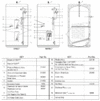
Water is leaking through the tundish from the Temperature & Pressure Relief Valve on the unvented cylinder OSO Indirect 20 RI. Half a year ago it was the same and I replaced the TPR15 valve. I installed the CPT15 equivalent. Water is leaking again. No more drops but a small stream. The unvented cylinder does not have an expansion vessel. The pressure behind the reducing valve is 1.4 bar - I read it with the expansion vessel for central heating. The expansion vessel is only for central heating. I read that the unvented cylinder may have an air bubble to correct pressure changes in the cylinder. I drained the water from the taps and from valve 5. After filling it is still dripping. Maybe valve 5 is damaged again or the water should be drained lower, using valve 12 (I could not unscrew it)? Maybe not enough air has collected inside?

 

Attachments

  • dla forum.gif
    dla forum.gif
    117.1 KB · Views: 72
First ensure any electrical immersion switched off, and heating coil off. You shoud try to use up the HW before recharging the air bubble.
I've read that valve 12 gets blocked so best to use bottom drain, 13. First shut off cold mains to UVC, then open and leave open hot tap(s) and maybe the T&P relief valve 5, (you may be able to jam or balance this open), when water stops draining shut everything and open the cold mains to the UVC, leave it for maybe 1/2hr then open a hot tap until air stops and water starts flowing, re instate the heating.
 
Cold Water in to the Oso off.
Open the hot tap.
One is meant to drain water / let air in via the "commissioning" drain valve #12 to get the correct sized air bubble. Quick to do if one can connect a hose and catch the drips that it will cause.

I never do that (except the first time when I had to remove and replace it with a new drain valve -- it was blocked up with slimy limescale). Ridiculous valve to fit for regular use by a householder (or plumber even) IMHO. The rubber washer invariably sticks and if not it leaks loads from the spindle while a hosepipe is connected.

I just use the TPRV #5 to let air in and water out of the hot tap.. It will sit open when twisted to the right spot (although one can get a 'service key' to hold it open)... it takes an age to stop 'gurgling'.

I find about 6 months is right for that amount of bubble to be absorbed into the water. I get a warning that the pressure is creeping up as a small reduction in flow shortly after opening a hot tap... (and faster than the cold). Time to refill the bubble. Last done in December.

I've never had the TPRV drip (except the first time when we moved in here, probably). The OSO original TPRV snaps closed quite firmly when rotated past a certain point (hence the service key tool I guess).

So I don't have any advice on why the TPRVs are passing on your install.

It may be worth checking the inlet pressure reducing valve is correctly set / operating? Unvented Qualified Plumber may be necessary?
 
The T&PRV should never lift as the expansion relief valve, item 4, which is set to a lower pressure, should lift first. The OSO cylinder, unlike the Megaflo and others does not have a air baffle hence the drain valve, item 12, which I think has a dip tube attached to allmost fully drain the cylinder and give a much larger air bubble than the others, thats why I suggested using the cylinder drain, since item 12 invariably gets blocked up
 
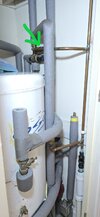
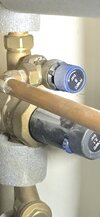
Thanks everyone for your help. Item 4 is 8 bar.
 

Attachments

  • 20250403_110631 a.jpg
    20250403_110631 a.jpg
    188.5 KB · Views: 42
  • 20250403_110726.jpg
    20250403_110726.jpg
    193.1 KB · Views: 60
The OSO cylinder, unlike the Megaflo and others does not have a air baffle hence the drain valve, item 12, which I think has a dip tube attached to allmost fully drain the cylinder and give a much larger air bubble than the others, thats why I suggested using the cylinder drain, since item 12 invariably gets blocked up
Nope.

No tube on that drain valve #12. https://www.oso-spares.co.uk/commissioning-valve
I have replaced mine. Also no tube is shown on the diagrams, above! Just the second of two immersion tubes #7 for the direct version of the cylinder.
My #12 was clagged up no water out no air in.
As said I now just replenish the bubble via the TPRV as I'm too lazy to clear the airing cupboard (aka hot press) out. Smaller bubble = more frequent replenishment.
As we are only two and low water users that works OK. Large family with higher water use maybe not!

The only dip tube is item #9 in the HW take off point and can be removed - if an external Pressure vessel is used in place of the bubble - to increase the stored hot water volume.

The 10 bar TPRV venting would be hotter water than the 8 bar PRV on the inlet multibloc venting water?
Or not?
https://osohotwater.co.uk/downloads/ has the manual for it, I believe.
Cold/tepid water = replenish the bubble (8 bar PRV vents).
Hot water = call a qualified person in (10 bar TPRV venting).
 
I wonder why does that drain valve seem to get clogged up on these UVCs, I have seen this mentioned frequently.
I mailed OSO technical re air baffle (or not, there isn't) in view of dip tube removal feature, and also what would be the final cylinder pressure expected with a full reheat to 60C with a fully restored air bubble but didn't get a "proper" answer, as I've stated a number of times, its definitely one of the worlds greatest mysteries as to why a pressure gauge is never installed on any UVC?.
If the T&PRV lifts on temperature then, IMO, there is something radically wrong with a immersion element stat, difficult to see a boiler reaching, is it 90C, the T&PRV setting.
 
I think replacing drain valve #12 is a good idea for the future. Maybe TPRV #5 got dirty due to long-term water leakage (replaced half a year ago)? The temperature on the heater regulators is set to 60 °C. Water is definitely leaking from TPRV #5. I guess I'll end up calling a qualified person. And it seemed so simple... :(
 
Please do note:- an unvented cylinder is a regulated unit and as such is not something that should really be worked on by anyone that isn't qualified., especially the attached safety devices. There is the potential for them to be quite dangerous and primarily why it is regulated, therefore it should only be worked on by a qualified engineer.

I would suggest the unit may need to be serviced correctly and they should be able to sort it out for you. .
 

If you need to find a tradesperson to get your job done, please try our local search below, or if you are doing it yourself you can find suppliers local to you.

Select the supplier or trade you require, enter your location to begin your search.


Are you a trade or supplier? You can create your listing free at DIYnot Local

 
Back
Top