I was thinking about the sort of 'management' eric was talking ('fantasising'?No - all that is needed, is a record of how much used, and when.

I was thinking about the sort of 'management' eric was talking ('fantasising'?No - all that is needed, is a record of how much used, and when.

I've got an idea.A recent introduction I understood, to relieve their staffs workload, from people switching too frequently.

Because that's the way the government we had from 2010 wanted things to work.It costs suppliers no more to process and distribute electricity generated from expensive fuel than when it is generated from cheaper fuel, so I don't really see why they should be allowed to make a lot more profit just because the fuels had become more expensive.

They don't "have to" in the same way that they "have to" take account of when it is day and when it is night, or when it is summer and when it is winter.You need to keep in mind, that suppliers have to buy there allocation of energy, on the spot market, ahead of time, taking the gamble on recovering their investment,

I wonder if there might be scope for these suppliers to save costs by not employing people whose job it is to fight with the people employed by other suppliers to fight with them, and by not spending money on marketing and branding and advertising, and by not spending money on enormous salaries for their senior executives, and by not spending money on dividends to shareholders.there is a limit to how far government can going in simply telling suppliers to charge less than they otherwise would, since (unless they 'subsidised the difference', with taxpayer's money) they would eventually create a situation in which the supplies 'went bust', because their outgoings were greater than the income they were being allowed to have.

I know somebody who used to work for a company closely associated with the regulation of the UK domestic electricity supply industry, and they regularly met with counterparts in other European countries who were, to a man, utterly gobsmacked by the braindead insanity we had wreaked on our electricity generating and distributing infrastructure. Whilst, of course, rubbing their hands as they swooped in to grab as much profit as they could. Profit which can only come, at the end of the day, out of consumer's pockets.The w/sale prices rises, came hand in hand, with instability, so covering themselves took care of that extra margin. Energy retail is a highly competitive market, with so many companies involved. Increase their prices, expect too big a profit, then they soon lose customers, who seek out a better offer.

But they will let me use the internet to relay consumption figures (to Octopus, as it happens) which I've recorded by looking at my meters.One solution, would be for Ofcom to allow the use of the Internet, as an acceptable option to relay consumption figures, to suppliers. Octopus already do this, using their pink thingummy. I have one, and it works a treat, feeding a constant stream of my instantaneous figures, every 10 seconds, to Octopus, but it is unofficial, I cannot be billed using it.

Depends on how you define "smart meter".The moment one wants a tariff which (for import and/or export) is 'dynamic' and/or which has more than two 'rate periods', there really is no option than to have what we call a 'smart' meter. I can't see that anything other than what we call a smart meter would be "suitable"! for such a tariff", no matter what Ofgem might say, can you?

Could that not be done locally, using an Android/iOS/Windows app which synced with the supplier as often as there was a change, connected to the meter over a local wireless connection of some sort, all of which would allow people to moderate their usage, but none of which was used for billing?Sure, that would be fine for billing, provided that the connection was at least occasionally available. However, one needs much better than 'occasional connection' if one wants to use and manage 'dynamic tariffs, doesn't one?

I was thinking about the sort of 'management' eric was talking ('fantasising'?) about, in which loads would be controlled, in real time, by the meter in response to changing dynamic tariffs.

That makes sense, and I know my father was working in a power station within a steel works, and his job included at time delaying a process, as grid power was expensive at that time, likely talking about 80s and 90s. But the industry has always been charged what it costs.We could have just one supplier, and their prices could be based on what it costs to make and distribute electricity, rather than a multiplicity of suppliers all trying to profit from the sale and dreaming up a multiplicity of pricing schemes aimed at getting customers of competitors to buy from them instead.
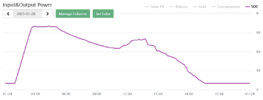
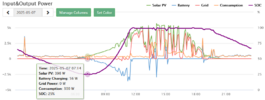
where it was not fully recharged with solar, but many days were like this
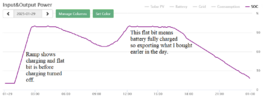
that second flat bit means I was exporting, at that time for no payment. The EV tariff I was on locked me in for 12 months, or pay £75, so not happy with off, peak.
The solar at moment is doing all my needs. It will not in the winter, but at 8.95p and every night come rain or shine, using 6 kWh would be OK if paid more the 8.95p/kWh for export, but Octopus flux charge 17.1p/kWh night rate, and give 10.54p/kWh for export, but standard rate I get 15p/kWh for export, and by 4 pm solar production has nearly stopped so not going to see many kWh at 30.68p/kWh.
Isn't the problem that without some kind of time signal (GSM,RTS,whatever) the meter doesn't reliably know what time it is?Indeed - but has that ever happened?
Some (many? all?) suppliers no longer offer 'new' dual-rate tariffs - but for those who, like me, already are on a long-established E7 tariff, there has never been any suggestion of my supplier saying that I "can't have it any more" - and nor has there (yet) ever been a problem with my changing to a new supplier and still sticking with my E7 tariff..
Even if gthe day ever comes when they say (truthfully or not) that my meter needs replacing and that they can no longer get dual tariff meters (that hasn't happened yet), they could still install a 'smart' meter, without its communication facility' and just use it as a ('manually read') dual-tariff meter.
2010 has little to do with the issue I was talking about, which has been with us since the year dot.Because that's the way the government we had from 2010 wanted things to work.
I was talking about an existing E7 supply such as mine, and the 'problem' you mentioned has always existed. It certainly existed in the days when I had an electromechanical time switch (which was often not remotely 'correct'), and I imagine that my current 'dumb' electronic meter has a much more reliable knowledge of 'what the time is' than its mechanical predecessor ever had!Isn't the problem that without some kind of time signal (GSM,RTS,whatever) the meter doesn't reliably know what time it is?
We could, but monopolies always engender concerns. Whilst one could eliminate the 'profit' element, in the absence of 'competition' there is no incentive to avoid the business being ridiculously inefficient - which is a phenomenon we've seen in the past.I've got an idea. ... We could have just one supplier, and their prices could be based on what it costs to make and distribute electricity, rather than a multiplicity of suppliers all trying to profit from the sale and dreaming up a multiplicity of pricing schemes aimed at getting customers of competitors to buy from them instead.
If you need to find a tradesperson to get your job done, please try our local search below, or if you are doing it yourself you can find suppliers local to you.
Select the supplier or trade you require, enter your location to begin your search.
Are you a trade or supplier? You can create your listing free at DIYnot Local