
- Joined
- 7 Sep 2022
- Messages
- 4,931
- Reaction score
- 1,438
- Country

Bathroom has a cupboard next to it that is big enough to accept a washer and condenser dryer. Water and power already in the cupboard so I'm just pondering on plumbing the waste
Immediately on the other side of the cupboard wall, in the bathroom, is the shower tray. It's a "plastic with chipboard support and sits on metal legs" type thing. The waste for the tray is a bottle trap that fits because there is a hole chopped in the floorboards, then the waste pips sit more or less on the floor. Out of the trap there is immediately a 135 degree compression coupler that goes into a very short bit of solvent weld, then a 90 degree bend and another short bit of straight run, then a 135 degree bend that disappears down under the floor boards no idea where to but I expect a 90 that turns left towards the back wall, under the radiator and toilet and out to join the soil stack.
I've got about 3 inches of room under the tray, no plans to remove the tray
Diagram of the waste, washer going where the W is:

Sorry I didn't get a pic of this; if one would help I can get one later
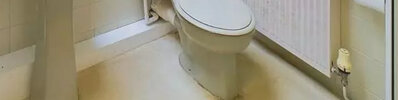
Elsewhere in the bathroom (right to left in the below pic) there is the shower tray in one corner, then a radiator, then a corner with some boxing and the stopcock, the toilet, the sink and the bath (not shown) and all their associated plumbing, which appears to be 40mm push fit. The boxing to the left of the sink is larger as it's accommodating the sink waste as well as the water feed. Not averse to making the boxing under the toilet larger if it had another waste
Right now I think, without drilling any external walls I can try either:
* Swap the 135 out of the trap for a 90, rotate the trap and try and get a solvent tee in the created space so I can 90off it and through the washer wall
* If solvent bosses/glue-on spigots even exist, carefully drill a hole in an accessible solvent section and glue the boss/spigot on
* Run a length of 32 along the wall, under the tray, over the rad tails and to the corner, turn and under the soil, into the sink waste's boxing and join in there however necessary
* Pull up the floorboards next to the shower, in front of the rad and try find the shower waste and tee into it, possibly such that I can come along behind the shower tray kick panel and then 90 down under the floorboards, hidden by the kick panel. The direction the floorboards run I would place good money that there will be a joist that defeats this plan to hide the pipe, but I'm not averse to having a short length of boxing adjacent the tray visible
Modifying the pipework under the tray is tricky because of the lack of working room and that if I wrecked anything it would likely be a tray out job, which is more than I want to get into right now
What would you do? Any of these? Something else?
Immediately on the other side of the cupboard wall, in the bathroom, is the shower tray. It's a "plastic with chipboard support and sits on metal legs" type thing. The waste for the tray is a bottle trap that fits because there is a hole chopped in the floorboards, then the waste pips sit more or less on the floor. Out of the trap there is immediately a 135 degree compression coupler that goes into a very short bit of solvent weld, then a 90 degree bend and another short bit of straight run, then a 135 degree bend that disappears down under the floor boards no idea where to but I expect a 90 that turns left towards the back wall, under the radiator and toilet and out to join the soil stack.
I've got about 3 inches of room under the tray, no plans to remove the tray
Diagram of the waste, washer going where the W is:
Sorry I didn't get a pic of this; if one would help I can get one later
Elsewhere in the bathroom (right to left in the below pic) there is the shower tray in one corner, then a radiator, then a corner with some boxing and the stopcock, the toilet, the sink and the bath (not shown) and all their associated plumbing, which appears to be 40mm push fit. The boxing to the left of the sink is larger as it's accommodating the sink waste as well as the water feed. Not averse to making the boxing under the toilet larger if it had another waste
Right now I think, without drilling any external walls I can try either:
* Swap the 135 out of the trap for a 90, rotate the trap and try and get a solvent tee in the created space so I can 90off it and through the washer wall
* If solvent bosses/glue-on spigots even exist, carefully drill a hole in an accessible solvent section and glue the boss/spigot on
* Run a length of 32 along the wall, under the tray, over the rad tails and to the corner, turn and under the soil, into the sink waste's boxing and join in there however necessary
* Pull up the floorboards next to the shower, in front of the rad and try find the shower waste and tee into it, possibly such that I can come along behind the shower tray kick panel and then 90 down under the floorboards, hidden by the kick panel. The direction the floorboards run I would place good money that there will be a joist that defeats this plan to hide the pipe, but I'm not averse to having a short length of boxing adjacent the tray visible
Modifying the pipework under the tray is tricky because of the lack of working room and that if I wrecked anything it would likely be a tray out job, which is more than I want to get into right now
What would you do? Any of these? Something else?
Last edited:


