
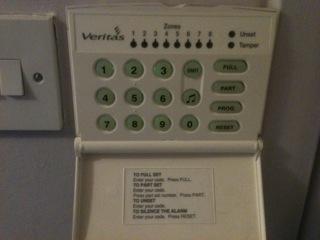
We’ve inherited an older Veritas alarm in a UK house and never really used it. After a power cut – or after switching the mains off to do other work – the keypad started flashing, the outside sounder went off, and nothing we type into the keypad makes any difference. Opening the panel to have a look has brought up a tamper fault on top of everything else. The keypad’s either dead, lit up but ignoring us, or flashing ‘unset’ with no zone lights showing. We want to know whether this is just a dead backup battery issue, whether the panel might have lost its programmed code, and what the safest route is to get it quiet and working again – ideally without paying through the nose for something that might be straightforward.
This is a common one in UK houses. Before you start spending money, do a couple of simple checks so you’re fixing the cause, not the symptom. I’ll run through what’s likely happening, what you can safely check yourself, and what a proper fix looks like – plus the usual bodges that don’t last.
What’s likely going on
The root of this is almost always dead batteries – and most people don’t realise there’s more than one.
Inside the main control panel (usually in a cupboard under the stairs or up high in a hallway) there’s a rechargeable lead-acid battery. Its job is to keep the system alive when the mains drops out. On the outside of the house, bolted up high on the wall, the sounder box has its own battery too. That one powers the siren independently so it can still scream even if someone cuts the mains on purpose.
Here’s the chain of events. Mains goes off. The panel tries to switch to its internal battery. If that battery’s been sat there for ten or thirteen years with no replacement, it’s stone dead – three or four volts instead of twelve. The panel can’t sustain itself, so it triggers a fault condition. The external sounder detects it’s lost communication with the panel and starts sounding on its own backup battery. If that battery’s also knackered, it’ll wail for a bit, then fade to a dying squeal, then maybe a pathetic bleep every minute or so until it gives up entirely.
When the mains eventually comes back on, the panel powers up, but it’s been fully dead. Depending on the age and model, it may have lost its programmed user code and reverted to the factory default. So now you’re typing in what you think is the code, and the panel’s ignoring you because it’s expecting something different. Meanwhile the tamper light’s going off because you’ve had the cover off trying to sort it, and the whole thing’s in a strop.
That’s the usual picture. Dead batteries, lost code, tamper faults – all stacked on top of each other.
Simple checks first
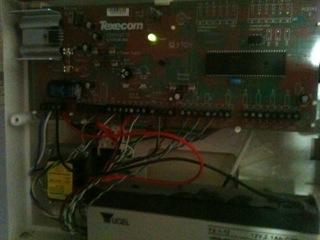
- Open the main panel carefully and look at the battery. It’ll be a small sealed lead-acid type, often labelled something like 12V 2.9Ah or similar. Check the voltage across the terminals with a basic multimeter if you’ve got one. You’re looking for around 13 volts if it’s on charge. If it’s reading under 10 volts off load, it’s done. Anything around 3-4 volts is completely dead. If you haven’t got a multimeter, just look at the battery – if it’s visibly swollen or the dates on it go back more than five years, replace it regardless.
- Check the two fuses inside the panel. There are usually a couple of small glass or blade fuses on the main board. If either has blown, the panel won’t power up properly even with mains connected. Hold them up to the light – you’re looking for an intact wire inside. A blown fuse means no power to part of the circuit, which explains a dead keypad or no zone lights.
- Check whether the keypad responds at all. If the keypad’s completely dead – no lights, no beeps when you press buttons – that points to a power issue at the panel end, not a code problem. If the keypad lights up but won’t accept your code, the code’s probably reverted to factory default. For most older Veritas panels, the factory user code is 4321 and the engineer code is 1234. Try those before assuming the keypad’s faulty.
- Listen to the external sounder. If it’s gone completely silent after hours of noise, the battery in there has likely died too. That box will need opening eventually, but it’s up a ladder and there may be a tamper switch inside, so leave it for now if the noise has stopped.
The fix – good, better, best
Good (minimum to get it quiet and functional)
Replace the internal panel battery. They’re widely available – a 12V sealed lead-acid in whatever amp-hour size fits the box. The original might be a 2.9Ah, but if a 7Ah physically fits in the panel enclosure, go for that instead. It gives you longer standby in a power cut and tends to have a longer service life. Swap it in, let the panel boot up on mains, then try the factory default code to unset. If that works, you can reprogram your own code from there using the panel’s programming sequence.
Better
Replace both batteries – the one in the panel and the one in the external sounder. You’ll need a ladder and probably a Torx or crosshead screwdriver for the sounder box. Be aware there’s usually a tamper switch inside the sounder lid, so the panel may trigger when you open it. Work with someone who can punch in the code downstairs while you’re up the ladder. Once both batteries are fresh, the system should hold up properly during a power cut and not randomly go off at three in the morning annoying the neighbours.
Best
Fresh batteries in both locations, a proper reset and reprogram of user and engineer codes, a walk test of all the detectors to make sure they’re still triggering correctly, and a look at whether the system suits how you actually live. If you’ve got pets, you may need the zones adjusted so the cat isn’t setting it off every time it wanders past a PIR sensor. At this point you’re into professional territory – and for a system this old, it’s worth getting a proper alarm company to give it a health check.
Bodges and mistakes to avoid
- Pulling the battery and mains to silence it, then just leaving it disconnected. The system sits there doing nothing, the sounder battery slowly drains, and six months later the external box starts wailing at 2am for no apparent reason.
- Trying random code sequences found online without knowing your exact panel model and revision. Older Veritas panels went through several versions and the programming steps aren’t all the same. Typing the wrong sequence can lock you out or put the panel into engineer mode with no way back without the engineer code.
- Painting over or ignoring the external sounder box. The battery in there will eventually swell or leak, and damp gets into these boxes over the years. A corroded sounder board is scrap.
When to bring in a specialist
If you’ve replaced the battery, tried the factory default codes, and the panel still won’t respond or accept any input, it may be engineer-locked. That means a previous installer set a code that locks out user programming, and without that code you’re stuck. At that point you need a proper alarm engineer – look for someone registered with an industry body like NSI or SSAIB. Get a couple of quotes. A straightforward battery swap and reset on a system like this shouldn’t be a big-money job, but costs vary by region.
If you’ve inherited a house and genuinely have no idea what the previous code was, a factory reset or engineer visit is your only realistic option.
Reality check
This isn’t a complicated fix in most cases – it’s just a dead battery causing a cascade of symptoms that make the whole thing look broken. Nine times out of ten, a fresh battery and the factory default code sorts it. Budget maybe twenty to thirty quid for a battery if you’re doing it yourself, or fifty to ninety for a callout depending on where you are in the country. The main hassle is the noise while you’re working it out, and the risk of annoying the neighbours if the sounder keeps going. If you’re up a ladder getting into the external box, take the obvious precautions and get someone to foot the ladder. Don’t rush it – a calm, methodical approach saves you chasing your tail.