
You are using an out of date browser. It may not display this or other websites correctly.
You should upgrade or use an alternative browser.
You should upgrade or use an alternative browser.
Lighting fault
- Thread starter ThePistol
- Start date

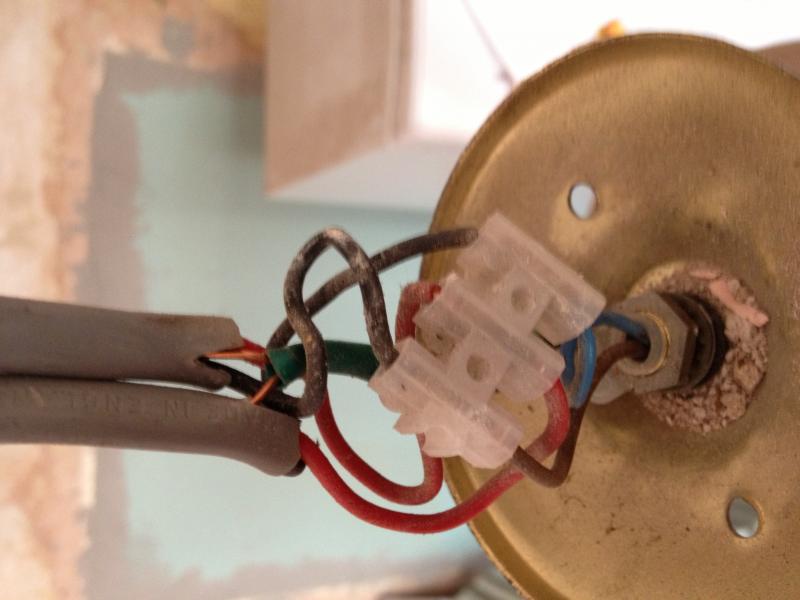
Having read this post several times now I am still confused about what you had and what you now have.
The photograph of the lamp unit wiring appears okay - Provided that the neutral and switch live blacks correspond to their respective sources. The assumption being that the bottom wire red/black is bringing the live and neutral to the light terminal block and the top red takes the live to the switch with the other black bringing the switch live back.
A photograph of the new switch wiring would help as well.
'Normal' switch wiring will not involve the neutral but just live and switch live (red and black) - that appears to be the way you have wired the new switch.
Turn the power off.
In order to verify that the top wire at the lamp unit is the live/switch live at the switch you need to firstly mark the top cable at the lamp black conductor with red tape to signify it is the switch live. Then connect the top cable red and black(red tape) together in a terminal strip. Then at the switch pick the cable you are assuming is the other end of this cable and test for low ohm resistance between the red and black conductors.
If you get a low resistance reading on your meter then you have identified the switch and lamp wires. If you don't then check the other switch cable.
Let us know what happens.
By the way you didn't find a small piece of conductor cable in the rear of the old switch did you?
The photograph of the lamp unit wiring appears okay - Provided that the neutral and switch live blacks correspond to their respective sources. The assumption being that the bottom wire red/black is bringing the live and neutral to the light terminal block and the top red takes the live to the switch with the other black bringing the switch live back.
A photograph of the new switch wiring would help as well.
'Normal' switch wiring will not involve the neutral but just live and switch live (red and black) - that appears to be the way you have wired the new switch.
Turn the power off.
In order to verify that the top wire at the lamp unit is the live/switch live at the switch you need to firstly mark the top cable at the lamp black conductor with red tape to signify it is the switch live. Then connect the top cable red and black(red tape) together in a terminal strip. Then at the switch pick the cable you are assuming is the other end of this cable and test for low ohm resistance between the red and black conductors.
If you get a low resistance reading on your meter then you have identified the switch and lamp wires. If you don't then check the other switch cable.
Let us know what happens.
By the way you didn't find a small piece of conductor cable in the rear of the old switch did you?
Hopefully this might help explain the old set up better:
As you can see, both cables are run down their own respective sides of the wall, relative to the light they control.
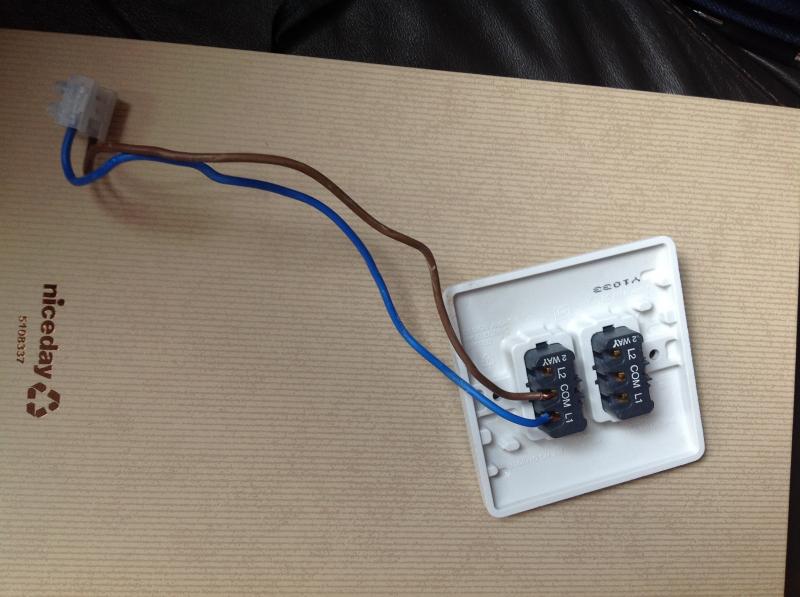
Both lights are controlled from a double switch on the left hand side of the drawing. The right hand side has a box recessed into the wall (hence the earth being connected there) but is covered by a blanking plate. Where you see the wiring change to harmonised colours (orange in the drawing is meant to be brown...), additional conductors have been added to extend the wiring through the wall. A photo of the back of the original double switch with the extended wires is below:
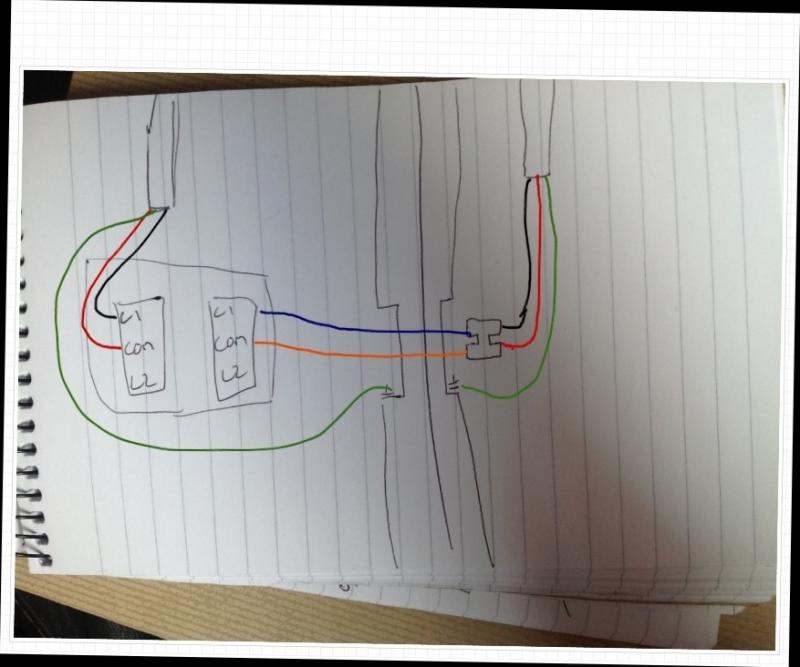
As you can see, both cables are run down their own respective sides of the wall, relative to the light they control.
Both lights are controlled from a double switch on the left hand side of the drawing. The right hand side has a box recessed into the wall (hence the earth being connected there) but is covered by a blanking plate. Where you see the wiring change to harmonised colours (orange in the drawing is meant to be brown...), additional conductors have been added to extend the wiring through the wall. A photo of the back of the original double switch with the extended wires is below:
So the question is....... is that a live and neutral coming down to the wall terminal block or is it live and switch live?
Only testing will tell - have you done it yet?
Also just make sure your terminals in the block next to the switch are not pinching the cable - they look quite tight especially the blue switch live?
Only testing will tell - have you done it yet?
Also just make sure your terminals in the block next to the switch are not pinching the cable - they look quite tight especially the blue switch live?
So the question is....... is that a live and neutral coming down to the wall terminal block or is it live and switch live?
Only testing will tell - have you done it yet?
On the right hand side of the wall? I've tested that and it's a live and a switched live
Then as I have added double check the terminals are not pinching the blue/brown insulators.
Out of interest what was you ohm reading?
Nothing seems to be pinched at the terminals by the light.
Resistance test will be done his evening a waiting for ante to drop my multimeter back round!
I have however just tested the terminals at the light fitting, and only the reds are showing as live....
How do you know this????So the question is....... is that a live and neutral coming down to the wall terminal block or is it live and switch live?
Only testing will tell - have you done it yet?
On the right hand side of the wall? I've tested that and it's a live and a switched live
How did you conduct the continuity test I suggested if your multi-meter is at your aunties and you don't currently have access to it?
How did you test that the red conductors at the light? - Please don't say with a test screwdriver!
It is difficult enough to try and work out what is wrong with your installation from afar without you giving us misleading information.
The 'pinching' of the terminal block terminals is the one connected to the switch by the way - not the one at the lamp.
How do you know this????So the question is....... is that a live and neutral coming down to the wall terminal block or is it live and switch live?
Only testing will tell - have you done it yet?
On the right hand side of the wall? I've tested that and it's a live and a switched live
How did you conduct the continuity test I suggested if your multi-meter is at your aunties and you don't currently have access to it?
How did you test that the red conductors at the light? - Please don't say with a test screwdriver!
It is difficult enough to try and work out what is wrong with your installation from afar without you giving us misleading information.
The 'pinching' of the terminal block terminals is the one connected to the switch by the way - not the one at the lamp.
Sorry if anyone thinks they've been misled - I've just done my best to explain what appears to be a confusing set up.
You're not going to like the answer but yes, I used a test screwdriver. This is how I know the black at the switch is only live if the switch is on.
To be clear though - there is no longer a block at the switch end, only the light end. The diagram including this was in response to questions about the old set up. The only blue/brown now is from the light fitting to the block.
We all know how easy it is to be misunderstood when trying to explain something, so maybe bits were misleading (your first diagram and the second are rather different), but it happens, don't worry. Moving on.
Testing the wires at either side of the switch will not tell you that the "dead" wire is a switched live - only that your switch works.
When you changed the "Faulty" switch" did you notice any damage to the wires? If a fixing screw had cut into the switched live then the short you describe would be explained and the non-working light is a separate problem.
Now you have the fitting down you can (when the meter is back) check the continuity switch to fitting. You need to check all links with the power off before going any further and draw up the scheme to show how it fits together.
Let us know how you get on.
Testing the wires at either side of the switch will not tell you that the "dead" wire is a switched live - only that your switch works.
When you changed the "Faulty" switch" did you notice any damage to the wires? If a fixing screw had cut into the switched live then the short you describe would be explained and the non-working light is a separate problem.
Now you have the fitting down you can (when the meter is back) check the continuity switch to fitting. You need to check all links with the power off before going any further and draw up the scheme to show how it fits together.
Let us know how you get on.

Using a neon screwdriver can be dangerous and give bogus results, you need to be using approved two pole equipment.
I have tried to follow the thread best I can:
So we have:
*Two single switches, swapped from an original two gang plate.
*Operating two separate lights.
*One switch and light works fine, but the other does not.
*The switch that does not work, blew and sparked upon switching, but this has now been replaced for new switch.
*The set up was working prior to changing of original two gang plate.
So we need to do some investigation.
*Inspect conductors for damage.
*Confirm continuity of CPC/earth and polarity.
*Confirm the that the switch is opening and closing the circuit.
*Identify the permanent live conductor.
*Confirm neutral connection.
I have tried to follow the thread best I can:
So we have:
*Two single switches, swapped from an original two gang plate.
*Operating two separate lights.
*One switch and light works fine, but the other does not.
*The switch that does not work, blew and sparked upon switching, but this has now been replaced for new switch.
*The set up was working prior to changing of original two gang plate.
So we need to do some investigation.
*Inspect conductors for damage.
*Confirm continuity of CPC/earth and polarity.
*Confirm the that the switch is opening and closing the circuit.
*Identify the permanent live conductor.
*Confirm neutral connection.

DIYnot Local
Staff member
If you need to find a tradesperson to get your job done, please try our local search below, or if you are doing it yourself you can find suppliers local to you.
Select the supplier or trade you require, enter your location to begin your search.
Please select a service and enter a location to continue...
Are you a trade or supplier? You can create your listing free at DIYnot Local
