
You are using an out of date browser. It may not display this or other websites correctly.
You should upgrade or use an alternative browser.
You should upgrade or use an alternative browser.
Radiator valve type
- Thread starter takacs
- Start date
-
- Tags
- radiator valve

Not sure what you mean when you say it doesn't have a valve? That looks like a Danfoss lockshield .... take the nut/cap off the top and you will find an allan key bolt inside. Weird it has the lockshield on the top, usually the TRV would be up there, if it's a TBOE.
 Yes, you are right. What I want to do it having a valve (?) that I can set by hand. Like this:
What valve is on the other side of the rad? You' want a Thermostatic Radiator Valve (TRV) as in your pic
- Joined
- 26 Oct 2023
- Messages
- 20
- Reaction score
- 8
- Country

One radiator in the system should not have a TRV fitted. It's usually the one in the hallway which is the coldest part of your house. It's also the place you fit your programmer stat. The stat controls the heat demand by reading the room temp. If you had a TRV fitted they would constantly fight each other.
For example, if your radiator shuts off at 20 degrees and your stat is calling for heat to 21 degrees, your heating will run constantly because you will never reach 21 degrees as your radiator will not excees 20 degrees.
For example, if your radiator shuts off at 20 degrees and your stat is calling for heat to 21 degrees, your heating will run constantly because you will never reach 21 degrees as your radiator will not excees 20 degrees.

- Joined
- 8 Oct 2023
- Messages
- 13
- Reaction score
- 0
- Country
Thank you for detailed idea. This is how the system used to be, I did not really like it though. To get a good temperature in the living room room, the hallway was constantly on and wasted energy for nothing because we were never there. Instead, the thermostat is in the living room now, and the room temperature is always great there. The temperature in the other rooms are either intentionally lower, or just track the living room.One radiator in the system should not have a TRV fitted. It's usually the one in the hallway which is the coldest part of your house. It's also the place you fit your programmer stat. The stat controls the heat demand by reading the room temp. If you had a TRV fitted they would constantly fight each other.
For example, if your radiator shuts off at 20 degrees and your stat is calling for heat to 21 degrees, your heating will run constantly because you will never reach 21 degrees as your radiator will not excees 20 degrees.
But occasionally, I want to switch on the hallway radiator, e.g. when the dryer rack is there. Therefore I want to have a valve there that I can easily open and close.
- Joined
- 8 Oct 2023
- Messages
- 13
- Reaction score
- 0
- Country
Thank you. What I am not sure is what kind of TRV I need. There are many types, and I have no clue which would fit to my valve, and whether I do it at all without changing the existing valve.What valve is on the other side of the rad? You' want a Thermostatic Radiator Valve (TRV) as in your pic
What valve is on the other side of the rad?
Ah, OK, whoever fitted that rad either had some spare danfoss lockshields or it may be there as a bypass. You say the thermostat was in that room/space? Was it fixed to the wall? That'll probably be why there are 2 non adjustable valves on that rad.
If you want a TRV on that rad then you need to change out the whole valve. This is the valve (Danfoss RAS-C2) that matches those lockshields
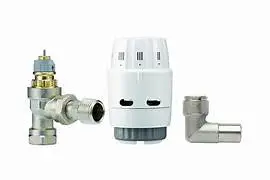
If you want a TRV on that rad then you need to change out the whole valve. This is the valve (Danfoss RAS-C2) that matches those lockshields
- Joined
- 8 Oct 2023
- Messages
- 13
- Reaction score
- 0
- Country
Thanks a lot, Madrab. You are correct, it was a fix stat in the hallway where this radiator is. This is exactly the type that my other radiators have. So, there is no option to replace it without closing the pipe system, and later refill it, right?Ah, OK, whoever fitted that rad either had some spare danfoss lockshields or it may be there as a bypass. You say the thermostat was in that room/space? Was it fixed to the wall? That'll probably be why there are 2 non adjustable valves on that rad.
If you want a TRV on that rad then you need to change out the whole valve. This is the valve (Danfoss RAS-C2) that matches those lockshields
View attachment 320577
Yes, you would need to depressurise the CH along with that rad and then replace the valve. You are in luck though as it's a top entry, you wouldn't need to drain either the rad or the system, just depressurise. You can re-use use the bottom nut and 10mm push fit reducer as they would fit the new valve if it's the one in the pic I sentno option to replace it without closing the pipe system

- Joined
- 27 Jan 2008
- Messages
- 29,346
- Reaction score
- 3,608
- Location
- Llanfair Caereinion, Nr Welshpool
- Country
Not quite correct, a TRV has a range, depending on the head a mechanical head around 6ºC and an electronic head around 2ºC the wall thermostat also has a range between on and off, between 0.5ºC and 1ºC, so if radiator starts to close at 19ºC and the wall thermostat set to 20ºC then on a cold day the wall thermostat will never turn off and the radiator will vary in temperature to maintain the room temperature, and the boiler will modulate to match, keeping the rooms spot on temperature without any hysteresis, but on warmer days the room will get slightly warmer so then the wall thermostat will turn boiler off.One radiator in the system should not have a TRV fitted. It's usually the one in the hallway which is the coldest part of your house. It's also the place you fit your programmer stat. The stat controls the heat demand by reading the room temp. If you had a TRV fitted they would constantly fight each other.
For example, if your radiator shuts off at 20 degrees and your stat is calling for heat to 21 degrees, your heating will run constantly because you will never reach 21 degrees as your radiator will not excees 20 degrees.
Well that is the theroy, in practice the wall thermostat is often poorly placed, it should be on the wall opposite to the radiator so the thermals cause a flow of air,
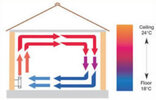 so there will naturally be a difference between the two thermostats, the TRV is at bottom of radiator so it samples the returning air, so will be cooler than the wall thermostat which is also often a lot higher up on the wall. Add to this often the wall thermostat is in the hall, and not placed so the thermals will naturally cause air to flow past it, even worse some times there is a stair case which means the hot air never reaches the wall thermostat it over heats upstairs first.
So at the moment my central heating is not running, it is timed to run at a lower temperature over night, so sitting at 18ºC
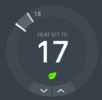 the radiator TRV is
 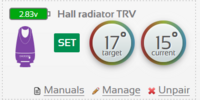 sitting at 15ºC a whole 3ºC lower in the same room, as one lower down, and two nearer to the front door. This differential will vary home to home, and also summer and winter, in the summer with no central heating running the two show the same temperature. So it is a balancing act to get the two thermostats to work together rather than fighting each other, which one requires some temperature read out as shown to be able to set, having a TRV with *123456 is about as much good as a chocolate fire guard, however once set then the electronic head can be swapped back to a mechanical as the wall thermostat now set and lock shield now set so can set the TRV with trial and error, but to start with it needs the read out in ºC.
My house has three makes of electronic head, the cheap (£15 each in 2019) eQ-3 do not show current, only target, but the wifi connected ones
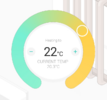 in both cases show the target and current temperature. However rather than carefully setting the TRV's and wall thermostat to work together by carefully setting the temperatures, it is far easier to get TRV heads which link to the wall thermostat/hub. This
 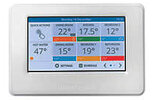 has to be far easier than trying to match the TRV and wall thermostat by adjusting temperatures and lock shield valve settings. However it costs more. There are a few makes, Honeywell Evohome, Drayton Wiser, and Hive to name a few, but the silly one I have Nest Gen 3 does not with the UK version have any linked TRV heads, and I am a cheap skate and will not pay out for yet another wall thermostat.
DIYnot Local
Staff member
If you need to find a tradesperson to get your job done, please try our local search below, or if you are doing it yourself you can find suppliers local to you.
Select the supplier or trade you require, enter your location to begin your search.
Please select a service and enter a location to continue...
Are you a trade or supplier? You can create your listing free at DIYnot Local
Similar threads
- Replies
- 3
- Views
- 1K

- Replies
- 5
- Views
- 1K

- Replies
- 0
- Views
- 920