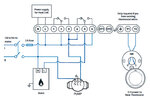
• Looking for a smarter way to manage your heating this winter? We’ve been testing the new Aqara Radiator Thermostat W600 to see how quiet, accurate and easy it is to use around the home. Click here read our review.

Replacing a Danfoss/Randall 3020 mechanical timer with a Tado Wireless Smart Thermostat Starter Kit V3+

Joined
26 Aug 2024
Messages
7
Reaction score
0
Country
United Kingdom
There are a few threads on this kind of swap out but not around my specific circumstance of a gravity fed boiler with no tied thermostat. I have the old style gravity fed hot water system with pumped central heating off a 2023 fitted non condensing Mistral oil boiler.

I want to change out the really old Randall mechanical timer (hot water and central heating switchable) to something I can monitor and set with ease. There is no thermostat wired to the current system, I do currently have it controlled from a remote thermostat that operates the boiler using through wireless switched plug to power on and off the system. Installing a Tado starter kit would enable me to remove the old Randall timer and wireless mains thermostat activated plug.

My question is regarding the wiring. Going from the Randall configuration:

Randall.jpg


To the Tado

tado.jpg


The L + N are pretty obvious but where would the HTG and DHW wires relocate to?

I haven't had the cover off the Randall yet but I expect there will likely be more than 4 wires in there; such as feeding 230V to the CH pump etc. These would be L N or earthing leads that I would assume just get doubled or tripled up on the L + N supply connectors on the Tado. Is that correct.

The Tado installation manual has wiring info for everything bar a gravity fed system. Though it does say conveniently to select the blue LED setting.
 
Last edited:
My question is regarding the wiring. Going from the Randall configuration:
If you look at the circuit diagram for the Randall, you can see that the timer, or on switch, turns on the hot water directly.
After that, there is a separate switch for the C/H.
This is a very simple way of making sure the heating only operates, if the hot water is already on.
The L + N are pretty obvious but where would the HTG and DHW wires relocate to?
A clever way to wire up the Tado, is like this example with a Nest...

1724707486603.png

Where ignoring the Nest thermostat connections,
Randall L would connect to L on Tado
N to N
HTG to CH NO
HW to HW COM
A small link wire added between L and CH COM and CH COM and HW NO
And a small link wire added between CH NO and HW NC

This layout has the benefit of switching on the hot water automatically (i.e. boiler), when only the heating is called for.

The Tado installation manual has wiring info for everything bar a gravity fed system. Though it does say conveniently to select the blue LED setting
I'll have to look into the "blue LED setting", it could be that the above layout is irrelevant, depending on the settings behaviour.

If you could post a picture of the Randall wiring, when you take the cover off, we may be able to confirm some things.
 
Last edited:
Thanks for the input.

The Tado manual says the blue LED activates both relays (for CH and HW) whereas the yellow setting omits the HW relay.

tado2.jpg


Leaves me wondering what the difference is between the Green and Blue configurations, presumably this has to be the wiring configuration for the pump?

Then you have to wonder why Tado don't offer up a wiring diagram for gravity fed systems. I can only presume it is internal pumping versus external pumping CH feed? Leaving a need somehow to get power to the external CH pump in a gravity system when CH mode is active. How the external CH pump is presently switched should become clearer when I take the cover off the Randall timer, hopefully.
 
Last edited:
Leaves me wondering what the difference is between the Green and Blue configurations,
The Blue LED mode mentions dual relay switching - i.e. it will (presumably) automatically switch on HW NO, if only central heating is called.
This would mean Randall HTG would connect to Tado CH NO
And DHW connects to HW NO
There would need to be links added between L, CH COM and HW COM.

I believe the Randall switch contact rating is 3(1)A @ 230V - this is the same as the Tado, but it may be worth double checking your pumps current rating.
 
I've found a suggested gravity wiring recommendation on the Tado community forum that looks OK to my untrained eye.

Randall HTG to CH NO
Randall DHW to HW NO
Bridge Live to CH COM
Bridge CH Com to HW COM

Combine all neutrals on N
Mains feed to L
Pump live to CH NO
Combine all earth on Earth

tado3.jpg


I will need three cables running to the Tado. Plugged mains feed (L, N and earth), Pump cable (L, N and possibly earth) and Boiler cable (HW, CH, then I'll need to figure out the boiler neutral from the current Randall wiring setup). I've checked and there are 3 cables running into or out of the Randall.

So, I should end up with:
3 leads in the N
1 mains lead in the live and one bridge
2 bridge in the CH COM
The boiler CH and Pump live in the CH NO
1 Bridge in the HW COM
The boiler HW in the HW NO
2 or 3 earths in the Earth

Does anyone see a problem with this wiring setup?
 
Last edited:
I believe the Randall switch contact rating is 3(1)A @ 230V - this is the same as the Tado, but it may be worth double checking your pumps current rating.

I had a look at the pump, it's a Grundfos UPS 15-60 130 with an amperage spec of 0.22A to 0.30A depending on speed setting.

 
As @RandomGrinch has pointed out Nest Gen 3 the output is on the Com C-Plan_basic_Nest.jpg but with Hive you can't connect to Com, so they use an internal configuration or software fix where one contact does boiler and the other does the pump, both work equally as well as each other.

I have found the winter use there is not real reason to program in domestic hot water (DHW) as you can't stop it heating up. So only in summer do you want the option for only running boiler without the pump.

I only use DHW to wash hands and the odd dish, and found running ½ hour 4 times a week gave me enough hot water, oil is cheaper than electric so it seemed the way to go.

However when we had solar panels fitted, we also got an iboost+ fitted so DHW heated from excess solar, and I have noted a huge reduction in summer oil use, on consideration I realise the 22 mm pipe work boiler to hot water tank is a huge uninsulated surface area, so each time the boiler runs it heats all the pipe work and the boiler, and also far more of the tank than with an immersion heater. So losses are far higher with oil than electric, in winter the heat goes into house anyway so no real loss, in summer it is simply lost.

So I have reconsidered the idea of heating the DHW with an immersion heater, I think my iboost+ was a waste of money, as pay in for exported energy is more than the cost of off peak energy, so I would have been in hind sight been better off with a simple timer, but the idea of heating DHW in summer with oil, is also flawed if you have an off peak supply.

I can only quote British Gas prices for electric, standing charge 62.21p per day single tariff, with 29.57p per kWh used. With the EV tariff and with BG you do not need an EV to get the tariff the standing charge drops to 59.14p and the peak 31.31p per kWh and off peak (5 hours) at 8.95p per kWh. Our dish washer, tumble drier (heat pump) and washing machine all have a delay start option, so can run over night. I can also run during the day when loads of sun shine, but this requires my solar panels and battery to work. So only looking at cost electric v oil and clearly to have off peak you need to use it for more than DHW.

I use peak power in the evening as shown here 1724756472555.png but most of my electric is used 1 am to 5 am at cheap rate.

So is it really worth heating the hot water tank in summer using oil? It is a lot of messing around, working out when to run the boiler, if the hot water tank had a thermostat then may be worth using oil, but without, is it worth it? I have pressed the button on the iboost+ and it says saved today 0.24 kWh, this equates to the power used to maintain the DHW temperature, by end of day may be 0.5 kWh so at 8.95p per kWh looking at 5p a day to heat DHW with off peak power, if no off peak then 15p per day.

Of course I don't know how much DHW you use, but is it worth heating DHW with oil in the summer? Problem is I can't measure oil used like I can electric, so can't say how much a day to heat with oil, but checked oil level last week and over the half way bracing bar in oil tank, by around 2" and previous years around 2" below the bracing bar.

So interested in what you think, is it worth heating DHW with oil in the summer, I assume oil as very few gas boilers are still on C Plan.
 
I installed solar this Summer so we now heat the water using the 3kw immersion except on thick cloud low solar days when the oil boiler uses only 300w. I worked out that by heating the water with solar I will save around £400 a year in lower heating oil consumption with the boiler running less or not at all during the warmer months when no CH is required.
 
The Tado pack arrived today so I have taken the casing off the Randall unit. Not entirely what I was expecting. All of the three cables are three core.

Position 1 - Empty
Position 2 - Pump live feed (HTG position)
Position 3 - Empty
Position 4 - Boiler live feed (DHW position)
Position 5 - Empty
Position 6 - Mains live feed
Position 7 - Neutral, 3 wires
Position 8 - Earth , 3 wires

This wiring configuration on the Randall does work with the ability to run water heating only or central heating which heats the water at the same time.

randall1.jpg
 
Last edited:
Wired up as per last post with two common bridges to live and the HW plus CH wires labelled up and fitted to their respective NO terminals; and it is functioning. The only thing I have noted is that the boiler cycles on and off more often than it did with the Randall controller. The cycling occurred even with cold water in the tank and a request to heat the radiators. Still, it is heating the water and it is heating the radiators separately.

tado4.jpg


The initial water heater ON from the phone app.

tado5.jpg


The subsequent request to also heat the radiators from the phone app.

Thanks to all for their input, it was a quick fit only made a little difficult with the access to the mounting board, peeking, fixing wires and tightening screws around a corner.
 
Last edited:

If you need to find a tradesperson to get your job done, please try our local search below, or if you are doing it yourself you can find suppliers local to you.

Select the supplier or trade you require, enter your location to begin your search.


Are you a trade or supplier? You can create your listing free at DIYnot Local

 
Back
Top