Vaillant boiler with tado

Joined
26 Jan 2021
Messages
60
Reaction score
2
Country
United Kingdom
Hi.

I’ve just had a vaillant ecofit pure 830 installed.

I was going to have a tado added but have learned that the tado cannot communicate via the ebus format that vaillant uses so the tado would only be an on/off switch effectively and would not have the modulation control (apparently)

Is this a big deal? Will the in/off be “good enough” for someone who does not know much about boilers? Or should I go with vaillant s own controls if they are superior?

Thanks in advance.
 
It's your choice at the end of the day!
The boiler will still modulate when connected to an on/off stat, but it will be controlled at the boilers discretion, rather than the stats; losing some efficiency in the process.

You might eek out a few more percent of efficiency by using the vaillant controls on the eBus to control the modulation, but if you prefer the Tado, there's no harm in trying it out; it will cost less than the proprietary Vaillant controls.

If you have any interest in home automation, there are even some open source projects that can communicate on the eBus, for little cost.
 
Thanks.

That is reassuring. I was a bit miffed when I found out so good to know.

Out of interest, do you have any links you could point me to for the open source stuff you mention?

Thanks again.
 
Is this a big deal? Will the in/off be “good enough” for someone who does not know much about boilers? Or should I go with vaillant s own controls if they are superior?

I would call it a big issue for cost, and comfort. It will still modulate, but nowhere near as efficiently, or effectively, as it would with the Vaillant controls. What it will do, is run the boiler flat out, until the boiler itself, decides from the flow temperature, that it needs to modulate. It will overshoot the set temperature on the room stat, then shut down. Rather like when driving, tearing up to red lights, then banging the brakes on, then tearing off to the next set of lights.

That compares to the Vaillant system, where it knows your desired room temperature, knows exactly how much heat the house needs as input, to get to the temperature, then hit it exactly, modulating from the start. Whilst maintaining the temperature, it can do so, very gently, so no rapid changes of temperature, of your radiators and pipes, no expansion and contraction noises.
 
Out of interest, do you have any links you could point me to for the open source stuff you mention?
eBusd is popular..

And this is the hardware adapter, for an RPi..

Occasionally the topic comes up in the forum, example...
 
I would call it a big issue for cost, and comfort. It will still modulate, but nowhere near as efficiently, or effectively, as it would with the Vaillant controls
I may be wrong, but I think that is slightly overstated.
There has been research suggesting that good modulating thermostats could improve heating efficiency by up to 15% - though typically 12% - really good.
However, a very good smart stat with proportional on/off load compensation, can improve efficiency by up to 10%.
This can be achieved by local weather compensation, or in the case of the Tado, Nest etc. by internet based forecasting (not as good as local sensor readings, but still adds to efficiency gains).

The difference in efficiency may not be as great as you think?
 

Attachments

However, a very good smart stat with proportional on/off load compensation, can improve efficiency by up to 10%.

All the tado can do, is tell the boiler heat, or no heat required, on or off - it will lack the essential 'how much heat'. The Vaillant control, sends the demand, stating indicating precisely 'how much heat' is required. Thus with that system, the Vaillant boiler can modulate throughout, matching supply of heat, precisely to the demand.

The result, is longer, slower burns, less wear and tear, and fuel savings.

I had my Vaillant boiler installed, with a basic on/off control, before upgrading to the Vaillant intelligent controls. The difference was night v day..
 
Last edited:
I had my Vaillant boiler installed, with a basic on/off control, before upgrading to the Vaillant intelligent controls. The difference was night v day..
Yes, it might have been "night v day" between a "basic on/off control" and modulating controls.
But we're not talking about a basic on/off control - were talking about a smart stat with proportional on/off load compensation, using algorithms that estimate the correct amount of heat required for the house to reach temperature, depending on internet and userbase weather forecasting.

The research points to it making a bit of a difference...
 
But we're not talking about a basic on/off control - were talking about a smart stat with proportional on/off load compensation,

So, you're saying it's on/off. That's all it can do, don't you see the major difference, between on/off, and a system which can request say a 10% level of burn from the boiler?
 
So, you're saying it's on/off. That's all it can do, don't you see the major difference, between on/off, and a system which can request say a 10% level of burn from the boiler?

I'm saying read the research....

Screenshot_20241010-214122_Adobe Acrobat.jpg
 
The Valiant doesnt support OpenTherm protocol?... which would allow modulation etc, a d is the protocol Nest, Tado, Hive etc all support.
 
The Valiant doesnt support OpenTherm protocol?... which would allow modulation etc, a d is the protocol Nest, Tado, Hive etc all support.
Vaillant boilers in the UK communicate with eBus - this is incompatible with OpenTherm.
Some Tado thermostats support eBus, but results seem to vary.
Vaillant do offer an OpenTherm to eBus adapter on the continent - the VR33, but this is unsupported and expensive to get over here.
 
I would say most boilers are not controlled in a way to get the maximum latent heat available from the flue gases, the whole idea is the boiler monitors the return water temperature and modulates (turns down) the output, so the return is cool enough to extract the latent heat from the flue gases.

So we do not want to turn the boiler off/on too often, as each time we do, the boiler has to start from scratch working out how much to modulate. So using the TRV's to control the flow in each radiator there seems to be no need to have a wall thermostat, however the problem would be, once all TRV's are satisfied there is nothing to turn boiler completely off. So the on/off wall thermostat is placed in a room kept cool, so if the day is likely to be warm, it will not turn on, and of course in a lower room, as heat raises, and in a room with no doors, or alternative heating, including sun through the windows.

In the main a room like that does not exist, so a compromise is required, be this a thermostat in a few rooms, or linked TRV heads, there are many ways to ensure the boiler does not turn off to often, so its build in system can extract the latent heat. Mine is not a condensating boiler so I do not need to worry, my boiler does not modulate.

However I have still installed a hub which can connect to many thermostats, so the boiler will run when any room so connected is too cool. My Wiser hub can connect to wall thermostats or TRV heads, I have just selected key rooms to be able to turn on boiler, but for me, boiler cycling is not a problem.

So you have to decide how to turn off your boiler in warm weather, cold weather you can control with just the TRV heads, warm weather is when you get the problem.

So using TRV heads to control the boiler output, or using a ebus control, I am sure the ebus control is slightly better, but as to if enough better to be worth using ebus rather than TRV heads, not so sure. Clearly using an on/off thermostat to control room temp compared with ebus the ebus wins hands down, but the on/off thermostat is only to turn off boiler in warm weather, the TRV heads control the boiler output.

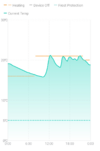
My house the TRV does not really do such a good job, as boiler will not modulate, so I see a hysteresis as boiler turns on/off, as seen here 1734445456563.png with your modulating boiler it should be a flat line, if set up correctly. Display shown is from a Kasa TRV head.

 

If you need to find a tradesperson to get your job done, please try our local search below, or if you are doing it yourself you can find suppliers local to you.

Select the supplier or trade you require, enter your location to begin your search.


Are you a trade or supplier? You can create your listing free at DIYnot Local

 
Back
Top