• Looking for a smarter way to manage your heating this winter? We’ve been testing the new Aqara Radiator Thermostat W600 to see how quiet, accurate and easy it is to use around the home. Click here read our review.

Fuse board - EICR assessment

Joined
15 Mar 2023
Messages
10
Reaction score
0
Country
United Kingdom
Hi All,
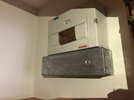
I attached pictures of the fuse board from our 2 bedroom flat.
How would an EICR assess this? What category would be assigned to it?
The fuse board is working well, we have not had any issues with it.
Thanks!
 

Attachments

  • IMG_8306.jpeg
    IMG_8306.jpeg
    154.3 KB · Views: 121
  • IMG_1349.jpeg
    IMG_1349.jpeg
    190.3 KB · Views: 114
The EICR will test the wiring too.

Whether the fuseboard will pass the EICR or not, the entire installation, including wires and accessories will be tested, some may show a bad result and some may be okay.

Not testing the wiring before changing the consumer unit can end up in problems.


How would an EICR assess this? What category would be assigned to it?
No one can be sure without testing it physically but as above, have a look at the link Pete has sent.
 
It's not ideal to have every circuit protected by One RCD if this is the case here, the board looks plastic but when it was installed probably completely compliant. Looks like the installers have taken good care from the labelling etc...
 
According to the "best practice guide 4"

Plastic cased CU -C3 if it's under a wooden staircase or on an exit route. no code otherwise
Circuits without RCD protection - C2 or C3 Depending on what exactly the circuits are for. The lack of labelling makes this hard to judge, but I think you have most if not all your sockets on the RCD and so will probablly come down on the C3 side.
Absense of circuit identification labelling - C3

This of course only covers what can be seen in the picture. Also there is nothing compelling electricans to follow said best practice guide.
 
According to the "best practice guide 4"

Plastic cased CU -C3 if it's under a wooden staircase or on an exit route. no code otherwise
Circuits without RCD protection - C2 or C3 Depending on what exactly the circuits are for. The lack of labelling makes this hard to judge, but I think you have most if not all your sockets on the RCD and so will probablly come down on the C3 side.
Absense of circuit identification labelling - C3

This of course only covers what can be seen in the picture. Also there is nothing compelling electricans to follow said best practice guide.

The labelling is on the open flap

Apart from that a sensible summary in the absence of more information
 
It is a personal option, the 1, 2, 3, 4, was replaced with C1, C2, C3, FI, LIM etc, because the old system it was said was misleading, the code 4 was does not comply with current addition as a new installation, and it was said that was unhelpful, as nearly every edition says from what date designs must follow that edition, so if designed before that date, then it complies. The current edition says so.

There are of course exceptions, where the intent is clarified. So for example we read "Every installation shall be divided into circuits, as necessary, to:
(iv) reduce the possibility of unwanted tripping of RCDs due to excessive protective conductor currents produced by equipment in normal operation" and many considered it was OK to have a load of MCB's fed from one RCD, it has been made clear now, it is not as simple as that.

However, the code C2 is "potentially dangerous" and the RCD tripping does not really cause a danger, so although a single RCD may not comply with the current edition, it does not cause a potential danger, so not code C2.

As to no RCD, I note after my solar panels were fitted, the central heating is not RCD protected, and this was just over a year ago. Clearly the scheme member electricians, who did the work, considered it was not required. With a rental agreement which prohibits any pins or nails being put in the wall, there can be no risk to tenants with buried cables not RCD protected. However, the electrician can't be sure it will remain as a rental property with that agreement, so some debate on buried cables.

However, there was a court case where an old lady inherited a home, and decided to rent it out, a fault was reported, and she immediately engaged an electrician to look at it, but he did not go straight away, and in that time the tenant brought a faulty oil filled radiators into the home, and the safety equipment in the home was not as it should be, so the combination of faults caused a death, it seems the landlady should have said sorry you can't move in yet, until the fault is corrected, the fact the tenant was aware there was a fault, it seems was not taken into account, and the fact that the tenants oil filled radiator was in part to blame also seems to have been overlooked, courts seem to want to blame the landlord, and they did with a huge fine.

So as a landlord you need to watch your back, and it is clearly prudent to have all circuits RCD protected, even if there is a way to show not required, and also if there is a fault, the tenant is not rewarded for doing without electric for the weekend, they will expect an emergency electrician to be called, if they have no lights or can't cook, they may accept a small fault say immersion heater not working until Monday, but not half the house being out, as owner-occupier we may muddle through, but not a tenant, so in the long run, all RCBO consumer units likely pay for themselves, in less call-outs, and call out during normal hours.

The EICR is more a watch my back thing, so you can stand up in court and say I had it all tested, and thought all was OK.

 
.... the code 4 was does not comply with current addition as a new installation, and it was said that was unhelpful, as nearly every edition says from what date designs must follow that edition, so if designed before that date, then it complies. The current edition says so.
Not really. It says that things which were compliant with earlier editions (but not the current one) are "not necessarily unsafe" - but that's very different from 'compliant' (with anything).

In any event, in the context of this thread, as I understand it EICRs are conducted on the basis of the edition of BS7671 current at the time of the inspection - so things which were compliant with earlier editions, but not the current one, might (or might not, at the discretion of the inspector) be 'coded'.
 
But code C2 does not mean does not comply, so as you say, up to the whim of the inspector.
True - but my point was that (seemingly contrary to what you were saying/implying) if something in non-compliant with the edition which is current at the time of the inspection, the inspector may (athis/her discretion) code it as C2 (or any other code) if he/she feels it warrants that code, even if it were fully compliant with some earlier edition of BS7671.
 

If you need to find a tradesperson to get your job done, please try our local search below, or if you are doing it yourself you can find suppliers local to you.

Select the supplier or trade you require, enter your location to begin your search.


Are you a trade or supplier? You can create your listing free at DIYnot Local

 
Back
Top