Low voltage cables through flexible plastic pipe/hose?

Joined
16 Jul 2006
Messages
144
Reaction score
6
Location
Norfolk
Country
United Kingdom
Hi all, have a new puppy that’s chewing everything.

I have a ton of audio gear that is powered from a UPS. All the cables my pup can get to, use those power supplies built into the plug, and the actual plug isn’t accessible to my puppy.

I’ve tried spraying those puppy deterrent sprays, he seems to like them.

Obviously 99.9% of the time I can stop him and tell him off, but to give a little extra protection to these wires, I wondered about getting say 8mm plastic tube, cutting a slit along the length and putting these cables in it. Or even using a bit of garden hose which gives a lot more space.

Only a temporary measure while pups teething.

Is this safe to do, not using for mains, only cables coming from power supplies. My obvious concern is for heat build up, but as these are only low ampage, I’m hoping it’s ok?

Also, out of interest please, if my PC and Monitor is plugged into a Cyber Power UPS, does that stop me having the houses RCD protection if I got a shock from either of them?

Many many thanks
 
Is this safe to do, not using for mains, only cables coming from power supplies. My obvious concern is for heat build up, but as these are only low ampage, I’m hoping it’s ok?
Almost certainly yes. What is the highest-power device you are contemplating using?


Also, out of interest please, if my PC and Monitor is plugged into a Cyber Power UPS, does that stop me having the houses RCD protection if I got a shock from either of them?

Yes, the UPS will see the RCD trip as a power failure and “uninterrupt” it. However the output of the UPS may be isolated, i.e. neutral and earth are not linked, so touching its live output is not dangerous. Others probably know more…
 
I have a ton of audio gear that is powered from a UPS.
Why a UPS, I wonder?
Obviously 99.9% of the time I can stop him and tell him off, but to give a little extra protection to these wires, I wondered about getting say 8mm plastic tube, cutting a slit along the length and putting these cables in it. Or even using a bit of garden hose which gives a lot more space. ... Only a temporary measure while pups teething. ... Is this safe to do, not using for mains, only cables coming from power supplies. My obvious concern is for heat build up, but as these are only low ampage, I’m hoping it’s ok?
It's very unlikley that there would be any problem.
Also, out of interest please, if my PC and Monitor is plugged into a Cyber Power UPS, does that stop me having the houses RCD protection if I got a shock from either of them?
Yes, it probably would (stop the output of the UPS benefitting from the house's RCD protection)

Kind Regards, John
 
Yes, the UPS will see the RCD trip as a power failure and “uninterrupt” it.
Indeed, but I don't think that's what the OP was asking about.
However the output of the UPS may be isolated, i.e. neutral and earth are not linked, so touching its live output is not dangerous. Others probably know more…
As I just wrote, and even if the neutral output of the UPS were connected to earth, an L-E fault on the output of the UPS would probably not trip the house's RCD, since that RCD will only detect imbalances between L & N currents on the input side of the UPS (which, as you say, will usually be 'isolated' from the output).
 
Also, out of interest please, if my PC and Monitor is plugged into a Cyber Power UPS, does that stop me having the houses RCD protection if I got a shock from either of them?
With my UPS, I use RCD sockets, with a grid power failure the UPS inverter auto connect neutral and earth. It feeds my central heating and 4 socket outlets. 5 kW output, from a 6.4 kWh battery, plus the solar panels. The inverter is supplied before the consumer unit, so RCBOs in the consumer unit are unaffected by what my UPS does. With a smaller unit with only one outlet like the shaver socket it may be isolated from the supply, larger unit
1743682806297.png
should have RCD protection built in, clearly not designed to have RCD sockets, as the socket is part of the UPS. I looked at the user manual, and some items do raise questions.
CAUTION! The UPS must be connected to a grounded AC power outlet with fuse or circuit breaker protection. DO NOT plug the UPS into an outlet that is not grounded. If you need to de-energize this equipment, turn off and unplug the UPS.
So that means the supply needs to be TT, or have a local earth rod, using a supply where the supplier gives you the earth is no good, as should a cable be hit causing you to lose the supply, you would also lose the earth connection. Mine had an earth rod outside, so still have an earth if the supply is lost, and the UPS auto connects the earth to the neutral if supply is lost. Maybe I have the wrong manual I hope so, as that manual is rather misleading.

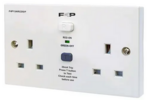
One needs to read carefully to see the output is a simulated sine wave, and no reference to any RCD protection. I looked at an RCD adaptor
1743684272568.png
and it does not give type, or any BS numbers. Hunting for data sheet I find is to BS 7071 1992 but looking to see if that is type A or AC could not find any reference and seems likely these adaptors are not suitable for a simulated sine wave output. Since in 1992 we were not really aware of the problems with DC with an RCD it seems unlikely the RCD adaptor shown is suitable.

As to other makes, I was getting fed up with trying to find the details. I did find a type A socket 1743685212538.pngand it may be better as "Mechanical Latch - No resetting required after a power loss" but the picture fails to show the type A logo
1743685456015.png
and I would want any one doing an EICR to know it was suitable without looking up the part number. I know my inverter states type AC can be used, and I have type A sockets, but nothing on the socket to say so.

So the big question, are you going to do anything about it? If at work, I would get type A RCDs fitted, at home, likely I would ignore it. As to the earth rod, if doing an EICR I would think one could code it as code C2, lets see what others now say?
My obvious concern is for heat build up, but as these are only low ampage, I’m hoping it’s ok?
Using extra low voltage means higher amps, but unlikely to be high enough to worry about. I use spiral wrap, not to stop the cats, but more to keep cables tidy.
1743682553375.png
 
Many thanks all

Highest device is a MacBook Pro M1 whose power adapter is a 140w with output of 20.5 volts and 5 amps

The only reason I got a UPS is that we (neighbours too) used to get a lot of power fluctuations and I didn't want it to damage any of my stuff, also wanted to be able to do a quick save if there was a power cut

Mines this one

 
Highest device is a MacBook Pro M1 whose power adapter is a 140w with output of 20.5 volts and 5 amps

The heat produced depends on the current and the thickness of the wires. Compare with the mains cord for a 1 kW electric heater, which is comparable to your 5 A; I bet it has a much chunkier cable, and we’d still not put it under a rug.

I think you’ll probably be OK, but that’s mostly because I doubt your MacBook gets close to that 5 A current often or for long periods.


Interestingly that says nothing about either RCD protection on the output or whether the output is isolated.

Others know more about this than I do. I only know the theory, not what the devices you can actually buy do in practice!

Thanks for the photos!
 
Interestingly that says nothing about either RCD protection on the output or whether the output is isolated. ... Others know more about this than I do. I only know the theory, not what the devices you can actually buy do in practice!
As I see it (and I've been known to be wrong :-) ) .....

If it's the (I think 'usual', but am not certain) type of UPS which takes the incoming mains down to ELV DC (floating across a battery, commonly 12V in small UPSs) and thence, via an inverter, back up to mains voltage to produce the output, then the input and output will inevitable be 'isolated' from one another.

As I said above, in that situation an RCD upstream of the UPS (e.g. 'the house RCD') will not react to a fault or L-E leak (even one through a person) on the output side of the UPS. IF one side of the output is connected to earth )and/or just to CPCs, hence exposed-c-ps of connected equipment), then the only way to get RCD protection on the output of the UPOS would be to have an RCD on that output (internal or external to the UPS).

On the other hand, if neither side of the output of the UPS is connected to earth (or CPCs etc.), then there would be no way of getting useful RCD protection of the output, even if an RCD were fitted. Howwver, if the output were truly 'floating', and could be guaranteed to stay that way (neither side connected to earth or CPCs, then there probably wouldn't be a true need for RCD protection.

If I've got some of this wrong, I'm sure someone will put me right :-)
 
Mines this one
Thank you, read the instructions it still says
1743718168039.png
I feel this is sneaky, it does not make it plain that an earth rod is required, and the diagram for my own UPS
1743718600290.png
also does not show an earth rod. It says on mine
1743718715099.png
Mine is one of three models, and it does say
1743719022856.png
So there is a built-in RCD, but it does not state it is to the required British standard so RCD sockets are used as well. Mine has to be to a set standard to get the G99 or G98 certificate. So the installers (not me) had to follow the rules. Since you are installing yours, it is up to you. Both as to fitting of RCD and earth rod.

I know with grid power, mine works, I got a new loop impedance and RCD tester, and testing a normal socket means walking down steps at side of house to reset, so I did this test RCD tester ramp.jpg on the UPS sockets, as I can reset at the socket. I was hoping @flameport would have answered this thread, he knows far more than me.
 
Just checking - do you know that this product exists pre cut: ..... And other versions here:
I've used some like those, and they've all been made out of pretty soft/thin plastic - so I'm not sure to what extent they would be 'puppy-proof'!
 
I have had to repair my bosses stand lamps a few times due to new puppy incidents. :)

I used to use hot sauce, the hotter the better, a dash of that spread where puppers likes to nibble and they start, shake their head then head for the water bowl :)
 
Interestingly that says nothing about either RCD protection on the output or whether the output is isolated.
Line interactive type, so the output is not isolated from the input. A fault which would trip an RCD will still do so if it occurs on the output of the UPS.

However that will then result in the UPS providing power from the battery, so there will not be any disconnection of the output if an RCD/RCBO on the supply trips - which is entirely the point of the UPS.
In that mode, the output would be isolated from any incoming supply, so the risk of shock from a defective device on the output is minimal, provided that it's used for it's intended purpose which is to supply one or a small number of devices located in the same place.
 

If you need to find a tradesperson to get your job done, please try our local search below, or if you are doing it yourself you can find suppliers local to you.

Select the supplier or trade you require, enter your location to begin your search.


Are you a trade or supplier? You can create your listing free at DIYnot Local

 
Back
Top