
• Looking for a smarter way to manage your heating this winter? We’ve been testing the new Aqara Radiator Thermostat W600 to see how quiet, accurate and easy it is to use around the home. Click here read our review.

What sort of earthing do I have?

Joined
5 Jun 2024
Messages
5
Reaction score
0
Country
United Kingdom
Hello good people - one for the knowledgable sparks here....

I have bought a house which has a small warehouse unit on the land, which has its own 100Amp 3 Phase supply. I have concerns over the installation so I've asked 3 electricians now to come and take a look, and I am getting conflicting advice.

My initial concnern was that I could not see an earth connection on the distribution board in the warehouse unit, and I could see an earth cable coming off the grid supply in the meter cabinet, but it is NOT connected to anything, and by the looks of it, never was.

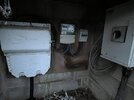
The service comes into a meter cabinet in a field, (see picture). There is an isolator switch (not fused) which connects to a 4-core armoured cable which runs about 80m to the warehouse where it is terminated to metal trunking and connected to the distribution board. There is no earthing arrangement on the board, no rods etc... Some of the circuits on the board are protected with RCBOs but there is no main incoming RCD.

Electrician #1 Says I have a TT supply, the grid do not give me an earth, and I should have an earth rod at the warehouse. However the building is earthed through the structure, which is fine. He tested earth fault impedence at 16 Ohms and said this should be under 200, and no work needed doing.

Electrican #2 Says I have a PME supply which has not been correctly installed. He says the unconnected earth on the grid supply should be connected to the armoured cable strands, and at the warehouse there should be a similar arrangement to take the earth into the distribution board. Additionally, he says the isolator switch in the meter cabinet should be changed for a fused device at 63 amps to protect the armoured cable.

Electrican #3 Did not comment on the type of earthing, but advised I should have an earth rod installed, and upgrade the breakers in the board to RCD devices.

I have logged an enquiry with Western Power / National Grid to ask what sort of supply I have too.

My gut feeling is that Electrician #2 is right, he seemed a lot more experienced but I would be grateful for other opinions.

Thank you
 

Attachments

  • 20250422_192850292_iOS.jpg
    20250422_192850292_iOS.jpg
    233.1 KB · Views: 120
The service comes into a meter cabinet in a field, (see picture). There is an isolator switch (not fused) which connects to a 4-core armoured cable which runs about 80m to the warehouse where it is terminated to metal trunking and connected to the distribution board. There is no earthing arrangement on the board, no rods etc... Some of the circuits on the board are protected with RCBOs but there is no main incoming RCD.
OK
Electrican #2 Says I have a PME supply which has not been correctly installed. He says the unconnected earth on the grid supply should be connected to the armoured cable strands, and at the warehouse there should be a similar arrangement to take the earth into the distribution board.
Unless there are any labels (probably near the origin of the installation) that indicate that the supply has been PME'd, then only your DNO (seemingly Western Power) could tell you whether or not that is the case.
However, depending upon the size of the 80m of armoured cable, it's quite possible that the EFLI (at the distribution board and beyond) would not be low enough (on the basis of the PME earth) if one connected the earth as PME - so you could well end up having to have a TTearth at the warehouse,even if the incoming supply was PME'd.
Additionally, he says the isolator switch in the meter cabinet should be changed for a fused device at 63 amps to protect the armoured cable.
There certainly should be some protection at the upstream end of the armoured cable.
Electrician #1 Says I have a TT supply, the grid do not give me an earth, and I should have an earth rod at the warehouse. However the building is earthed through the structure, which is fine. He tested earth fault impedence at 16 Ohms and said this should be under 200, and no work needed doing.
16Ω is certainly well low enough for a TT earth, and I would have thought that using the building's structural metal as the earth electrode (rather than having an additional rod) ought to be fine - but others may disagree. Even if you did add a TT rod, it would do little to reduce the 16Ω - and the structure of the building is "not going to go anywhere"!
Electrican #3 Did not comment on the type of earthing, but advised I should have an earth rod installed, and upgrade the breakers in the board to RCD devices.
As above, an additional earth rod would really not alter/improve things significantly.
My gut feeling is that Electrician #2 is right, he seemed a lot more experienced but I would be grateful for other opinions.
Maybe, but I'm personally more inclined to think that #1 may be closer to the mark. As above, we don't seem to know for sure that the supply is PME'd and, even if it is, it may well not be possible to get adequately low EFLIs from it in the 'distant' warehouse.

Others may well have different ideas!

Kind Regards,John
 
The DNO should tell you the earthing arrangement. This is so where there are two supplies in close proximity that there is no chance for someone to touch two earthing systems at a different voltage at the same time. From what you say, not a problem in your case, but that's why the DNO are the people to select earth type.

I think where I work, there has been an error, as two independent transformers supply the works and all is linked together, with air lines or railway lines, which run for some 8 miles, so not worried.

To get an earth rod to 8Ω which was required in the gas plant I worked it, it needed between 3 and 8 x 1.2 meter long rods, so adding a single rod will do very little.
 
16Ω is certainly well low enough for a TT earth, and I would have thought that using the building's structural metal as the earth electrode (rather than having an additional rod) ought to be fine - but others may disagree. Even if you did add a TT rod, it would do little to reduce the 16Ω - and the structure of the building is "not going to go anywhere"!
From a common sense engineering point of view, you're absolutely right. Adding an earth electrode is going to achieve nothing at all.

Doing it by the book though, I don't think that's compliant, and the earth electrode must exist as a dedicated separate thing.
 
PME with an additional earth rod.
As I've said, we don't seem to know for sure that the supply has been PMEd and, even if it is, whether the EFLI would be low enough at the end of 80m of SWA (of a size we don't know) might well preclude TN-based ADS.
 
This one looks similar and is labelled PME, I had the DNO out to this one as the Ze was high, they said the additional earth goes to an earth rod (as I suspected)

Screenshot_20250509-205922_Gallery.jpg
 
From a common sense engineering point of view, you're absolutely right. Adding an earth electrode is going to achieve nothing at all.
I'm glad you agree.
Doing it by the book though, I don't think that's compliant, and the earth electrode must exist as a dedicated separate thing.
I'm not so sure about that ....
BS 7671 said:
542.2 Earth electrodes
542.2.1 The design used for, and the construction of, an earth electrode shall be such as to withstand damage
and to take account of possible increase in resistance due to corrosion.
542.2.2 Suitable earth electrodes shall be used. The following types of earth electrode are recognized for the
purposes of the Regulations:
(i) Earth rods or pipes
(ii) Earth tapes or wires
(iii) Earth plates
(iv) Underground structural metalwork embedded in foundations or other metalwork installed in the foundations
(v) Welded metal reinforcement of concrete (except pre-stressed concrete) embedded in the ground

(vi) Lead sheaths and other metal coverings of cables, where not precluded by Regulation 542.2.5
(vii) other suitable underground metalwork.
We obviously do not know details of the OP's building, but I imagine that 542.2.2 (iv), (v) or, as a last resort, (vii) might well be satisfied by what the OP has.

Kind Regards, John
 
This one looks similar and is labelled PME, I had the DNO out to this one as the Ze was high, they said the additional earth goes to an earth rod (as I suspected)
Even though the meter and surrounds 'looks similar' what matters is whether or not the local DNO network has been "PMEd" - and we don't know whether it has. We do know that, even if it has been, the DNO's earth has not yet been connected to the installation.

However, as I also said, it seems quite likely that (in view of the length of the distribution cable), the DNO-supplied earth (when connected to the installation) would not be adequate for ADS, so the warehouse may well need to be TTd, with ADS provided by residual current devices, anyway.
 
Even though the meter and surrounds 'looks similar' what matters is whether or not the local DNO network has been "PMEd" - and we don't know whether it has. We do know that, even if it has been, the DNO's earth has not yet been connected to the installation.

However, as I also said, it seems quite likely that (in view of the length of the distribution cable), the DNO-supplied earth (when connected to the installation) would not be adequate for ADS, so the warehouse may well need to be TTd, with ADS provided by residual current devices, anyway.
I'll be honest I didn't read all the original question, and I agree :-)
 
Thanks for the comments guys, very interesting. DNO couldn't tell me so they are sending someone out next week. No labels in sight.

To address the query about the building type, it is steel frame construction so may well tick that box.

Will see what the guy says next week!
 
Thanks for the comments guys, very interesting. DNO couldn't tell me so they are sending someone out next week. No labels in sight.

To address the query about the building type, it is steel frame construction so may well tick that box.

Will see what the guy says next week!
Come back and tell us, if you remember.
 
However, as I also said, it seems quite likely that (in view of the length of the distribution cable), the DNO-supplied earth (when connected to the installation) would not be adequate for ADS, so the warehouse may well need to be TTd, with ADS provided by residual current devices, anyway.
Is there anything that actually forbids use of RCDs for ADS on a TN supply?
 
Is there anything that actually forbids use of RCDs for ADS on a TN supply?
I don't know about 'forbid', but ....
BS 7671 said:
415.1 Additional protection:RCDs
415.1.1 The use of RCDs with a rated residual operating current not exceeding 30 mA is recognized in
AC systems as additional protection in the event of failure of the provision for basic protection and/or the provision
for fault protection or carelessness by users.
74
415.1.2 The use of RCDs is not recognized as a sole means of protection and does not obviate the need to
apply one of the protective measures specified in Sections 411 to 414.
.... but 415.1.2 does not seem to acknowledge the fact that in the case of a TT installation (and maybe some TN ones) one has no choice but to rely on RCDs for ADS.

Kind Regards, John
 
Yeah, it's not very well worded but I think the consensus is that should be read as forbidding the use of RCDs to directly provide shock protection, rather than using them as a means of ADS.

It just seems perverse to me to when faced with a "not good enough" TN earth to replace it with a "worse" TT earth.
 

If you need to find a tradesperson to get your job done, please try our local search below, or if you are doing it yourself you can find suppliers local to you.

Select the supplier or trade you require, enter your location to begin your search.


Are you a trade or supplier? You can create your listing free at DIYnot Local

 
Back
Top