• Looking for a smarter way to manage your heating this winter? We’ve been testing the new Aqara Radiator Thermostat W600 to see how quiet, accurate and easy it is to use around the home. Click here read our review.

Live to earth resistance reading

Joined
1 Dec 2006
Messages
8,032
Reaction score
1,264
Location
Cumbria
Country
United Kingdom
My steam iron suddenly tripped the RCD in the consumer unit. Testing the element between the live and earth terminals I expected to get open circuit but actually read 17.5 Mohms not a short circuit. Before I throw it away just wanted to check if that was likely to be trippimg the rcd or there is an allowable amount of earth leakage on a steam iron element that won't cause a trip. I was testing with a multi meter so not sure if it is likely to break down with a mains voltage on it. Thanks
 
Last edited:
17.5 meg is fine. In Portable Appliance Testing (PAT), the insulation resistance should be 1 megohm (1,000,000 ohms) or greater to pass the test. IR tests are carried out with a high voltage as it can show a weakness that a simple resistance test does not detect. But sometimes, a clumsy refill of the tank can cause issues. Maybe, by the time you had got your meter out things had dried out a bit.
I suggest you try and use it again, before you condemn it.
 
Thanks TTC just reasemmbled and tried it again and it tripped the rcd again. So presumabley not the element but they seem to be a bit of a nightmare getting any further into them. In the past when I have tried invariably faulty parts have not been available so I won't bother digging any deeper. If it was a leakage when I filled the tank it has had over 24 hours to dry out. I will leave it in the cupboard for a few more days and try again but I'm not hopeful. Thanks anyway
 
I thought you would test between L and N and turn the dial up to maximum?
 
actually read 17.5 Mohms
17.5 megohms is perfectly acceptable, however.

I was testing with a multi meter so not sure if it is likely to break down with a mains voltage on it.
It is very much possible for insulation to read ok when tested at the voltages used by a multimeter, but break down when exposed to higher voltage. This is why proffesional insulation testing is done at high voltages.

Unfortunately even the cheapest house-brand insulation testers likely cost more than your iron is worth.
 
17.5 megohms is perfectly acceptable, however.


It is very much possible for insulation to read ok when tested at the voltages used by a multimeter, but break down when exposed to higher voltage. This is why proffesional insulation testing is done at high voltages.

Unfortunately even the cheapest house-brand insulation testers likely cost more than your iron is worth.
Yes, I expected I would have read open circuit rather than seen any resistance at all and that is what is a little confusing. Yes not really worth me buying a tester, but a new iron is £120+ so would like to repair if possible.
 
I'd suspect mineral insulated heating elements in such kit. Will need a proper Megger type insulation tester to confirm a fault almost certainly.
L-E and / or N-E fault though... has the OP checked both L and N? Also check the mains cable for faults?

Can spares for the exact make and model of steam (generator) iron be obtained economically?
 
I thought you would test between L and N and turn the dial up to maximum?
That would be checking the thermostat and the elements resistance which should have a very low reading.

Heating elements can break down under voltage stress. What seems ok at 1V (multimeter test voltage) may leak milliamp-level currents at 230V, which will cause rcd tripping. You need a pat tester or an insulation tester to confirm.

Time to buy a new iron.
 
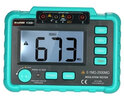
An insulation tester cost me £35 when I could not find where my old faithful was. VC60B.jpg But is it worth buying a tester which tests at 250, 500, or 1000 volts for one iron?

The other method
Diffrence line neutral 8 Feb 24 reduced.jpg
again the tester cost £35, so is it worth testing?
 
An insulation tester cost me £35 when I could not find where my old faithful was <image> ... But is it worth buying a tester which tests at 250, 500, or 1000 volts for one iron?
No.

(unless, perhaps, one feels the need to spend £120 or more for a replacement iron :-)).
 
I do have a press,
1749649397565.png
but would not call that an iron, even if it does the same job. The old iron I have is used to keep the door open 1749649519491.png but an iron
1749649585264.png
is not that costly, and even fancy ones 1749649679424.pngbut once you get to fancy types, then the testing is also more complex. Yes 1749649809411.png over £500, but to test it, would require some dismantling, and I could not guide someone how to test such a complex device.
 
I'd suspect mineral insulated heating elements in such kit. Will need a proper Megger type insulation tester to confirm a fault almost certainly.
L-E and / or N-E fault though... has the OP checked both L and N? Also check the mains cable for faults?

Can spares for the exact make and model of steam (generator) iron be obtained economically?
Yes cable disconnected from element and o/c readings across plug as expected. Found that manufacturers do a £40 fixed repair so going back today
 

If you need to find a tradesperson to get your job done, please try our local search below, or if you are doing it yourself you can find suppliers local to you.

Select the supplier or trade you require, enter your location to begin your search.


Are you a trade or supplier? You can create your listing free at DIYnot Local

 
Back
Top