
• Looking for a smarter way to manage your heating this winter? We’ve been testing the new Aqara Radiator Thermostat W600 to see how quiet, accurate and easy it is to use around the home. Click here read our review.

Weed infested flower bed

Thanks all. Nothing growing there now, but had various bedding plants there until last year. I (think) I gave up as they were supposed to be hardy annuals but not the case.
It's a big late to grow anything big this year, but I have a display bed with roses at the back (tall), peonies in the middle, and then large (decorative) dahlias in front of them.

The peonies and large dahlias regrow each year, about one metre high and wide, so if you plant like that, there will not be much room for weeds. They are big and lush with dense foliage. They grow a big root in the summer, which will throw up a big plant next year. You cut them back to the ground in early winter when frost kills the foliage.

Peonies flower in late spring, dahlias come up as the peonies are finishing, and flower until frosted.

These are all pretty easy to grow, and provide a lot of flowers.

You will need to spray for blackfly a few times, this will also kill caterpillars, thrip and other pests. I don't get fungal diseases, except on the roses, which get mildew and black spot. They will survive if you don't spray them but don't be as good.

If you want, you can put bulbs for daffodils and tulips in the same bed. They won't interfere with the other plants because they grow at different times.
 
It's a big late to grow anything big this year, but I have a display bed with roses at the back (tall), peonies in the middle, and then large (decorative) dahlias in front of them.

The peonies and large dahlias regrow each year, about one metre high and wide, so if you plant like that, there will not be much room for weeds. They are big and lush with dense foliage. They grow a big root in the summer, which will throw up a big plant next year. You cut them back to the ground in early winter when frost kills the foliage.

Peonies flower in late spring, dahlias come up as the peonies are finishing, and flower until frosted.

These are all pretty easy to grow, and provide a lot of flowers.

You will need to spray for blackfly a few times, this will also kill caterpillars, thrip and other pests. I don't get fungal diseases, except on the roses, which get mildew and black spot. They will survive if you don't spray them but don't be as good.

If you want, you can put bulbs for daffodils and tulips in the same bed. They won't interfere with the other plants because they grow at different times.
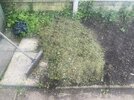
Just followed your advice re mulch from cut grass. Obviously not optimum height or coverage.

How would you treat remainder of bed?

I notice the hoe not removing all root systems. Do I have to do a second sweep?

Thank you again.
 

Attachments

  • IMG_9699.jpeg
    IMG_9699.jpeg
    732.3 KB · Views: 39
If the plants are too big to hoe off, you can either be more vigorous, or spray weedkiller on the exposed leaves.

Glyphosate will travel down into the roots and kill them, so for that to work you need active healthy leaves. So
I'd wait a week after hoeing.

Next time you mulch, I'd suggest starting at the back, by the fence, thickly, and working forward. I think it will be more effort for you to weed the back of the bed.

Once you have mulched, do not disturb that soil again. You will bring seeds to the surface and encourage regrowth. If weeds come through the mulch, pull them out or spray them. Not many will come through more than once. Grass can. Weeds that can't get through will die from lack of light.

Open ground can be hoed once a week, that has the effect of always killing seedlings before they have time to grow strong.

When you want to plant through a mulch, pull it back for a bucket sized hole, dig out and put in your plant, and draw back the mulch to cover the bare soil, but with your new plant poking through.
 
If the plants are too big to hoe off, you can either be more vigorous, or spray weedkiller on the exposed leaves.

Glyphosate will travel down into the roots and kill them, so for that to work you need active healthy leaves. So
I'd wait a week after hoeing.

Next time you mulch, I'd suggest starting at the back, by the fence, thickly, and working forward. I think it will be more effort for you to weed the back of the bed.

Once you have mulched, do not disturb that soil again. You will bring seeds to the surface and encourage regrowth. If weeds come through the mulch, pull them out or spray them. Not many will come through more than once. Grass can.

Open ground can be hoed once a week, that has the effect of always killing seedlings before they have time to grow strong.

When you want to plant through a mulch, pull it back for a bucket sized hole, dig out and put in your plant, and draw back the mulch to cover the bare soil, but with your new plant poking through.
Thanks again. Noted re treatment of stubborn weeds. I have Weedol. Is that comparable to Glyphosate?

Re the non mulched area- are you just recommending hoeing/weedkiller to prepare for bedding plants?

Back of bed-should have said this problem exacerbated by next door being empty for years.
 
If you want to have a go, there is just about time to put some of these in. Soak in water overnight before planting. Some may die as it is getting late in the year. See if they are to your taste. Not everybody like these big flowery plants, but I find them easy. You may find them on sale locally.

 
Thanks again. Noted re treatment of stubborn weeds. I have Weedol. Is that comparable to Glyphosate?

Re the non mulched area- are you just recommending hoeing/weedkiller to prepare for bedding plants?

Back of bed-should have said this problem exacerbated by next door being empty for years.

Weedol comes in several varieties. As long as it is not Pathclear, or "for lawns" you can use it on green leaves. Glyphosate is inactivated in the soil so will not harm anything you plant later.

Yes, I am suggesting keeping the bed clean of weeds while you decide what else to do.

You can use weedkiller on weeds that come through the fence. You can apply it with a watering can if you have nearby plants that could be damaged by spray drift. Glyphosate will kill the roots. A weedkiller labelled "fast acting" may only kill the leaves and small plants.
 
You can mulch it with organic matter...

I formerly used horse muck, on wood shavings bedding which does not smell unpleasant and is easier to spread than straw bedding. You may find a local stable that you can dig it out from into your own sacks. Dig out may be free. Ready bagged is usually much more expensive. It will include a useful supply of baler twine.

You will need to mulch about twice a year. The organic matter will rot down and the worms will kindly draw it into the ground for you, you don't need to dig it in.

Chicken sh!!...
 
When grandfolks kept all them chickens we'd use chicken s. to keep the soil mulchy, mixed with grass clippings...don't have any now but i like to throw in comfrey and nettles. Dry out the nettles in the sun then don a pair of thick gloves and run your hand along the stalk to remove the stingers, then break 'em up into the bin. Add an accelerator or, better yet, chuck in a few worms to help things along.
Nematodes are a good addition to your soil, by the by and help keep it fresh n' fertile.
 
If it's a sunny bed, you could lob in a couple of tomato plants as well. Near the fence, you can staple on some large mesh plastic netting to support them off the ground. They grow fast. Freshly picked toms are infinitely better than anything you buy in a shop. They will shade the fence and discourage weed growth. You can use weedkiller before planting.
 
If it's a sunny bed, you could lob in a couple of tomato plants as well. Near the fence, you can staple on some large mesh plastic netting to support them off the ground. They grow fast. Freshly picked toms are infinitely better than anything you buy in a shop. They will shade the fence and discourage weed growth. You can use weedkiller before planting.
Didn’t mention our massive slug problem. Priority has been stopping them getting into kitchen and conservatory, but guess toms would attract them?

Thanks
 
If it's a south facing spot keep an eye out for ants, too. I had a cold frame up against a fence that was often swarmed by ants. Fizzin' things would set up a nest 'neath the tom's and soon kill 'em off. :(
 
Slugs are quite mobile, but if you protect the borders of the flowerbed or house with thinly scattered pellets, they will eventually kill all the local ones, plus the ones that wander in from outside. I think I heard they can walk 20 yards in a night.

Yours might be coming under the fence. I get that. Look out for any damp and shady ares, for example a faulty gutter, downpipe or drain.

You will notice the numbers drop after a week or two. Renew pellets after rain. Shelter them under hedges and foliage, and do not put in heaps..
 
If it's a south facing spot keep an eye out for ants, too. I had a cold frame up against a fence that was often swarmed by ants. Fizzin' things would set up a nest 'neath the tom's and soon kill 'em off. :(
Thanks. North facing spot.
 
Slugs are quite mobile, but if you protect the borders of the flowerbed or house with thinly scattered pellets, they will eventually kill all the local ones, plus the ones that wander in from outside. I think I heard they can walk 20 yards in a night.

Yours might be coming under the fence. I get that. Look out for any damp and shady ares, for example a faulty gutter, downpipe or drain.

You will notice the numbers drop after a week or two. Renew pellets after rain. Shelter them under hedges and foliage, and do not put in heaps..
Thanks. Our species seem to be impervious
to pellets.
 
This all still seems a bit topsy turvy - I wouldn't worry about killing all and any natural processes - start by deciding and putting in what you do want.

If it was mine, I'd probably dig some holes and chuck in a bunch of spuds as a clearing crop - it's very late to do so, but you'd get the satisfaction of some harvest towards the end of the year, whilst also clearing the soil as you do so.

Bedding plants are fine if you're happy weeding and buying and replanting each year.

So, what do you want in there? Vegetables? Fruit bushes? Fruit trees? Ornamental shrubs? Hardy perennials? Ground cover? Herbs? Annuals....?
 

If you need to find a tradesperson to get your job done, please try our local search below, or if you are doing it yourself you can find suppliers local to you.

Select the supplier or trade you require, enter your location to begin your search.


Are you a trade or supplier? You can create your listing free at DIYnot Local

 
Back
Top