My daughter's house, in Turkey, has a flat roof with easy access, and there is no question the solar panels to heat DHW work well. When C.A.T. was open, they had an array of solar panels they had tried, and the homemade one, a radiator painted black under a double-glazed window unit, was doing as well as the commercial units. And they had some success, and also a lot of failures, this back in the 80s when we had not developed the PV solar panels.
Trying to keep heat in tanks and pipes is not easy. My immersion heater and tank were not very well insulated, and the iboost+ showed how much energy used to keep it hot for the week.
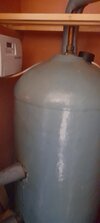

I put more insulation as shown, it did not help as much as expected, clearly water also used, but 16 kWh to 13 kWh is not much of a reduction, so the extra insulation will take years to pay for its self, but the electric v oil was also a surprise, 16 kWh electric v 30 kWh for oil, clearly the losses with pipework and boiler.
So let us look at the facts, it costs for handwashing extra, no baths or showers, around 15 kWh per week to keep the water hot. Unless you have an intelligent system, where the energy provider takes control of the EV charging and solar panels, here in Wales we can pay between 8.5p to 40p per kWh to buy electric. And we can sell it for between 4.5p and 30p per kWh. This is a huge difference, and not talking about those who get a historical high rate, or those who have not submitted the correct paperwork so get zero for export.
So at 23.86p/kWh which is Octopus base rate, with no peak or off-peak, we are looking at £186 per year to heat DHW. At 8.5p/kWh that drops to £66 and the difference is £120, so all our efforts can likely save us £100 a year. The question is, if worth the effort?
And with government incentives, and energy prices changing so often, the do your maths does not work, as in 5 years time, it all may have changed.
However, government incentives tend to have strings. Like to get the cheap solar panels, you must also have a unidirectional heat pump, I can see the sense for one system to heat and cool, but if we have globule warming, heat pumps which can only heat the house is daft. And often the solar panels are that small, with no battery, hardly worth having.
The problem is we get someone like me, with 6 kW of solar panels and a 5 kW inverter, with a 6.4 kWh battery, who has found the solar panels do pay, and likely payback time is 5 to 7 years, advising someone with 2.5 kW of panels and no battery, who in real terms has a white elephant, as they are two small to work with.
In the main, energy hungry equipment uses 3 kW, as this is the limit for a 13 amp plug, and we have a back-ground leakage/usage for items like freezers, so the system needs to be able to supply 4 kW, so minium battery size is around the 4 kWh mark.
I can produce 5 kW, although solar panels are 6 kW, the inverter is only 5 kW, I will be using some, but want the battery to accept around 4 kW, otherwise exporting when batteries are not fully charged.
But what one does with a 2.5 kW array, not sure.



