• Looking for a smarter way to manage your heating this winter? We’ve been testing the new Aqara Radiator Thermostat W600 to see how quiet, accurate and easy it is to use around the home. Click here read our review.

Concrete post tilted. Gap in fence

  • Thread starter Thread starter NHW
  • Start date Start date

NHW

Joined
21 Jun 2013
Messages
220
Reaction score
2
Country
United Kingdom
20250906_173027.jpg


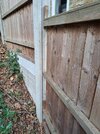
As you can see, over time the concrete slab at the bottom has sort of dropped on the left hand side and you can see a gap at the bottom. I have tried to get the fence to be fully horizontally level in order to show what it should look like when it is straight.

And then the concrete post on the right hand side has over time tilted/dipped towards the right, so much so that the fence panel on the right hand side isnt even slotted into the grooves in the concrete post and pretty much has no support on the right hand side. Neighbour bought the fence panel to replace as it was assumed to be a standard size 6ft x 4ft (which it was if the post wasn't leaning lol).

How can we rectify this without having to move the post? is there something that we can slot/fix inside the right hand channel of the concrete post like some sort of sleeve/catch that will bring out the channel element of the post?

We did think about fixing batons to the right hand side of the new fence but because the tilt is uneven (gradually gets wider at the top) it would be quite hard to get an angled cut that long and that precise, it would essentially have to be in the shape of a pizza slice but 6ft high and the angle would have to be perfect for it to slot in correctly.

any advice would be much appreciated. Thanks
 
If you're going to do it properly, you need to reset the right hand post so that it's vertical.
 
Even if you used a ratchet to bring the post to vertical, it looks like it still might not hold the panel. The post may be set too far over to the right.
 
Even if you used a ratchet to bring the post to vertical, it looks like it still might not hold the panel. The post may be set too far over to the right.
ah i see what you mean it looks as though you would be right there. But do you think if I try the method mentioned above to get the post straight and then added on a baton to either end of the fence. That might (for the short-term) solve it? but again the guy did mention it took him weeks to get it straight
 
ah i see what you mean it looks as though you would be right there. But do you think if I try the method mentioned above to get the post straight and then added on a baton to either end of the fence. That might (for the short-term) solve it? but again the guy did mention it took him weeks to get it straight

It would be difficult to give the connection to the baton enough strength to withstand high wind.

You are better off getting the posts the right distance apart.
 
I reckon you could glue a batten to the end of the fence panel [eg a tiling batten]. Sit the panel on the batten to keep pressure on it whilst the glue dries. Use the ratchet strap you're going to buy to straighten the fencepost to put a bit more pressure on [but not too much, these panels tend to be "value engineered"]. A small "u" of galvanised strap top and bottom to secure the batten to the panel might help as well.
Then straighten the fence post.
See how it goes.
If the glued joint between panel/batten fails them you can always move the post.
Bit bodgey, but will be a lot less effort if it turns out that you don't have to move the post.
 
Dig out soil to the left of the post base, pull the post upright, repack soil tightly around the upright post and tamp it down. I think the post would then support the panel in the groove.
 
Dig out soil to the left of the post base, pull the post upright, repack soil tightly around the upright post and tamp it down. I think the post would then support the panel in the groove.

I agree, it looks as if the gap at the bottom, will close up, as the post is rotated in the ground, to vertical. Rotate it to vertical, with a ratchet strap attached to the top of the right post, and at the base of the left-hand post. Stop the strap from riding up, by lashing it down with pegs, or better, ground anchors. Apply the tension gently, tightening a little each day or so, as the post moves. Remove some soil, on the left of the right post, also try moistening the soil.
 
I straightened a post knocked when a lorry reversed into it, I used a car jack and timber braced up the post ( to spread load) to slowly jack it back to upright . Timber has to be used as jacking against concrete post risks snapping the post.
 
We did think about fixing batons to the right hand side of the new fence but because the tilt is uneven (gradually gets wider at the top) it would be quite hard to get an angled cut that long and that precise
I know that this is a bit of a bodge but it is possible (in some cases is basically the only option) and it can be easy & effective.

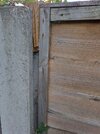
My garden is on the side of a steep valley and the ground is quite loose, i.e. liable to move. On one boundary the previous owner (a professional builder) put a lot of time & effort into the fence; concrete fence posts set in concrete, concrete gravel boards, really solid fence panels. But c. a year ago I noticed a loose panel and told the new neighbours. They said that they had used wedges to deal with this in a couple of places and they did so here as well.

20250909_181009.jpg

On another boundary the management company had a firm of 'professional' builders put a bit of fence in and c. six months
ago I noticed a loose panel. I happened to have some feather-edge offcuts to hand, so I cut some bits off, screwed them together, wedged them in place and screwed the panel to them.

20250909_181604.jpg

Obviously doing this leaves a gap between the panel and the post and a gap at the bottom. I think it depends whether / how much this bothers you.
 
I know that this is a bit of a bodge but it is possible (in some cases is basically the only option) and it can be easy & effective.

The OP's problem, would not be solved with wedges, the post lean is far too much. I have used wedges, to good effect on some of our panels, just to silence the rattle, in the wind.
 
I don't know if it's "proper" but the soloution my parents and I have used to this sort of problem is to screw/nail extra wood to the fence panel to fill the gap.
 
Last edited:

If you need to find a tradesperson to get your job done, please try our local search below, or if you are doing it yourself you can find suppliers local to you.

Select the supplier or trade you require, enter your location to begin your search.


Are you a trade or supplier? You can create your listing free at DIYnot Local

 
Back
Top