• Looking for a smarter way to manage your heating this winter? We’ve been testing the new Aqara Radiator Thermostat W600 to see how quiet, accurate and easy it is to use around the home. Click here read our review.

Chemical Stud Alignment

Joined
9 Jan 2011
Messages
247
Reaction score
6
Location
London
Country
United Kingdom
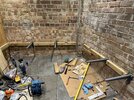
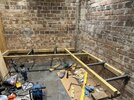
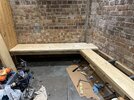
This is my first time working with chemical anchors and it's for a floating bench I'm building on a garden wall.

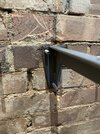
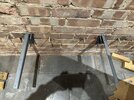
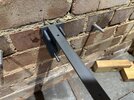
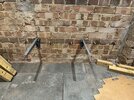
I've read up on the process and have successfully drilled and installed the anchors for my timber ledger plate. However these heavy duty metal brackets were another matter and I couldn't find any tips anywhere to properly line things up, so I thought I'd ask how everyone else does it.

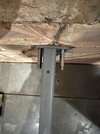
The studs I'm using is Rawlplug M10 x 130mm Stainless steel studs. I'm drilling 12mm holes to a depth on 85mm into the wall. And the 3 mounting holes in the brackets are 10mm.

The problem is that there is 0 tolerance for the stud going through the bracket mounting holes, it has to align precisely at the exact angle or it does't go through. But there are 3 holes, so if one of them is even 0.1mm out it doesn't work. And since the holes in the wall are 12mm there's already 2mm of play. Multiply that by 3 and you can see the problem. And then multiply that by the length of the stud protruding from the wall, which is 45mm, and it's an even bigger problem.

I tried to achieve as much precision as possible when drilling the holes (using pilot holes, templates, spirit levels and squares), but honestly, it still seems impossible to achieve. Additionally the studs need to be set in the wall 5mm from the back of the hole to allow the resin to fully encase it. That means you can't easily push the brackets over the studs whilst they're setting without disturbing them and causing the cure to fail.

So anyway, at 18 degrees centigrade with a working time of about 7 minutes, the only sensible solution I could find, working alone, was to inject the resin into the hole. Then quickly twist each stud into the holes to the right depth. Then whilst carefully holding the studs in situ try to wiggle the bracket over the studs before the resin gets tacky. I sprayed silicon lube all over the base plate and the holes beforehand to prevent the resin extruding and bonding directly to the brackets. I then carefully held the bracket in place and gently wiggled it level with my spirit level and then slid a pile of bricks underneath to support it so that the studs were not under load.

It's really not the way it's advised to do it, but nothing else would have worked as far as I could see. As it is, the brackets are now on OK and the studs have set hard. However, I didn't get alignment so perfect that I can completely slide the brackets off and back on. They'll only move about 1cm before the opposing angle of one of the studs will prevent complete removal. I just abhout satisfied though and it should do what I need.

So what's the correct technique, what am I missing that you guys are doing?
 

Attachments
  • IMG_1464.jpg
    IMG_1464.jpg
    257.5 KB · Views: 42
  • IMG_1465.jpg
    IMG_1465.jpg
    587.6 KB · Views: 43
  • IMG_1468.jpg
    IMG_1468.jpg
    579 KB · Views: 41
  • IMG_1469.jpg
    IMG_1469.jpg
    362.9 KB · Views: 40
  • IMG_1470.jpg
    IMG_1470.jpg
    697.5 KB · Views: 43
Last edited:
This is my first time working with chemical anchors and it's for a floating bench I'm building on a garden wall.

I've read up on the process and have successfully drilled and installed the anchors for my timber ledger plate. However these heavy duty metal brackets were another matter and I couldn't find any tips anywhere to properly line things up, so I thought I'd ask how everyone else does it.

The studs I'm using is Rawlplug M10 x 130mm Stainless steel studs. I'm drilling 12mm holes to a depth on 85mm into the wall. And the 3 mounting holes in the brackets are 10mm.

The problem is that there is 0 tolerance for the stud going through the bracket mounting holes, it has to align precisely at the exact angle or it does't go through. But there are 3 holes, so if one of them is even 0.1mm out it doesn't work. And since the holes in the wall are 12mm there's already 2mm of play. Multiply that by 3 and you can see the problem. And then multiply that by the length of the stud protruding from the wall, which is 45mm, and it's an even bigger problem.

I tried to achieve as much precision as possible when drilling the holes (using pilot holes, templates, spirit levels and squares), but honestly, it still seems impossible to achieve. Additionally the studs need to be set in the wall 5mm from the back of the hole to allow the resin to fully encase it. That means you can't easily push the brackets over the studs whilst they're setting without disturbing them and causing the cure to fail.

So anyway, at 18 degrees centigrade with a working time of about 7 minutes, the only sensible solution I could find, working alone, was to inject the resin into the hole. Then quickly twist each stud into the holes to the right depth. Then whilst carefully holding the studs in situ try to wiggle the bracket over the studs before the resin gets tacky. I sprayed silicon lube all over the base plate and the holes beforehand to prevent the resin extruding and bonding directly to the brackets. I then carefully held the bracket in place and gently wiggled it level with my spirit level and then slid a pile of bricks underneath to support it so that the studs were not under load.

It's really not the way it's advised to do it, but nothing else would have worked as far as I could see. As it is, the brackets are now on OK and the studs have set hard. However, I didn't get alignment so perfect that I can completely slide the brackets off and back on. They'll only move about 1cm before the opposing angle of one of the studs will prevent complete removal. I just abhout satisfied though and it should do what I need.

So what's the correct technique, what am I missing that you guys are doing?
Wed fix the mounting bracket in place with a plug and screw, then proceed to chemical anchor the remaining holes with the bracket in place.
 
Kinda like what I did. However that's not how it's supposed to be done according to the manufacturer because there's not supposed to be any load or any disturbance to the anchors while the resin sets. I agree though, there doesn't seem to be an alternative.

For a vertical fixing I don't see a problem, but for a horizontal wall bracket like mine I had to jump through hoops to have the brackets completely supported by other means.
 
I didn't get alignment so perfect that I can completely slide the brackets off and back on. They'll only move about 1cm before the opposing angle of one of the studs will prevent complete removal. I just abhout satisfied though and it should do what I need.

If you had less of the stud protruding, this would be less of an issue. I.e. have enough for the nut, rather than the ~40mm you seem to have.
 
Yes, agree, that's definitely a factor. I was hoping to be able to slide the backets completely off and back on again to clean up, level and pack from behind if required. As it happens they will only slide forward about 1cm before misalignment of the studs prevents any more movement. Quite surprising, but probably due to the close tolerences of the bolt holes in the brackets. They're 10mm. If I drilled them out to 11mm that may have done what I wanted, but hey ho.

So anyway, cutting the bolts down will not help me that much to get the brackets on and off in this case because as it is there's only 1cm of movement, but that's not a disaster. I'm going to cut them down to stubs anyway for neatness.

Incidently, I tried my 115mm cutting disc in an angle grinder, but blimey it was tough going! I then tried a good cutoff disc in my Dremel 4000 and cutting just one bolt took over 10 mins and wore the disc out to nothing! I really didn't think they were going to be that hard. I've just popped to ToolStation and picked up some Abracs INOX cutting discs. I'm hoping these will do a better job, but we'll see...
 
Incidently, I tried my 115mm cutting disc in an angle grinder, but blimey it was tough going! I then tried a good cutoff disc in my Dremel 4000 and cutting just one bolt took over 10 mins and wore the disc out to nothing! I really didn't think they were going to be that hard. I've just popped to ToolStation and picked up some Abracs INOX cutting discs. I'm hoping these will do a better job, but we'll see...

I had bad discs! The new 1mm Inox discs glided through the bolts in no time!
 
If you need that sort of precision, you would be better off making a template out of some scrap plywood or similar material.
 
I’d have bolted the stud to the bracket with a nut either side. That would have held the stud square to the hole in the bracket. Slide it into the holes wait for the resin to set and unbolt.


You still need to drill the holes fairly accurately.
 
If you need that sort of precision, you would be better off making a template out of some scrap plywood or similar material.
Yes, I did cut 4 precise templates out of plywood to help with drilling and then to help with positioning the studs whilst the resin was wet. I binned them in the end! Drilling the wall needed a 12mm masonry bit, so I couldn't drill through the template (even the shaft was 11mm), and for positioning the studs they were also no good. The 10mm holes in the template grab the bolt threads too tightly and pull them around too much. If I used larger holes they wouldn't have replicated my metal brackets so I was better off just using the brackets directly. The rawlplug guidance says you should not really touch anything whilst curing as you could compromise the strength, create voids in the resin, push the studs in too far (they need to be fully suspended in resin, 5mm from the end), etc. The main thing though was that the studs need to be perfectly parallel through their entire length otherwise the template wouldn't slide back off and would be stuck. If I'd used M8 studs it would have been much easier, but at 10mm there's like a micron of potential leeway and no flex in any of the components - wall, studs or metal bracket - so not easy.

I’d have bolted the stud to the bracket with a nut either side. That would have held the stud square to the hole in the bracket. Slide it into the holes wait for the resin to set and unbolt.

This wouldn't work unfortunately, otherwise I would have. I did something similar, but not as simple as you describe. Why? Because inserting studs into chemical anchor requires a twisting motion, like threading it in. Sliding them all in would not adquately encase the thread and grip the stud while it cures. There's another factor - inserting the bolts results in quite a lot of resin extruding from the hole. It's pretty messy and those bolts would become covered and permanently bonded to everything as well as resin all over the walls. You can't touch anything while it's curing so you'd just have to leave it to harden. That's what I was trying to avoid.

I think the way I did it was the only way it could be done, without some high precision jig or assembly line tools! (or someone with proper skills I don't possess). For an easier life though I think thses brackets would be better just screwed into the wall with standard plugs and screws. But because the bench is floating I wanted the highest possible strength for the fixings and I'm happy enough with how they were installed.
 

Attachments

  • IMG_1475.jpg
    IMG_1475.jpg
    682.6 KB · Views: 27
  • IMG_1476.jpg
    IMG_1476.jpg
    702.8 KB · Views: 29
  • IMG_1477.jpg
    IMG_1477.jpg
    590 KB · Views: 27
I think it’s still possible. Leave the nuts on the stud just loose enough so that you can spin the stud as you insert it. Although if you’re using enough resin for it to extrude out of the hole, I’d disagree that a twist is essential to fully encase the stud. And you’ve got extruded resin to deal with in both methods.

Anyway, you’ve got it sorted - enjoy making stuff on your bench.
 
What made you go for chemical fixings?
Dunno! I'm new to this...

I just thought chemical anchors provided the best strength, placed less strain on weak bricks and distributed the load better. ie, I've had concrete blocks split in the past when I've used concrete screws close to the edge, and plugs and screws also cause expansion as they drive in and potentally high stresses and failure. Given the number of fixings I needed and strength I wanted to acheive ( 4 meters of floating benches with potentially 5 seated people) I pretty much ruled out most other solutions.

I think it's probably sensible to use a mix of fixings. There's still a place for plugs and screws and they may still make a showing in this project. But like I say, I'm just figuring things out.
 
Looking at the end result I have to say that is a lot of effort / cost to get a floating effect that doesn’t really work in the corner. Same thing with 4 legs the front would have done it.
 
Looking at the end result I have to say that is a lot of effort / cost to get a floating effect that doesn’t really work in the corner. Same thing with 4 legs the front would have done it.
I tend to overthink and over engineer things - guilty as charged. But floating was what I wanted and floating is what I'll build. If nothing else, just for the mental challenge.

It's far from finished anyway, the corner is what I'll deal with next.
 
I tend to overthink and over engineer things - guilty as charged. But floating was what I wanted and floating is what I'll build. If nothing else, just for the mental challenge.

It's far from finished anyway, the corner is what I'll deal with next.
You have done a good job so far. Is this your house.
 

If you need to find a tradesperson to get your job done, please try our local search below, or if you are doing it yourself you can find suppliers local to you.

Select the supplier or trade you require, enter your location to begin your search.


Are you a trade or supplier? You can create your listing free at DIYnot Local

 
Back
Top