• Looking for a smarter way to manage your heating this winter? We’ve been testing the new Aqara Radiator Thermostat W600 to see how quiet, accurate and easy it is to use around the home. Click here read our review.

Lining a cast iron gutter with uPVC gutter

Joined
18 Feb 2010
Messages
557
Reaction score
14
Location
West Lothian
Country
United Kingdom
Short version is that I have an old cast iron gutter, and I am considering ‘lining’ it with uPVC guttering. Looking for a bit of a sounding board here, appreciate any comments. I could of course get someone out to replace it, but it would cost thousands and no guarantee of a long term resolution.

Long version is that the gutter sits on top of the sandstone wall, so when it leaks it leaks into the wall and only becomes evident once the wall is visibly saturated. Conservation area, so would need planning permission to replace with different material. Gutter is bedded in mortar, it also is in a number of sections with angled joints due to a bay window. This means that it is not a simple proposition to just lift off and reseal the joints with putty/mastic. I lined it all before with continuous long lengths of flashband and painted over with bituminous paint and it was a pretty good job (even if I say so myself) and its lasted a good 6 years or more. I’ve also tried various other methods including bitumen mastic, evercryl etc, and they all work well but time passes and with standing water most of the time the water eventually seeps through they leak at the joints again. Always the problem with this type of gutter is that the issue arises at this time of year when its raining for weeks on end, and getting a period where it is dry enough for long enough to dry it out enough to repair is nigh on impossible.

My bright idea (in theory) is that if I could drop a uPVC gutter inside the existing gutter it wouldn’t be seen so no planning permission required, I would have a better chance of setting it up to fall towards the downpipes and it could be repaired easily/cheaply. It would mean two points of failure before getting into the walls. I suspect that if I could get a slightly smaller gutter of a similar profile it should just sit in place, but would also need to have an outlet that would fit inside the existing cast downpipe and have angled bends suitable for getting around the bay.

Anyone done something similar before or see any other flaws in the plan?
 
If I was repairing these joints, I would clean first , wire brush/blow torch, then dab Acropol into the joint, and around to about 3 inch either side of the joint, then using a strip of fibre glass matting, lay it over the joint, then keep dabbing the matting with acropol until the matting has disappeared.
 
OP,
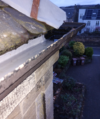
Why not post pics from below & above the gutter(s)?

Recent pic with Evercryl applied in one of the sections that is leaking


1764760366588.png


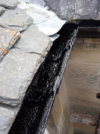
From below
1764760974794.png
 

Attachments

  • 1764760313553.png
    1764760313553.png
    500.4 KB · Views: 8
  • 1764760796839.png
    1764760796839.png
    611.7 KB · Views: 9
If I was repairing these joints, I would clean first , wire brush/blow torch, then dab Acropol into the joint, and around to about 3 inch either side of the joint, then using a strip of fibre glass matting, lay it over the joint, then keep dabbing the matting with acropol until the matting has disappeared.
I appreciate the advice, but I have repaired in the past and I am aware of lots of different methods for repairing cast gutters and have tried a few different materials and methods.

For me the fundamental problem is the design. There is always standing water in the gutter and when they leak, and they eventually will, they leak into the inside of the wall and it is very difficult to repair them in wet weather. The idea of a gutter inside the gutter is that leaks can be identified and repaired easily and quickly without waiting for a dry spell and if they do leak there is a second layer to get through before reaching the wall.

Edit: And other factor is that a UPC gutter inside could easily be set up with a slight fall, which would be no simple task for the cast iron gutter
 
Last edited:
The joints are too lumpy, so it wouldn't sit nicely in the gutter, they would overflow over the sides, rainwater would get in around the sides, wind would dislodge them, etc etc.

I'd agree with repair, just do the bits where it's leaking, standing water isn't a huge deal in gutters.
 
My worry about the inlay of old guttering v new plastic is that the profiles are likely different?

In a commercial sense, I can imagine that some sort of “ribbon” of plastic could be custom fitted into a gutter as a liner, moulded by towing some kind of heated weight along the run.
Then somehow plastic welding the joins/corners.

But doing it yourself would be tricky.

In dry weather, maybe lining with fibreglass would work
 
My worry about the inlay of old guttering v new plastic is that the profiles are likely different?

In a commercial sense, I can imagine that some sort of “ribbon” of plastic could be custom fitted into a gutter as a liner, moulded by towing some kind of heated weight along the run.
Then somehow plastic welding the joins/corners.

But doing it yourself would be tricky.

In dry weather, maybe lining with fibreglass would work
I probably wasn't clear enough on this. I had originally considered a lining that was a close fit to the profile of the original gutter, but for all the issues you and Deluks have identified I already discounted this.

My thoughts are that a standard uPVC half round, maybe high-cap if it would fit, secured inside the existing gutter could be set up to a slight fall and carry the water to the downpipes. The existing gutter is large and should allow for movement and fitting standard corner sections etc.

Part of where this comes from is that if I was to completely remove and renovate or replace this gutter I would put a dpm underneath with a lip on the inside, so that leaks or overflow would run down the outside of the walls. That's a huge amount of work and expense with lots to go wrong and the main reason for the cast gutter over just replacing it with uPVC is aesthetics/planning - if it was purely for functionality, no one would be fitting cast iron gutters now.

Essentially its not a gutter lining, its a new uPVC plastic gutter, with the same functionality as any gutter fitted to a modern house - its just hidden from view by the existing cast gutter. If it leaks/splashes/overflows etc, then it goes into the existing gutter so I am no worse off than I am now. Repairs can be made without waiting for dry weather.

There are some things I still have to work through, like the detailing of the termination to the existing downpipe etc, but I can't think of a reason why this is very much different from if I didn't have any planning restrictions and I was just removing the cast gutter and replacing with uPVC.
 
There are some things I still have to work through, like the detailing of the termination to the existing downpipe etc, but I can't think of a reason why this is very much different from if I didn't have any planning restrictions and I was just removing the cast gutter and replacing with uPVC.

It might be worth collecting some off-cuts of plastic gutter, and seeing what would be the best fit. Plastic gutter is very easy to reshape, with the application of a little heat. Just lay it in your gutter, apply heat, and it's own weight will pull it into place. Rather than using the manufactured joint pieces, just overlap, and use solvent adhesive, so it can sit flatter. At the down spout, it needn't be more elaborate, then a undersize hole cut in the bottom of the gutter, expanded, and turned into a shallow funnel, with heat.
 
It might be worth collecting some off-cuts of plastic gutter, and seeing what would be the best fit. Plastic gutter is very easy to reshape, with the application of a little heat. Just lay it in your gutter, apply heat, and it's own weight will pull it into place. Rather than using the manufactured joint pieces, just overlap, and use solvent adhesive, so it can sit flatter. At the down spout, it needn't be more elaborate, then a undersize hole cut in the bottom of the gutter, expanded, and turned into a shallow funnel, with heat.
Brilliant Harry. I never would thought of solvent weld and heat deformation. That's a potential game changer and actually resolves a few of my worries on the detailing.

Overlapping and solvent welding the joints might actually help create a step that would help with directing flow in the direction of the downpipe. I wonder though if using the standard unions would be better for allowing a bit of movement. I like the idea of creating a perfectly sized funnel at the downpipe as I was concerned that I might not get a good fit here.

A little heat might also help with the corners. I was a little concerned that I would get to some of the non standard angles on the bay section and run into issues, but maybe a little gentle heat could help bend it by a few degrees.

I don't have any off cuts, but I can buy a couple of straight sections cheaply and try for fit - i've already made an internal profile with carboard to get a feel for what would fit.
 

If you need to find a tradesperson to get your job done, please try our local search below, or if you are doing it yourself you can find suppliers local to you.

Select the supplier or trade you require, enter your location to begin your search.


Are you a trade or supplier? You can create your listing free at DIYnot Local

 
Back
Top