Damp Proof Course

Joined
22 Dec 2025
Messages
4
Reaction score
0
Country
United Kingdom
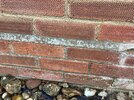
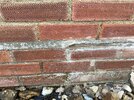
My semi detached house built in the fifties has a damp proof course fitted but it seems to have a sloping mortar cover over it . Some of the cover has disintegrated over the years and been replaced badly. Consequently dampness has bridged the dpc. I’m interested if anyone can explain why the dpc is “bridged” and how I should go about replacing it? Would love to hear from someone who understands what’s going on.

 

Attachments

  • IMG_4021.jpeg
    IMG_4021.jpeg
    1.2 MB · Views: 48
  • IMG_4020.jpeg
    IMG_4020.jpeg
    1.1 MB · Views: 50
Do you have drain gully near as it looks wetter than it should be under dpc.
I wonder if water is escaping and not all of it is being taken away causing excess damp in brick's under dpc
 
Bridging is when the floor level outside is at or above the dpc level, which allows moisture outside to travel up and cross into the house. Normal a two brick height is left to prevent it occurring. There may be other causes, like penetrating damp or leaks from gutters or pipes. Or the path level might have been reduced to address the problem before you purchased the property, but the damp remains.
 
Thanks for those replies. The stones at the base of the wall separating the wall from a concrete path (at the same level) does have plastic sheet under the stones which I guess would add to the dampness below the dpc but there are no gutters or pipes causing additional wet areas.
But my main problem is replacing the mortar around the dpc? It covers (bridges) the dpc with an upward slope, How is it applied? Why does it have a slope? Why doesn’t it allow the damp to cross it?
I’ve checked many videos on YouTube but none describe the dpc/mortar arrangement on my house.
Any further comments greatly appreciated.
 
But my main problem is replacing the mortar around the dpc? It covers (bridges) the dpc with an upward slope, How is it applied? Why does it have a slope? Why doesn’t it allow the damp to cross it?
I’ve checked many videos on YouTube but none describe the dpc/mortar arrangement on my house.
I would guess a 1950s house would have a bitumen DPC.

some houses typically from Edwardian period had a 20mm or so thick DPC course, sometimes slate or maybe liquid bitumen.

They were then often covered with a thin lime or cement render, sometimes trowelled into a slope like a weather struck detail. AFAIK it was mainly a cosmetic detail.

I doubt if the thin bit of missing render that covered the mortar is the cause of damp getting above.


Is the wall a cavity construction? - and if so do you have cavity wall insulation?

Are you getting any damp internally?
 
Thanks for your reply.
The wall is not cavity as it’s a flat roof extension (original part of the build) and houses a downstairs toilet where there is slight evidence of damp, the reason I started looking outside. I suppose the sloping of the mortar over the dpc could be cosmetic and/or also a rainwater running down the wall deflector? But surely it must transmit damp up from below the dpc?
 
But surely it must transmit damp up from below the dpc?
Not really no. There will be a wetting and drying thing going on at the surface, but of no real consequence to the performance of the DPC.

The 'damp' could be numerous things, such as cold bridge condensation, or build quality issues. Those are a modern-ish London Rustic brick. Are you sure it's not cavity construction?
 
Definitely no cavity, it’s a cold room in the winter, north facing, with a small radiator, only suitable for a quick visit haha.

The house is one of many ex council houses built in the fifties that seems generally well built. The rest of the house has the same form of dpc/mortar with no evidence of damp inside the house.

Interesting you say no problem with the mortar bridge so I assume as someone mentioned earlier it’s cosmetic?
So during the spring/summer I will try to restore the mortar to its original condition, remove any plastic sheet under the adjacent stones and see how I get on.
 
But my main problem is replacing the mortar around the dpc? It covers (bridges) the dpc with an upward slope, How is it applied? Why does it have a slope? Why doesn’t it allow the damp to cross it?
A bridge needs a base in the ground for the damp to rise, you just have badly smeared mortar
I’ve checked many videos on YouTube but none describe the dpc/mortar arrangement on my house.
Any further comments greatly appreciated.
The dpc may have failed locally.
 
Back
Top