Radiator replacement - should we go for higher BTU than needed?

When you say horizontal, how do you mean? Just a normal convecting radiator or a designer type? You do get flat panel, contemporary looking rads that are convectors BTW.

 
When you say horizontal, how do you mean? Just a normal convecting radiator or a designer type? You do get flat panel, contemporary looking rads that are convectors BTW.

I see what you mean now, so even the designer tubular ones that are horizontal wouldn't be as good? If we went for an horizontal radiator and the sofa is in front of it we would go for a normal convecting radiator.

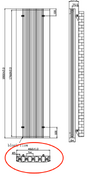
The vertical one we were looking is this one, it's aluminium but not sure what type
 

Attachments

  • Screenshot 2026-05-21 at 17.09.36.png
    Screenshot 2026-05-21 at 17.09.36.png
    660.8 KB · Views: 8
You really can have that if you prefer, output sized appropriately.
Thanks, from the online calculators the room would need about 5700-6000 BTU for the living room (room is only 4x4m - 2.3 ceiling). Do you think going to a 8000BTU is a good option?

Also I've seen people talk about doing heat loos survey but it does look quite expensive. Our house is from the mid 1990 so fairly recent.
 
Last edited:
I hadn't really thought about us having to deal with potential problems if buying directly.

Most custards don't!
And is why it's standard practice to add 20% when supplying... But that is like forbidden fruit, nowadays, when customers think they can save a few quid by ordering stuff online!
Trouble is... The online suppliers don't have a clue what they're selling and don't care!
 
Thanks, from the online calculators the room would need about 5700-6000 BTU for the living room (room is only 4x4m - 2.3 ceiling). Do you think going to a 8000BTU is a good option?

Also I've seen people talk about doing heat loos survey but it does look quite expensive. Our house is from the mid 1990 so fairly recent.

Does the room ever feel very cold or generally comfortable?
 
Heat loss calcs are designed to provide the amount of heat that a given room can lose in an hour in Kw, that is then matched to the output of the radiators at a given delta that can then replace that heat loss, that is then designed to ensure that the space is comfortable to be in. Unfortunately that doesn't cater for how a given radiator may heat that room up and how that then feels to the user. They are useful when replacing like for like, as the performance of that type of radiator is understood but when changing the type of radiator to others that heat the space differently, then that information doesn't tend to be as real world useful

1779383870238.png
Looking at the specs of that vertical rad suggest that it may have hollow tubes which could act as convectors, a call to the supplier would confirm though.
 
Heat loss calcs are designed to provide the amount of heat that a given room can lose in an hour in Kw, that is then matched to the output of the radiators at a given delta that can then replace that heat loss, that is then designed to ensure that the space is comfortable to be in. Unfortunately that doesn't cater for how a given radiator may heat that room up and how that then feels to the user. They are useful when replacing like for like, as the performance of that type of radiator is understood but when changing the type of radiator to others that heat the space differently, then that information doesn't tend to be as real world useful

View attachment 415108
Looking at the specs of that vertical rad suggest that it may have hollow tubes which could act as convectors, a call to the supplier would confirm though.
Thanks, i'll check with them. Would that be good if that's the case?
 
Honestly, oversize it a bit with regards to the room heat loss and go for it. I've never had any issues with them not heating a room properly.
 
Honestly - I've had clients ask me to pull designer, tubular, vertical rads out out more times than I care to remember because they just fail to heat a decent sized room properly. I removed 3 - 550mm x1800mm doubles from my own living room (26m2) because they were woefully inadequate at heating the space without being on for hours (last time I listened to SWMBO when it came to CH)

As mentioned they do have their place but If there's only one going into a 16m2 room then I would probably suggest other options, it really can be a case of form over function.
 
I disagree, but opinions do differ, that's fine.

Hard to know what we should go for.

Currently in the living room we have a small vertical radiator that the previous owner had replaced a few years ago. We did noticed that it heated the room not as well as traditional radiators but thought maybe it was because it was not big enough and close to the door so the heat seemed to go in hallway and not in the living room. So we thought if we replaced it with a bigger vertical one and put it in a more central position that could help.

We coped ok this last winter. But the main struggle we had was that none of the other radiators had valves that worked so if we left the heating on longer to heat the living room it would get really hot upstairs really quickly as the other radiators were blasting and the heat from downstairs just going up.

Currently we don't really have any space to put a horizontal radiator except behind the sofa as the layout is tricky, but we thought that it could damage the sofa and block a lot of the heat anyway? (Our sofa is a tall back sofa as well, it's a recliner but got it as the static version so it's quite tall).

Do you guys think it could be a better option? And if so how much gap to leave between the sofa and radiator?

We have big french doors opening to the garden so can't really put a horizontal one there. The room isn't the biggest and we have to squeeze a small dining table/chairs and also a work from home desk too so a bit tight on space.
 
Last edited:
Currently we don't really have any space to put a horizontal radiator except behind the sofa as the layout is tricky, but we thought that it could damage the sofa and block a lot of the heat anyway?
If you can only fit one rad then I'd use a conventional, albeit contemporary design, if you want it to look good. A Type22(K2) radiator behind the couch is proven to work well, as long as there is a reasonable air supply allowed to get to the bottom of the rad and a little space left between the rad and the back of the couch. I'm sure you will notice the difference immediately.

Especially if a column has been used before and didn't do the job and the CH had to be run a lot longer. That is obviously inefficient and will cost more to heat the room up properly. May also be time to upgrade other valves to TRV's too.
 
If you can only fit one rad then I'd use a conventional, albeit contemporary design if you want it to look good, Type22(K2) radiator behind the couch, that's certainly proven to work well, as long as there is a reasonable air supply allowed to get to the bottom of the rad and a little space left between the rad and the back of the couch.

Especially if a column has been used before and didn't do the job and the CH had to be run a lot longer, which is obviously inefficient and costs more to heat up the room properly. May also be time to upgrade the valves to TRV's
Yeah we will upgrade the valves to TRV on all the radiators upstairs.

Would a gap of about 10-15 cm be enough you reckon between sofa/radiator?

It's quite hard to know if the radiator was not good enough (could do with a bigger one though) or if it was just the lack of TVR that made it worse.

There's a big radiator in the hallway downstairs and a small one on the landing upstairs and one per bedroom but it just feels like in this house the heat just rises really quick. We only lived in flats before so that's a big difference.

We quite like the bedroom to be around 17-18 degrees at night and about 20 downstairs. But without the TVR it was a struggle to get this.

We re not really bothered about a vertical radiator we just want to make it work with the space and we're worried the sofa would get damaged if too close or the room not heat that well if it's blocking it
 

If you need to find a tradesperson to get your job done, please try our local search below, or if you are doing it yourself you can find suppliers local to you.

Select the supplier or trade you require, enter your location to begin your search.


Are you a trade or supplier? You can create your listing free at DIYnot Local

 
Back
Top