
Wait isn’t the NRV between the balanced cold and the UVC EV/cylinder feed? It’s what stops hot water going back into the balanced cold?I would suggest installing it before the PRV because the PRV closes when the upstream pressure is > 3.0bar so the arrestor wouldn't be of any benefit if installed on the balanced cold, (if the hammer is in the mains leg), the UVC EV should act as a arrestor to relieve the pressure in the balancedmaincold if this is where the hammer is occuring as the ICG NRV will then open in the UVC direction.

You are using an out of date browser. It may not display this or other websites correctly.
You should upgrade or use an alternative browser.
You should upgrade or use an alternative browser.
Water hammer from unvented cylinder
- Thread starter Taconite5
- Start date
Sure can - which bit do you want to see?Can you do a video and post it on YouTube?
It is, but when you shut a tap taken off the balanced cold and when/if the pressure builds up very rapidly due to the water flow stopping abruptly then the PRV will close very rapidly, the pressure is then trapped in the mains up as far as the PRV but any pressure that may have built up in the balanced portion will be relieved as the NRV will open but this doesn't do anything to relieve or stop the pressure build up in the mains portion.Wait isn’t the NRV between the balanced cold and the UVC EV/cylinder feed? It’s what stops hot water going back into the balanced cold?
Thanks that diagram really helps!It is, but when you shut a tap taken off the balanced cold and when/if the pressure builds up very rapidly due to the water flow stopping abruptly then the PRV will close very rapidly, the pressure is then trapped in the mains up as far as the PRV but any pressure that may have built up in the balanced portion will be relieved as the NRV will open but this doesn't do anything to relieve or stop the pressure build up in the mains portion.
View attachment 416149
I'm wondering if it's the balanced cold causing the problem then. I'm going to fit a T here and see if I can take some pressure readings.

Thanks that diagram really helps!
I'm wondering if it's the balanced cold causing the problem then. I'm going to fit a T here and see if I can take some pressure readings.
Do you have a toilet valve that shuts off quickly?
That's a good idea, you might then take a few readings with various HW only draw off flowrates and ditto from the balanced cold.Thanks that diagram really helps!
I'm wondering if it's the balanced cold causing the problem then. I'm going to fit a T here and see if I can take some pressure readings.
Why is there another PRV installed?, is it because the mains pressure exceeds the max (I think) pressure ratio of 3:1, ie, a max mains pressure of say 8 to 9 bar, have you measured this mains pressure?, if its say 5.5bar or less then it might be better to remove the extra one.

Water hammer is caused by hydraulic shock, invariably where the pressure is higher and there is a valve that shuts down quickly. That quick shut down causes a pressure spike and creates a pressure wave and that will travel along and rattle any valves or loose pipework that it encounters until it dissipates - that knocking is the water hammer - invariably 1/4 turn or solenoid valves are the known culprits
The trick is to find what valve it is that is causing it, so it's down to tracking the pattern of the hammer and being able to replicate it. There may be an issue when the balanced cold is running and something then impedes or shuts down the flow and the wave is travelling back up and bounces the Pressure Reducing Valve on the control group. These PRV's are known to knock when the flow suddenly reverses, it's similar in behaviour to a directional TRV that is flowing the wrong way and the spring of the valve resists the flow and the valve bounces on the seat, creating the knock.
When it knocks can you put a large screwdriver on the PRV and hold it to your ear, you will hear the valve knock quite clearly, if that's what it is.
The trick is to find what valve it is that is causing it, so it's down to tracking the pattern of the hammer and being able to replicate it. There may be an issue when the balanced cold is running and something then impedes or shuts down the flow and the wave is travelling back up and bounces the Pressure Reducing Valve on the control group. These PRV's are known to knock when the flow suddenly reverses, it's similar in behaviour to a directional TRV that is flowing the wrong way and the spring of the valve resists the flow and the valve bounces on the seat, creating the knock.
When it knocks can you put a large screwdriver on the PRV and hold it to your ear, you will hear the valve knock quite clearly, if that's what it is.
No they tend to close slowly as the float rises up.Do you have a toilet valve that shuts off quickly?
If the taps are closed really really slowly you can avoid the hammer but it’s just not practical
It was spiking to 7-8 bar when the kitchen tap or dishwasher valve closed. When flowing it was reading about 4-5 bar. The ICG was seeing the full force of this.That's a good idea, you might then take a few readings with various HW only draw off flowrates and ditto from the balanced cold.
Why is there another PRV installed?, is it because the mains pressure exceeds the max (I think) pressure ratio of 3:1, ie, a max mains pressure of say 8 to 9 bar, have you measured this mains pressure?, if its say 5.5bar or less then it might be better to remove the extra one.
One other thing I really don't get - last night I drained the entire system and opened the taps. Refilled it all. If you use the cold tap it didn't do the hammering.
As soon as you switch to hot you hear the classic clunk noise once and then if you switch back to cold it hammers continuously then when opening and closing the cold tap.
It's something to do with water being drawn off for the HW then causing the issue
As soon as you switch to hot you hear the classic clunk noise once and then if you switch back to cold it hammers continuously then when opening and closing the cold tap.
It's something to do with water being drawn off for the HW then causing the issue
I know which taps are causing it. The problem is it only happens ever after hot water has been drawn and then if you use any cold water it clunks.Water hammer is caused by hydraulic shock, invariably where the pressure is higher and there is a valve that shuts down quickly. That quick shut down causes a pressure spike and creates a pressure wave and that will travel along and rattle any valves or loose pipework that it encounters until it dissipates - that knocking is the water hammer - invariably 1/4 turn or solenoid valves are the known culprits
The trick is to find what valve it is that is causing it, so it's down to tracking the pattern of the hammer and being able to replicate it. There may be an issue when the balanced cold is running and something then impedes or shuts down the flow and the wave is travelling back up and bounces the Pressure Reducing Valve on the control group. These PRV's are known to knock when the flow suddenly reverses, it's similar in behaviour to a directional TRV that is flowing the wrong way and the spring of the valve resists the flow and the valve bounces on the seat, creating the knock.
When it knocks can you put a large screwdriver on the PRV and hold it to your ear, you will hear the valve knock quite clearly, if that's what it is.
If I've drained the system then repressurised or leave it overnight to settle - it's quiet - unless that's because the pressure built up in the HW is pushing against the valve stopping it bouncing?
Your theory makes a lot of sense and I'm wondering if the shock wave is travelling back up to the ICG.
The ICG PRV is set to 3.0bar, what is the other PRV set to??It was spiking to 7-8 bar when the kitchen tap or dishwasher valve closed. When flowing it was reading about 4-5 bar. The ICG was seeing the full force of this.
I set it so it doesn’t spike above 3.0 bar when the kitchen tap (which comes off the mains) is closed. Dynamic pressure reads around 2.2 BarThe ICG PRV is set to 3.0bar, what is the other PRV set to??
Either way it didn’t make a difference to the noise on the ICG.
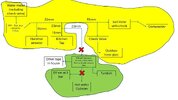
In post #31, thread "Water Hammer" you have a schematic showing a pressure gauge, you say the mains pressure is normally 4.5bar?, did you take this pressure statically, with no flow and before you installed the PRV?, can you post this schematic here showing the position of the PRV and (even roughly) include the distances between the various items.
Edit, you do show the schematic with the PRV, post #12, here, but not the PG, I think you also said that this PG was also remaining at 8bar even after closing off the mains due to a NRV, if you just temporarily slacken the PG connection to give a small leak off dribble then it will read properly for a few tests without having to remove the NRV.
Edit, you do show the schematic with the PRV, post #12, here, but not the PG, I think you also said that this PG was also remaining at 8bar even after closing off the mains due to a NRV, if you just temporarily slacken the PG connection to give a small leak off dribble then it will read properly for a few tests without having to remove the NRV.
Last edited:
In post #31, thread "Water Hammer" you have a schematic showing a pressure gauge, you say the mains pressure is normally 4.5bar?, did you take this pressure statically, with no flow and before you installed the PRV?, can you post this schematic here showing the position of the PRV and (even roughly) include the distances between the various items.
Edit, you do show the schematic with the PRV, post #12, here, but not the PG, I think you also said that this PG was also remaining at 8bar even after closing off the mains due to a NRV, if you just temporarily slacken the PG connection to give a small leak off dribble then it will read properly for a few tests without having to remove the NRV.
So everything is yellow is contained under the kitchen cupboard. Probably no more than 1m long.
Everything in green is in the cylinder cupboard.
The pipe leading to the cylinder from the kitchen is probably a good 10m long as it weaves between joists above the ceiling and up about 4-5m from ground level.
Yeap the 4.5 was before the PRV fitted.
It's the bit about when pressure has built up in the HW system (and the HW cylinder inlet is hot up to the EV), I'm wondering now if this pushing on the NRV the ICG so it doesn't "bang". As soon as I draw off some hot water I've relieved the system so then when I switch to cold it's sending a shock into the ICG. Does this make sense? If this is the case I'm really confused how to fix this! Are Caleffi ICG's any good? Perhaps if I got a G3 to fit another brand?
Or it doesn't hammer if I drain the system and refill. Then I use the hot - switch to cold and it's back again.
Attachments

DIYnot Local
Staff member
If you need to find a tradesperson to get your job done, please try our local search below, or if you are doing it yourself you can find suppliers local to you.
Select the supplier or trade you require, enter your location to begin your search.
Please select a service and enter a location to continue...
Are you a trade or supplier? You can create your listing free at DIYnot Local
Similar threads

- Replies
- 3
- Views
- 4K
- Replies
- 1
- Views
- 1K
D