EPC rating

In the early days you could pay about £35 for an EPC direct
I paid £65 for our EPC through My Builder. He wasn’t there long and I think it was just a job on the side for him. In fact I did notice that most of the appointments were for before 8.30 am or after 5.30 pm.

Sitting round my mums house watching a 12 year old carry out an EPC survey. I think he had to start at 7.30 as he has to be in school shortly…..
 
But it is needed to be able to rent out a house and as of 2030 if you do not have a C rating then you will not be allowed to rent out but it means nothing if you have a C now because The government are looking at further moving the goalposts so that it will mean any house that has a gas boiler will NEVER attain a C whatever else you do.
True, they do and always will serve a purpose legally but that's different to people paying much attention to them.
 
I paid £65 for our EPC through My Builder. He wasn’t there long and I think it was just a job on the side for him. In fact I did notice that most of the appointments were for before 8.30 am or after 5.30 pm.
If you look on the EPC Register you can find assessors close to you, avoiding the likes of Mybuilder.
 
Sounds like a cowboy, hope you didn't pay for it.
With my old house, I found I had an EPC, but I had not paid anyone to do it, think it must have been an error, and he had put wrong house number on the form.

But the points being affected by type of bulb fitted is daft, just too easy to swap them. It is something we are forced to do, but the cost to up the rating is shown in an order no one any sense would follow.

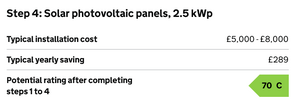
It shows how many points, how much it will cost, and saving, so says I can gain 6 points 1781560216098.png Who would spend the money to put up scaffold for 2.5 kW of solar panels? I fitted 6 kW of panels and have a 5 kW inverter and 6.4 kWh of battery, as to saving, I am paying less than £200 a year for electric including standing charge. So the recommended size is a bit silly unless getting it for free.
 
Do these certificates ever inluence buying decision for anyone?
If intending to rent it out then yes, most definitely. I'd always read it thoroughly if borderline grading. Often it's just lagging the water cylinder or changing the bulbs that would be enough to tip it over into the next grade. Anything greater needed then no, not worth the cost vs return benefits.
 
I looked at mine again.
Hot waterFrom main system, no cylinder thermostatPoor

Well it also has an immersion heater which does have a thermostat, the central heating does heat the DHW in the winter, but can't see how a cylinder thermostat will really change amount of energy used?
LightingLow energy lighting in 23% of fixed outletsPoor

Like to know what was in the other 77% as all are either CFL or LED.
An average household would need to spend £1,130 per year on heating, hot water and lighting in this property. These costs usually make up the majority of your energy bills.
You could save £163 per year if you complete the suggested steps for improving this property’s energy rating.
Well not far off with cost of oil but then the list.
Step 1: Floor insulation (solid floor) 83 years to break even. (2 points)
Step 2: Low energy lighting less than 1 year, but already done. (1 point)
Step 3: Solar water heating. 68 years to break even. (3 points)
Step 4: Solar photovoltaic panels, 2.5 kWp. 17 years to break even. (6 points)
But last two don't make any sense. If you fit solar photovoltaic panels then they can heat the water, so it would be pointless to fit both. I would need it seems 12 points to get to next band, and with the info it gives, that could not be done at a reasonable cost, so to try and get next band does seem pointless pun intended.

I have it would seem gained 10 points with LED lighting, and solar panels which also heat DHW. Electric wise, I am about net-zero, around £150 per year, which is in the main due to standing charge, so it is just the oil bill.

Under the main house is a flat, and the EPC for this says:-
Step 2: Hot water cylinder insulation. (1 point) but it does not have a hot water cylinder, it draws hot water from the house above it.
Step 4: Hot water cylinder thermostat. (1 point) but as above it does not have a hot water cylinder.
Step 5: Heating controls (room thermostat). (2 points) but it has a room thermostat, it was the house above it which had no thermostat.
Again no way would it pay to do any improvements, and can't understand why anyone would have treated the flat and main house as seprate abodes, both the oil and electric is common to both.
 
Like to know what was in the other 77% as all are either CFL or LED.
LightingLow energy lighting in 23% of fixed outletsPoor

Could this refer to non replaceable bulbs/ fittings that have low energy lamps and although the rest (77% ) have cfl or led you can still fit a halogen bulb so you get marked down.
 
A bit pointless then.
Not really, some might want to carry out improvements to lower their carbon footprint/utility costs, some might not. The EPC gives you that information, but of course, you don't have to do anything in a domestic private home.
 
Not really, some might want to carry out improvements to lower their carbon footprint/utility costs, some might not.
Yes I have done improvements. There are two main reasons, one is running costs, which will lower the carbon footprint, and the other is comfort.

So as an example, solar panels reduce running costs, but together with the battery it also ensures with a grid failure my central heating will continue to run. Where putting extra insulation in the loft, may reduce losses, but also makes the loft space unusable, so only half my loft has the extra insulation.

Heating must be a major use of energy, clearly solar panels don't really help, as in winter their output is low, but to heat only as and when required, can reduce the use by a massive amount, however the heat pump technology does not allow fast recovery times, so if we look at two homes, the old peoples home, where the rooms are all heated 24/7 and be it bedroom or living room, due to the nature of nursing care, all rooms are heated 24/7, but before those old people had to go into a home, likely their house had some rooms hardly ever used, I know my house is like that, so having programmable TRV heads for me saves me a lot of money, but in an old peoples home would likely save nothing.

And the EPC does not take into account the lifestyle of the occupants.

So the Step 1: Floor insulation (solid floor) 83 years to break even. (2 points) may be daft, but adding carpets with a thick underlay can do basically the same thing.

For an assessor to walk around in winter with a heat loss measuring gun and say you are losing a lot of heat through your walls, and you can do this or this to help is good, but cavity wall insulation assumed, basically means they have not done their job.

So for an EPC to work, it needs to be done in winter and summer, either on their own is pointless. In the last 15 years I have lived in three houses.
1) Open-plan, reasonably sized windows, main problem was heating in winter.
2) and 3) doors on the rooms, main problem was sun through the windows in summer, getting the home too hot.

So home 2) we were able to stop the overheating by planting apple trees which stopped the direct sun in the summer, problem was winter, where the leafs had fallen, so sun could heat the living room in 2 hours from 20°C to 32°C, the problem in the main was central heating reaction time, once the sun hit the bay windows, we wanted the radiator to stop heating the room as fast as possible. So two things, one was a modulating boiler, so radiators were not stinking hot to start with, and two was a fast acting electronic TRV head. But this was mainly due to bay windows to start with. However, radiators needed to store as little energy as possible, so once turned off they cooled down fast, so an electronic TRV head dropped that peak from 32°C to 25°C, it still warmed up the room, but not as much.

Move to this house, and the living room is too high for trees to stop direct sunlight, windows not quite as big, so winter, there is no problem, with this house problem is in the summer, OK lovely view, 1781617594333.png but the living room in summer gets hot, my cure is an AC and solar panels, to keep the room cool, so costs me nothing to cool the room, but the EPC rating should be saying things like getting the reflective film put on the windows, both 2) and 3) reflective film would have helped.

But to work out what is required, needs a summer and winter visit. For any assessor to work out if growing trees will help, is really only going to happen with a visit at the crucial time.

So to in home 2) to replace the apple trees with evergreens will reduce the overheating in winter, but it would mean no apples.

Each home is unique, there is no one method suits all, and for the owner-occupier the EPC, or EICR, or any other inspection, really only tells them what in the main they already know.

Where it all changes is with rental properties, where the occupier has little option to do major changes. Be it solar panels, or central heating type, they are stuck with what the landlord has done.

However, sleeping rough can easily be the result of forcing landlords, I have seen it again and again where landlords have said enough is enough, and to jump through the government hoops is just not worth the hassle, so have sold the property, so finding a property to rent is getting harder and harder.

OK no one wants to rent property with silver fish, but that must be better than a sleeping bag in the street. In real terms around here, it means the mobile home parks, as since not a building, there are no building regulations.

So I, and I am sure many others, got a surveyors report before buying this house, so what is the point of the EPC?

 
A bit pointless then.
More than a bit pointless
Carried out by "inspectors" with 24 hours of training who make assumptions based on age of the house - for example they assume that you only have 100mm of loft insulation in an older house - no they dont go and check that you actually have at least 270mm
 
So for an EPC to work, it needs to be done in winter and summer, either on their own is pointless
No, an EPC looks at things like U values/heat loss of the structure, boiler efficiency and insulation levels. That is the same winter or summer, cold or warm, and should interest a potential buyer.

As you say it has nothing to do with individual circumstances. Trees aren't part of an EPC.
 

If you need to find a tradesperson to get your job done, please try our local search below, or if you are doing it yourself you can find suppliers local to you.

Select the supplier or trade you require, enter your location to begin your search.


Are you a trade or supplier? You can create your listing free at DIYnot Local

 
Back
Top