ChatGPT > What is it actually measuring?
It is not simply measuring electrical conductivity like a two-pin meter.
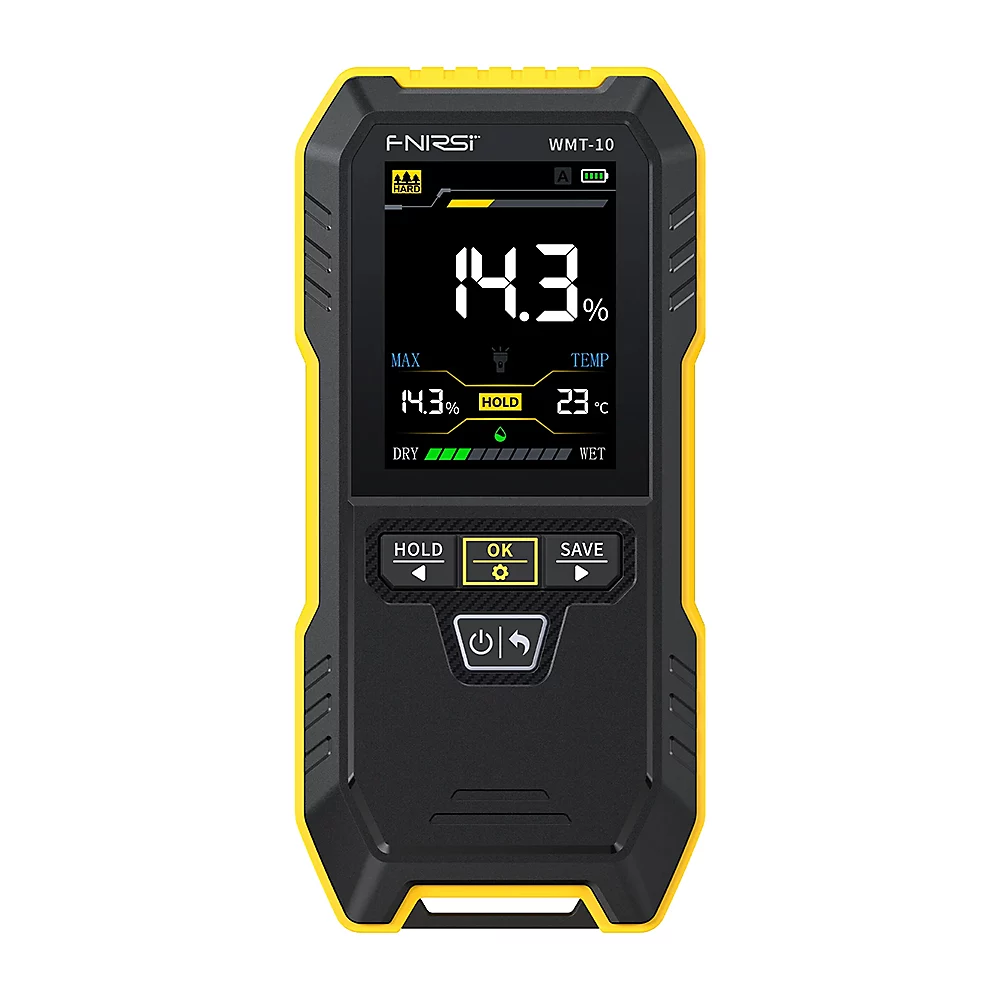
The WMT-10 has a sensor behind the flat face of the instrument. That sensor creates an alternating electromagnetic field which penetrates into the material. The material changes the electrical properties of that field, and the meter interprets those changes as an estimate of moisture content.
FNIRSI describes it as non-contact/inductive testing, with a sensing depth of up to about 17 mm and a sensor area of roughly 40.5 × 40.5 mm.
A simplified picture is:
meter coil/sensor → electromagnetic field → wall → field is altered → electronics measure the change → algorithm estimates moisture %
Water is important because it has a very high dielectric constant compared with dry building materials. Adding water therefore substantially changes the material's electrical properties.
So is it conductivity?
Partly related, but not in the same way as a pin meter.
A conventional pin meter essentially does:
Apply a voltage between two electrodes → measure resistance/conductance → infer moisture.
That's why salt-contaminated masonry can cause pin meters to give very high readings: salts make the material electrically conductive.
A pinless meter instead relies predominantly on dielectric/impedance changes caused by the electromagnetic field. In engineering terms, it's closer to measuring how the material affects an AC electromagnetic field than measuring simple DC resistance.
However, the distinction isn't absolute. Real instruments can be sensitive to both dielectric properties and losses/conductivity, depending on their sensor design and operating frequency. So I wouldn't describe the WMT-10 as a "pure dielectric moisture meter."
Here's the important catch with the WMT-10
The number on the screen is not a direct measurement of "water percentage in the wall."
The electronics measure some electromagnetic property and then the software converts that into a moisture estimate based on an assumed material.
That's why the WMT-10 has different modes for:
plaster wall
concrete/brick wall
softwood
hardwood
The manufacturer's specifications give quite different ranges for the different materials.
So, for example, if you put it on a plaster wall and it says 15%, you shouldn't interpret that as "15% of this wall's mass is water." It's essentially saying:
"The electromagnetic response I'm seeing is equivalent to approximately 15% moisture according to this instrument's calibration for this material."
That's a very important distinction.