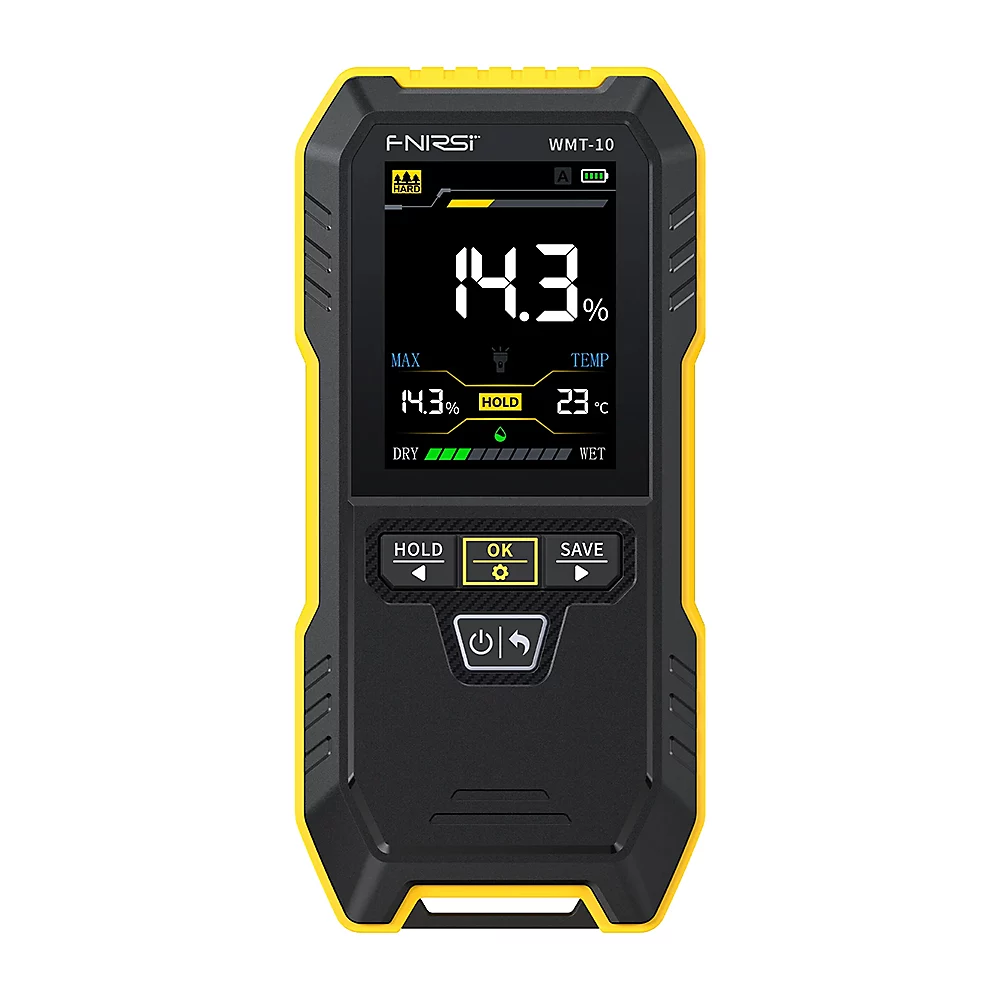
Awesome Quality Damp Meter

Joined
17 Apr 2009
Messages
581
Reaction score
9
Location
Sussex
Country
United Kingdom
Highly recommend this one, only £24 from B&Q but amazing.
Lightning fast and extremely stable
(i.e. if you push it hard into the wall the reading doesn't change)
reads behind skirting boards without pins,
uses wave induction.
Made in China by a company that makes about 400 meters of various sorts.
Absolutely blinding.
Rechargeable via USB, records readings to disk,
I am using it on a chimney
but it seems to be multi material.
Amazing readings = valuable knowledge

wmt 10.webp

 
You can’t detect damp in a wall with that. You would need the proper equipment and take a core sample.

I don't know what you mean by that, it is an excellent bit of kit and the readings are rock solid stable and penetrate beneath the surface which allows you to draw an exact map of the pattern of dampness.
That company, Chinese I'm afraid, makes hundreds of handheld instruments like this and they know exactly what they are doing.
Screwfix has a Bosch one at £259.99
I doubt it would beat this one, sorry to say.
 
Looks like a load of crap like all damp meters. Only a fool relies on the results of one of these devices. Building Surveyors love them. No self respecting good damp expert will have one in their kit.
 
I too am very sceptical about the machine. That said, I have never used that particular one.

The basic pins ones I purchased previously used to lie. I would would test old water stains on plaster and the meter would tell me that the plaster was still damp. One day I put some wallpaper paste over a patch. It was dry the next day- indicating that there was no damp at all.

The pin based versions test continuity. When a dry wall has previously had damp, I guess that the salts become more conductive of the current.

I binned my damp meter. It gave too many false readings.

If I want to know if there is damp in the wall, I now mix up a tiny amount of wallpaper (starch) based paste. If it is dry and no longer sticky the next day there is no damp. You can then wash away the paste after.

If trying to determine if you are dealing with condensation or damp- tape some bacofoil to the wall- if the surface is wet, it is condensation. If it is wet on the reverse, it might be damp (that said, the latter is not definitive given that the wall may already have been wet before you put the bacofoil on).
 
Believe me I have a large collection of these f ing pieces of xxxxe.
Smash them all with a hammer.

But that Chinese unit is rocksolid quality.
Try it and you can send it back for a refund if unsatisfied.

Here is a list of all the other handheld units they do, it's a long list from a serious company.


pinned.jpg
 
ChatGPT > What is it actually measuring?

It is not simply measuring electrical conductivity like a two-pin meter.

The WMT-10 has a sensor behind the flat face of the instrument. That sensor creates an alternating electromagnetic field which penetrates into the material. The material changes the electrical properties of that field, and the meter interprets those changes as an estimate of moisture content.

FNIRSI describes it as non-contact/inductive testing, with a sensing depth of up to about 17 mm and a sensor area of roughly 40.5 × 40.5 mm.

A simplified picture is:

meter coil/sensor → electromagnetic field → wall → field is altered → electronics measure the change → algorithm estimates moisture %

Water is important because it has a very high dielectric constant compared with dry building materials. Adding water therefore substantially changes the material's electrical properties.

So is it conductivity?

Partly related, but not in the same way as a pin meter.

A conventional pin meter essentially does:

Apply a voltage between two electrodes → measure resistance/conductance → infer moisture.

That's why salt-contaminated masonry can cause pin meters to give very high readings: salts make the material electrically conductive.

A pinless meter instead relies predominantly on dielectric/impedance changes caused by the electromagnetic field. In engineering terms, it's closer to measuring how the material affects an AC electromagnetic field than measuring simple DC resistance.

However, the distinction isn't absolute. Real instruments can be sensitive to both dielectric properties and losses/conductivity, depending on their sensor design and operating frequency. So I wouldn't describe the WMT-10 as a "pure dielectric moisture meter."

Here's the important catch with the WMT-10

The number on the screen is not a direct measurement of "water percentage in the wall."

The electronics measure some electromagnetic property and then the software converts that into a moisture estimate based on an assumed material.

That's why the WMT-10 has different modes for:

plaster wall
concrete/brick wall
softwood
hardwood

The manufacturer's specifications give quite different ranges for the different materials.

So, for example, if you put it on a plaster wall and it says 15%, you shouldn't interpret that as "15% of this wall's mass is water." It's essentially saying:

"The electromagnetic response I'm seeing is equivalent to approximately 15% moisture according to this instrument's calibration for this material."

That's a very important distinction.

 
Sensing depth 17mm , that’s a joke , you need a core sample from middle of wall to accurately detect damp .
Surveyor used one on my last home , gave a 100% reading , the wall was power dry , it had a foil lining behind the wall paper .
 
A core sample ? Like in Antarctica ?
What for - to see the fossil record ?
I don't think think this property is that old .... but if it was it would explain a lot !
 
It's never ever the meter, how much it cost or how many features it has. Never.

It's always how it is used, and the users ability to correctly interpret the readings in context of what is being measured.
 
A core sample ? Like in Antarctica ?
What for - to see the fossil record ?
I don't think think this property is that old .... but if it was it would explain a lot !
To correctly test for damp brick work it is drilled to obtain a core sample and pressure chamber device is used to detect damp , any moisture detected by a meter at surface is irrelevant . Amazed by your ignorance .
 
A core sample ? Like in Antarctica ?
What for - to see the fossil record ?
I don't think think this property is that old .... but if it was it would explain a lot !
the surface of wall etc can be very influenced by daily events, how many people are in the room, cooking activity .... and as such readings can swing wildly - you really need to be 10mm deep or more to get any real indication- accuracy of the numbers is far less important than the skill in how and where they were taken
 

If you need to find a tradesperson to get your job done, please try our local search below, or if you are doing it yourself you can find suppliers local to you.

Select the supplier or trade you require, enter your location to begin your search.


Are you a trade or supplier? You can create your listing free at DIYnot Local

 
Back
Top