What is weather compensation?

Joined
27 Jan 2008
Messages
29,433
Reaction score
3,615
Location
Llanfair Caereinion, Nr Welshpool
Country
United Kingdom
I read about people having it on their system, and scratch my head to work out how it all works. So correct me if wrong, the thermostat controls the amount of heat which is used by each room, often the thermostat is programmed, so room temperatures vary through the day, and the thermostat can tell the boiler in two ways, as to if more or less heat is required, either by the return temperature of the water, or electrically.

Using the electric method, again two options digital i.e. on/off, or analogue, i.e. up/down, the problem with analogue is some hub has to collect all the on/off signals from the thermostats and turn them into an analogue signal. As we have many thermostats around the house, and other than EPH which can set them up as master and slaves, most systems either would need to use either just one thermostat for whole house, OK with hot air system, but not really with water, or some hub to work out how much heat is required based on how many TRV heads are calling for heat. This would only work if all TRV heads are linked, in the main we run on a near enough system, with key thermostats able to fire the boiler, and most TRVs only regulate the water and don't electrically connect to any hub.

So in the main, the boiler output is controlled by the return water temperature, in early versions the feed water temperature, as to if the boiler turns on/off, or modulates, either way it adjusts output in the main depending on the return water temperature. With condensing boiler we want that analogue control so it can gain the latent heat of the flue gases. So we want to avoid any thermostat turning the boiler off, unless all rooms are satisfied.

I suppose the wall thermostat is there to tell the boiler it is needed, where the return water temperature will tell it when not needed, but is seems this is not used, but the demand on the boiler is down to how many TRV heads are calling for heat.

This will be more down to the program running in each TRV head, to what the outside temperature is doing, and I just can't get my head around what weather compensation does, the more I think about it, the less sense it seems to make.

So what does it do?
 
I know you are trying to help, and thank you but the first thing I not is
room stat.
But that has an s missing, I have in main house 12 room thermostats, some wall and some TRVs, all programmable, and 3 linked to boiler, so the most efficient flow temperature will vary a lot more down to how many devices are calling for heat, to what the outside temperature is.

At 9 am I would say it needs a high flow temperature as all the TRVs are opening, this is down to time of day not outside temperature, which may have a small bearing on what is required, but in comparison to variations due to which rooms are calling for heat, it is very small.

So is weather compensation a left over from a bygone age before the programmable TRV came out?
 
So is weather compensation a left over from a bygone age before the programmable TRV came out?
Not really, it's one of the reasons I don't recommend micro managing homes with individual room controls. If you have that with multiple room stats then weather compensation is not for you.
 
I must admit there seems to be two vastly different approaches to heating the home. With an old peoples home you want all rooms same heat 24/7 as no one can ever seem to agree what heat is the best.

But I find I can't sleep in a hot room, during the day 10°C to 25°C I just change what clothes I am wearing, but at night, even if the AC is making a lot of noise, where I was living in hot countries, like in Hassi R'mel in Algeria, I had to have a cool room at night. 54°C in the day was OK as long as a still day, but at night I want it cool.

But although my boiler does not monitor return water temperature and modulate to gain latent heat, I know many do, so an analogue control is essential, turn a boiler off with an external control, and it needs to start setting its output from scratch all over again.

The more thermostats connected to a hub, the easier it is to not turn off the heating too early, and if only on TRV heat is calling for heat, then boiler should not turn off, but I know of the 12 thermostats in the main house, only 3 can turn the boiler on/off. But still not got my head around how measuring outside temperature helps.

I can see if -5°C outside, then the boiler should never turn off, and if 15°C outside then it may reach a point where the boiler can't reduce output enough so must turn off.

However, with analogue controls, it should be easy enough to say if the thermostat is at minium and the temperature is still raising then the boiler must be turned off. How does outside temperature help?

I remember looking at geo-fencing, and thinking what a great idea, the further to drive from home the cooler it can let the house be, and once it senses you are returning it can slowly warm the house as you approach so once home it is back to temperature required.

However it seems it did not work that way, as it detected you had left the house it turned the heating off, and it did not turn it back on again until one was nearly home, so yes when you walked through the door, heating already on, but house was still cold, so in real terms geo-fencing is useless.

Maybe weather compensation is something simular, and it only works with homes with hot air central heating or something like that?
 
How does outside temperature help?
It doesn't for that. It adjust the flow temps, cold outside and staying cold it will be pretty constant maybe cooling a bit until the room stat is satisfied. If it's cold outside but heats up then the flow temp will cool down so the temp doesn't overshoot the room stat. Cold outside means more heat loss so flow temps will be higher, but the opposite as the outside temperature heats up.
Maybe weather compensation is something simular, and it only works with homes with hot air central heating or something like that?
Mine is saving me money, along with opentherm controls, on a typical wet radiator system.
 
However, with analogue controls, it should be easy enough to say if the thermostat is at minium and the temperature is still raising then the boiler must be turned off. How does outside temperature help?
That's reacting to the room temperature change (load compensation). Weather compensation is attempting to anticipate the demand before the room temperature changes. So in an ideal system it'll always be superior at modulating the boiler before it has to cycle.

Most of us do not have ideal systems though, the weather comp curve is set up assuming a specific heat loss and radiator efficiency. If you're cooking, opening a window, lagging your radiators with clothes, closing off parts of the system (trvs) etc you change the parameters, and that's where load compensation can be more effective.
 
So unless one goes to the lengths of a building management system, it is either programmable TRVs or weather compensation not both. That makes some sense.

I have many times questioned analogue control, with PLCs it was really 253 steps, and the question is how many steps are really required?

So a home with one thermostat controlling the boiler, if digital i.e. on/off, every time it turns off/on, it resets the boiler, so in the main not good, it can be set so the TRVs cause it to rarely turn off in cold weather, but a single analogue thermostat would work far better.

But even if the Wiser/Evohome etc. hub can run in analogue mode, as long as you have multi-sensors, be they wall thermostats or TRVs in the main the boiler will not switch off very often, but run at reduced output.
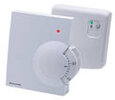
What messes it all up, is a thermostat like this, 84067_P.jpgit was a very clever design in its day, designed for on/off boiler not modulating, it would start turning the boiler off/on before it reached temperature and also after, slowly adjusting the mark/space ratio, so the home did not over shoot. It worked very well.

However, with a condensate modulating boiler, it completely messed up the boilers own antihysteric system, yet found it on a professionally fitted boiler. Same firm also ran water direct from mains into a power shower, so I rated them as cowboys.

They got so much wrong with the controls, I lost faith with heating engineers, and started to question what they did. However electricians were the same, ask why they did that, and answer is because we always do it that way, no thought as to why. So as technology has changed they have not, more conserned as to if a bulb is called a bulb or a lamp, as to how to actually light the room.

Same with plumbers, cistern, tank, cylinder, does it matter as long as we can work out what the item is. After all the furness is still called a boiler, and if it boiled was we would say it's faulty.

I do have a hysteresis problem, there will always be a slight problem with an on/off boiler, but I think with the right setting it can be reduced, but until winter, not much I can do.
 
I've done a lot of fiddling with weather compensation over the last 12 months, with our midea ashp.

We have temp sensors in most rooms but as denso suggests for most residential homes the way forward is less individual room stats/controls.

Pure weather compensation relies on no room stat control (load compensation) whatsoever. The outlet flow temperature through the radiators will only be controlled by the outdoor temperature- ashps have an external temp sensor built in for this purpose. The weather compensation curve, which is actually more like a straight line, will be a simple plot of "if external temp is x, outlet flow temp is y". It is amazing how well this works and how stable it maintains indoor temperatures....95% of the time.

What compromises the above approach is when it is very windy, or a lot of solar gain, so we have found that we need some minimal form of load compensation to slightly adjust the outlet flow temp by 1 or 2 degrees C if the indoor temp is under, or over shooting. I use a simple tapo temp sensor in our hallway and this 'integrates' with our ashp using home assistant. This will then as said slightly adjust our weather compensation curve up or down until the indoor temp stabilises, and then it will go back to the default curve.

This approach results in a perfectly stable indoor temp 24/7. We do use smart TRVs sparingly in the bedrooms to prevent overshooting and can also adjust the temp slightly down at night. We could easily set up a night time set back for the whole house if we wanted, but we personally don't this.

What you generally don't want is over use of TRVs and closing down a lot of the circuit as this impacts on overall efficiency of the system by restricting flow rates and how much heat can be dissipated. This is the other reason that it's normally a bad idea having individual room controls and homeowners trying to micro zone their house as if they actually looked at heating costs and what they are saving by doing this they'd probably discover that is is very little. The heat source, whether this be a heat pump or boiler, will then be excessively cycling as it cannot dissipate the heat quickly enough through the circuit. Aside from negligible cost savings, generally the less cycling the better for the actual health of the appliance as well.

We've also balanced the radiators to then even out the heat output across the rooms as whilst the emitter size has obviously been calculated to compensate for that rooms specific heat loss, that isn't precise so this has needed a bit of fine tuning.
 
.We have temp sensors in most rooms but as denso suggests for most residential homes the way forward is less individual room stats/controls.
Not in our house. For some of the reasons previously given, some of our rooms have massively varying requirements. Take dining room - door closed, gets nicecand toasty quite quickly; door open, all the heat bu***rs off upstairs to the lounge. Then the lounge has a high vaulted ceiling (not ideal in winter), but also large south and west facing windows, so can need "lots" of heat or very little.

"So keep the door closed" is probably in your mind. Not when you have a menagerie who like the freedom of the house :rolleyes:
Pure weather compensation relies on no room stat control (load compensation) whatsoever. The outlet flow temperature through the radiators will only be controlled by the outdoor temperature- ashps have an external temp sensor built in for this purpose.
Which then fails when cooking, or a door is open, or ...
What compromises the above approach is when it is very windy, or a lot of solar gain,
Or, an intelligent system so the TRVs can indicate the requirements, the flow temp set to the most demanding, and the rest throttle flow as required.

It's where I am heading, but lack time to sort it :(
 
This is the other reason that it's normally a bad idea having individual room controls and homeowners trying to micro zone their house as if they actually looked at heating costs and what they are saving by doing this they'd probably discover that is is very little.
The big issue I have with micro managing things and turning off rooms completely when not in use, is a "proper" heat loss and radiator sizing outcome.

For a typical 4m x 4m living room the radiator requirement is less than 1kw, for the same with no advantageous heat gain from neighbouring rooms it is over 3kw. If you assume the lower then it won't be big enough when the other rooms are off, if you go for the worst case scenario then the radiators will be massively oversized when all the rooms are heating up, and cost as much as 4 times more.

I get tweaking things a bit with TRV's but continually switching rooms on and off isn't worth it, IMHO. And with weather compensation to work properly, which saves money in itself, it is a non starter.
 
A guy is coming to change our old radiators to smaller units without room controls - the new combi-boiler and monitoring thermostat does such a good job in keeping everything in order without any need for them.
 
The heat source, whether this be a heat pump or boiler, will then be excessively cycling as it cannot dissipate the heat quickly enough through the circuit. Aside from negligible cost savings, generally the less cycling the better for the actual health of the appliance as well.
This is something I had been looking at.
We've also balanced the radiators to then even out the heat output across the rooms as whilst the emitter size has obviously been calculated to compensate for that rooms specific heat loss, that isn't precise so this has needed a bit of fine tuning.
I found this method did not work too well with second house.
We do use smart TRVs sparingly in the bedrooms to prevent overshooting
That was the main problem, leave a bedroom door open, and that room would become far too hot.

First house the hot air was fed with ducts to each room, and returned through vents in each door, and one thermostat did control whole house, but since then my homes have had a water distribution system, the second house was open plan, so the TRVs stopped bedrooms over heating.

But you need a central point to locate a thermostat/sensor which reflects the whole house, and this house the hall and landing cool slower than the rooms off it, so although one can adjust heating time with a lock shield valve one can't control cooling time, so the hall/landing was not the place to monitor whole house, and it basically cuts the house in two, with north side and south side, and the south side does get the sun, so is naturally weather dependent, where the north side is more temperature dependent.

So like @SimonH2 I do need some individual room control but also @drives point of running a boiler with only one radiator open is also a consideration.
For a typical 4m x 4m living room the radiator requirement is less than 1kw, for the same with no advantageous heat gain from neighbouring rooms it is over 3kw.
Not found it quite that bad, well living room twice that size at least, three walls are outside walls, of the wall left, one bit divides to under stairs cupboard unheated, then the fire place, then door, and then bathroom. So only heat loss or gain is up or down and the door. So likely does heat bedrooms above, but the insulation between it and flat below means very little loss or gain through the floor.

Therefore, the living room does not lose or gain heat from rest of house except through the door, I think previous owners used the open fire. I suppose we have enough wood around, and it would be free heat, but I remember drafts, and dusting with open fires, no thank you, not again.
new combi-boiler
I think for me that would be a back-wards step, I can't see how heating DHW alone works, done it twice, second house and mother house, the DHW was heated direct with gas, the problem in both cases, the DHW pipes were designed for stored hot water, and far too large bore. So the heat loss from the pipe work was quite significant, in winter heat loss from DHW pipes does not matter, it goes to heating the house, but summer, the more central the hot water store is to the outlets the less loses, and heating DHW with off-peak or solar is far cheaper to using gas, so only reason for a combi-boiler is to use the space where the cylinder is for something else. Monitory wise, they don't help, they only help space wise.

But I must admit I only have one TRV head linked to the hub, so main house, wife's bedroom, hall, and living room being too cold can fire the boiler, all other rooms rely on the boiler already being running. I retained the hall thermostat 1) so not relying on primary cell batteries. 2) so can fire boiler for DHW if required. 3) it displays the temperature in the hall so warns if something going wrong. But being hard-wired, it is really no use, as in centre of the house which is always the warmest place, I was conned into buying Nest Gen 3, being told it worked with Energenie TRV heads, well one, it worked wrong way around, the wall thermostat told the TRV what to do, and two, when Google took over, it stopped working with Energenie. Now I also have Wiser, which is far better, but still looking at ways to improve control, as the re-heat time for my house is long.
 
The big issue I have with micro managing things and turning off rooms completely when not in use
Who said anything about turning off completely ?
I'm working my way towards programmable stats (currently Salus T510) in each room. It's not so much "on and off" (though they do have setbacks when not used), but controlling the temperature of each individually.
For a typical 4m x 4m living room the radiator requirement is less than 1kw, for the same with no advantageous heat gain from neighbouring rooms it is over 3kw. If you assume the lower then it won't be big enough when the other rooms are off, if you go for the worst case scenario then the radiators will be massively oversized when all the rooms are heating up, and cost as much as 4 times more.
I've been steadily putting larger rads in as I've been "doing up" rooms. In most cases it doesn't make much difference - and in the lounge I've put a 3m long by 180mm high K22 rad using otherwise wasted space behind the reclining sofa. It heats the room up quickly when we want it to, but just ticks over on the stat once warm (or if we've heat coming up from downstairs, or lots of solar insolation, or ...)

But how does a larger rad "cost 4x more" ? Yes, there's a one-off cost, but once fitted the running costs should be lower by allowing operation at lower temperatures. That's where the "intelligent" controls come in - the flow temperature should be set by the room with the highest demand with it's control valve open, while other rooms will throttle the flow to suit requirements. The "lead" room will probably change - e.g. once the lounge up up to temperature, it'll throttle back and another room can take over flow temperature control. Done intelligently, one rad will be fully open all the time there's heating demand.
And with weather compensation to work properly, which saves money in itself, it is a non starter.
Weather compensation is a throwback to "one stat to rule them all" thinking - i.e. the 1960s called and said hello :ROFLMAO: It cannot save money over an intelligent system with individual room control - at least, not without sacrificing comfort which is the main point of central heating.
As several have admitted, perfection in thermal balancing is impossible to achieve in the real world where doors get left open or closed, the sun is shining in or not, someone is cooking or not, someone is showering or not, ... So if you run a system on the basis of a "central sensor to rule them all" you are 100% guaranteed to spend most of the time with rooms too warm or not warm enough.
A decent intelligent system individually controlling each room will do everything weather comp does - but much much better, and while giving better comfort. Not found one yet, haven't the time to develop one :( Can be done with something like OpenHAB, but also want to avoid reliance on a central server for even the basics.
That was the main problem, leave a bedroom door open, and that room would become far too hot.
As the saying goes, even the best of plans usually fails when it meets reality :rolleyes:
So like @SimonH2 I do need some individual room control but also @drives point of running a boiler with only one radiator open is also a consideration.
One of the reasons for having a thermal store - apart from getting rid of the "work of the devil" combi. Gives a nice neutral point, so I can run the heating off a fully modulating pump that is happy to go down to zero flow rate in a controlled manner. That means I can run it on constant head - so flow rate will vary with load, without the hissing that typically accompanies partially open valves when the system is throttled back.
The intent eventually will be to control the temperature of the thermal store so that it's a) got enough heat higher up for hot water requirements, and b) just enough heat lower down where the heating tap off is to satisfy the heating.
I think for me that would be a back-wards step, I can't see how heating DHW alone works, done it twice, second house and mother house, the DHW was heated direct with gas, the problem in both cases, the DHW pipes were designed for stored hot water, and far too large bore.
It wasn't so much stored heat, it was gravity systems - when you've only a few feet head from the header tank in the loft, then you need 22mm (3/4" in old money - just pulled the last of that out of this house) or larger pipes to get decent flow. Now we're on mains pressure water, everything is 15mm - less volume to "flush through", less surface area to lose heat, and lagged where I've been working and/or can get at them.
... when Google took over, it stopped working with Energenie.
One of the criteria I have for "most things" is "doesn't rely on someone else's computer" (a.k.a. the cloud) to work. Stuff like central heating isn't something you want to be ripping out and replacing (even if it's only controls) every few years just because some corporation got bored and wanted to sell you the new s**t.
 
Who said anything about turning off completely ?
Eric has said it often, "no point heating rooms that aren't used".
Weather compensation is a throwback to "one stat to rule them all" thinking - i.e. the 1960s called and said hello :ROFLMAO:
Of course it isn't, it's completely different, in the 60s the outside temperature wasn't a factor at all.
But how does a larger rad "cost 4x more" ?
The example I gave, 960w vs 3400w, £42 vs £242 on Screwfix.
It cannot save money over an intelligent system with individual room control - at least, not without sacrificing comfort which is the main point of central heating.
Not my experience, if that's yours, then great.
As several have admitted, perfection in thermal balancing is impossible to achieve in the real world where doors get left open or closed, the sun is shining in or not, someone is cooking or not, someone is showering or not,
Of course, I've said that often. But some houses, yours and Eric's at least, sound far for the norm and if you need particular tweaks to make it work better, then great.
So if you run a system on the basis of a "central sensor to rule them all" you are 100% guaranteed to spend most of the time with rooms too warm or not warm enough.
Not my experience at all, central stat with opentherm, weather compensation and manual trv's works just fine for me and the ones I install.
 

If you need to find a tradesperson to get your job done, please try our local search below, or if you are doing it yourself you can find suppliers local to you.

Select the supplier or trade you require, enter your location to begin your search.


Are you a trade or supplier? You can create your listing free at DIYnot Local

 
Back
Top