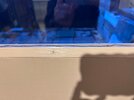
Water coming through glass on external wooden door

Joined
4 Mar 2025
Messages
17
Reaction score
0
Country
United Kingdom
Hello and help.
We recently had a wooden door made & fitted, the glass came separate and was put in by the joiner. All good… or so we thought. With the recent storm I noticed the wind was blowing the rain underneath the glass and it was coming inside the door. Obviously I was horrified but on closer inspection realised there’s no sealant around the glass. It’s just been placed in the gap with the wooden beading pinned inplace. It feels very sturdy and secure but does that also need some kind of weather sealing?
I’ve attached a photo to show what I mean.
When looking online all the information I find seems to be about sealing the external frame but I can’t find details on the glass itself
Is there a particular sealant I should get to go around the glass?
Should I remove the glass to ensure inside is fully dry?
Any advice would be greatly appreciated.
Thank you

 

Attachments

  • IMG_4867.jpeg
    IMG_4867.jpeg
    583.2 KB · Views: 33
  • IMG_5210.jpeg
    IMG_5210.jpeg
    573.6 KB · Views: 33
The wavy line at the base of the glass in the second pic could be the ill fitted rubber seal that is letting the water in. Unless your confident re fitting it get the joiner back.
 
The wavy line at the base of the glass in the second pic could be the ill fitted rubber seal that is letting the water in. Unless your confident re fitting it get the joiner back.
I think the wavy line is actually water that’s got inside. Yep I’m not confident so will get him back out to re seal it asap. Thank you
 
No rubber seal , it’s silicon .

I think you are correct. And it looks like the silicone might have a gap in it.

I suspect the joiner/fitter will simply apply silicone around the glass on the outside. I would be inclined to specify a clear MS polymer instead of silicone. I say that as a decorator. Paint does not adhere to silicone. I get grumpy when I have to cut away excess silicone before I can repaint doors/windows. MS polymers are not quite as flexible as silicone, but they will accept paint.

I might be wrong but I think I recall @crank39 mentioning a product sold specifically for the installation of DGUs in timber.
 
There doesn’t seem to be any seal rubber or silicone, I’ve messaged the fitter to confirm. I’m assuming we will need to remove the beading to ensure inside is fully dry before replacing and siliconing? Thanks for the replies
 
I might be wrong but I think I recall @crank39 mentioning a product sold specifically for the installation of DGUs in timber.

Having been Awol for a while, I dont know what Crank may have suggested but we use a Butyl Flexistrip, fondly known as ' putty on a roll'. We use the one made by Hodgson Sealants. You don't need to go to the expense of a whole box , Reddiseals sell it by the 19mtr roll
 
Having been Awol for a while, I dont know what Crank may have suggested but we use a Butyl Flexistrip, fondly known as ' putty on a roll'. We use the one made by Hodgson Sealants. You don't need to go to the expense of a whole box , Reddiseals sell it by the 19mtr roll

Ahh... that is what it is called. Tnx.

I take it that you only use it on the outer face.

Do you let it sit slightly proud and trim the excess to prevent water pooling?

Sorry for all the questions. I have only used tube based sealants in the past.
 
There doesn’t seem to be any seal rubber or silicone, I’ve messaged the fitter to confirm. I’m assuming we will need to remove the beading to ensure inside is fully dry before replacing and siliconing? Thanks for the replies

If there is no seal, I would expect the glass to rattle when you tap it.

An easy way to test would be to push a filler knife in and see how deep it goes.
 
Ideally you use it on both faces , as you would in the past with putty.
And yes put it on so some is proud of the rebate ( literally 1-2 mm so majority is on rebate ) then cut off any excess.
 
Ideally you use it on both faces , as you would in the past with putty.
And yes put it on so some is proud of the rebate ( literally 1-2 mm so majority is on rebate ) then cut off any excess.

So both faces even when installing a DGU in timber? I had always, perhaps, incorrectly, thought that they should only be held captive on one side to allow each pane of glass to move, or is the case that the the butyl allows movement of both sides?

Again, tnx
 
Butyl strip is a lot like blutac in consistency when first applied so allows for movement
 

If you need to find a tradesperson to get your job done, please try our local search below, or if you are doing it yourself you can find suppliers local to you.

Select the supplier or trade you require, enter your location to begin your search.


Are you a trade or supplier? You can create your listing free at DIYnot Local

 
Back
Top