
You are using an out of date browser. It may not display this or other websites correctly.
You should upgrade or use an alternative browser.
You should upgrade or use an alternative browser.
Drilling a cast iron soil pipe
- Thread starter endecotp
- Start date


I’ve done this dry; what exactly would you use for lubrication?
Drilling cast iron is self-lubricating.
So.....
Buoyed by my success with the scrap bit of pipe (post #13), this afternoon I have attempted to drill into the real pipe.
The material seems to be massively harder. After maybe 30 minutes of drilling (with breaks), it has barely got below the tip of the drill. And the drill seems to have worn down significantly in the process. It hasn't got to the point where the hole saw is in contact with the metal.
I've actually changed the pilot drill for one from another hole saw, previously used only on wood I think so still quite sharp, with no improvement.
I think these pilot drills are just regular HSS. So I could get a 1/4" drill better suited to cast iron and use that to finish the hole. But then I still have the actual hole-sawing to do, and I imagine that the saw I have will be similarly useless.
Please share your advice. Especially if you've ever actually done this!
Thanks.
Buoyed by my success with the scrap bit of pipe (post #13), this afternoon I have attempted to drill into the real pipe.
The material seems to be massively harder. After maybe 30 minutes of drilling (with breaks), it has barely got below the tip of the drill. And the drill seems to have worn down significantly in the process. It hasn't got to the point where the hole saw is in contact with the metal.
I've actually changed the pilot drill for one from another hole saw, previously used only on wood I think so still quite sharp, with no improvement.
I think these pilot drills are just regular HSS. So I could get a 1/4" drill better suited to cast iron and use that to finish the hole. But then I still have the actual hole-sawing to do, and I imagine that the saw I have will be similarly useless.
Please share your advice. Especially if you've ever actually done this!
Thanks.
- Joined
- 21 Mar 2024
- Messages
- 592
- Reaction score
- 168
- Country

30 minutes rofl. Cast drills easy with a sharp drill and you should be through it in seconds if it's cutting. You'll have work hardened that spot now and it will likely be very difficult to drill. Try a brand new drill roughly the size of the pilot in another spot - slow speed setting and good pressure. Burst it a couple seconds at a time, make sure you can see swarf coming out - if its not discard and get a new drill immediately. Once youve proven you can get through give the hole saw a bash - if it struggles get a tungsten carbide one, they're not that dear
30 minutes rofl. Cast drills easy with a sharp drill and you should be through it in seconds if it's cutting. You'll have work hardened that spot now and it will likely be very difficult to drill. Try a brand new drill roughly the size of the pilot in another spot - slow speed setting and good pressure. Burst it a couple seconds at a time, make sure you can see swarf coming out - if its not discard and get a new drill immediately. Once youve proven you can get through give the hole saw a bash - if it struggles get a tungsten carbide one, they're not that dear
Thanks for that! “Work hardening” sounds like a plausible and interesting possibility.
Regarding drills - some include cast iron in their “suitable for” and some don’t. I now wonder if I should take any notice of that. Tomorrow, I could get a pack of 5 “suitable for metal” Erbauer drills and/or one Bosch “suitable for steel and cast iron” drill.
Cobalt pilot
Cobalt pilot
Thanks.
At one point, I got the impression that cobalt drills might be less suitable for cast iron. Now why was that….
Ah yes:

Bi-Metal Hole Saws for Wood, Metal & Plastic | UK Drills
Bi metal hole saws for clean cuts in wood, plastics and metal using the correct arbor and speed. Fast UK dispatch from a specialist supplier.
 ukdrills.com
Note that their “bi-metal” hole saw says “suitable for: … cast iron”. Now tap on the “cobalt” tab and it says “For wood, plastics, steel and stainless steel”.
But then look at drills, rather than hole saws:

Cobalt Drill Bits for Stainless Steel & Hard Metals | UK Drills
Shop M35 cobalt drill bits for stainless steel, harder metals and heat-resistant drilling. 5% cobalt alloy drill bits with fast UK dispatch.
ukdrills.com
and it’s the “cobalt 5%” drills that say “cast iron”.

Are you sure about that???And you can't discharge condensate into a cast iron stack either!
Latest update:
Success, with a new Bosch HSS drill I was through in about a minute, using bursts as described. But:
Brand new hole saw, same model as before. It did the first couple of mm OK but then stopped making any progress.
I do wonder if it gave up when I first squirted it with water - might that cooling contribute to hardening? I wasn’t using any water when I did the experiments outside.
I guess that’s the next step then!
Try a brand new drill roughly the size of the pilot in another spot - slow speed setting and good pressure. Burst it a couple seconds at a time, make sure you can see swarf coming out - if its not discard and get a new drill immediately.
Success, with a new Bosch HSS drill I was through in about a minute, using bursts as described. But:
Once youve proven you can get through give the hole saw a bash
Brand new hole saw, same model as before. It did the first couple of mm OK but then stopped making any progress.
I do wonder if it gave up when I first squirted it with water - might that cooling contribute to hardening? I wasn’t using any water when I did the experiments outside.
- if it struggles get a tungsten carbide one, they're not that dear
I guess that’s the next step then!
Last edited:

Its fine to put it into cast as long as its in the wet bit ie it can't be the top connection to the stack.Well, I was!
As long as you have a bath, basin or wc above it there's no problem

- Joined
- 21 Mar 2024
- Messages
- 592
- Reaction score
- 168
- Country
Possibly, might mean you're sort of quenching the metal. I drill a lot of stainless at work and never use water or cutting fluid, you just need to keep an eye on it because when it stops cutting its heating and you'll never get through it. Those carbide hole saws are the tits though, drilled through tons of stainless and 10mm plate with themLatest update:
Success, with a new Bosch HSS drill I was through in about a minute, using bursts as described. But:
Brand new hole saw, same one as before. It did the first couple of mm OK but then stopped making any progress.
I do wonder if it gave up when I first squirted it with water - might that cooling contribute to hardening? I wasn’t using any water when I did the experiments outside.
I guess that’s the next step then!
I note that e.g. this TCT hole saw doesn't mention cast iron:
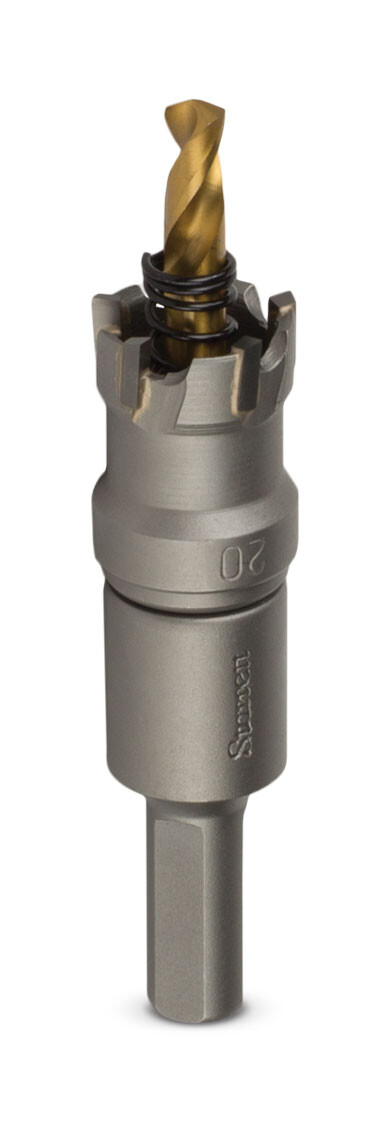
 www.lawson-his.co.uk
Oh, what to do?
The test pipe in the garden was so easy. Drilling the pilot hole this morning with a fresh drill was so easy. Now there's actually a hole in the pipe, so it would be preferable to finish that one. Possibly using a TCT hole saw, if that might be better at removing the now-hardened metal? Or maybe I should just start in a new spot and drill without any water like I did on the test piece and be through in a couple of minutes.
Related, unhappy, question: what's the best way to fill a hole you've abandoned in a cast iron soil stack? I'm thinking a blob of epoxy, or something of that sort.
Starrett SM22 22mm / 7/8" TCT Stainless Steel Hole Saw
For cutting high alloy and stainless steels, non ferrous light metals and reinforced fabrics. . Tough tungsten carbide tipped teeth have a positive cutting angle which provides fast and efficient removal of chips and swarf. . Ideal for production cutting. . Tungsten carbide tipped teeth provide...
www.lawson-his.co.uk
Oh, what to do?
The test pipe in the garden was so easy. Drilling the pilot hole this morning with a fresh drill was so easy. Now there's actually a hole in the pipe, so it would be preferable to finish that one. Possibly using a TCT hole saw, if that might be better at removing the now-hardened metal? Or maybe I should just start in a new spot and drill without any water like I did on the test piece and be through in a couple of minutes.
Related, unhappy, question: what's the best way to fill a hole you've abandoned in a cast iron soil stack? I'm thinking a blob of epoxy, or something of that sort.
- Joined
- 21 Mar 2024
- Messages
- 592
- Reaction score
- 168
- Country
Believe me it'll fly through that, hardened or no.

DIYnot Local
Staff member
If you need to find a tradesperson to get your job done, please try our local search below, or if you are doing it yourself you can find suppliers local to you.
Select the supplier or trade you require, enter your location to begin your search.
Please select a service and enter a location to continue...
Are you a trade or supplier? You can create your listing free at DIYnot Local
Similar threads
- Replies
- 10
- Views
- 9K
- Replies
- 4
- Views
- 5K