115V AC between the dishwasher and the tile edging?

Joined
2 Apr 2017
Messages
99
Reaction score
8
Country
United Kingdom
I was lying on the floor trying to inspect the bottom hinges of the dishwasher door, as it was sticking, and I suddenly felt like I'd had something jabbed into my leg by the tile edging. I couldn't see or feel anything on the edging that would cause that, so I went back to what I was doing, and it happened again.

Cut to the chase, it was only happening when I had my hand on the metal inner of the dishwasher door and my bare leg was touching the edging.

My multimeter appears to be showing 115V AC between the two.

So how does that happen? How has the edging apparently become part of a circuit?

EDIT - I've also confirmed that there's 115V between the door and the washing machine, and the door and the sink. We've been living here for a year now, and I've only discovered this by pure chance.

meter.jpg
 
Last edited:
Need to make more measurements to be sure, but my first suspect would be that the earthing of the dishwasher has gone bad, either in the dishwasher itself or in the circuit feeding it).
 
It seems that the dishwasher is not earthed.

Either there’s a problem with the dishwasher or with your house wiring.

Assuming that the dishwasher has a plug, unplug it and measure the resistance between the plug’s earth pin and the dishwasher chassis. That should be zero. If it’s not zero, the dishwasher has a fault and you should leave it unplugged and not use it.

If that is zero, then there is a fault in your house wiring. If you’re lucky, maybe just that one socket has lost its earth. Turn all the power off and look inside the socket. If that looks normal, then things get more exciting…
 
If that is zero, then there is a fault in your house wiring. If you’re lucky, maybe just that one socket has lost its earth. Turn all the power off and look inside the socket. If that looks normal, then things get more exciting…
Check for voltage - or lack of it - between all three socket connections.

Since you appear to be able to use a meter,
with the "power" and switch ON,
you should read 230 V (or so) between Line and Neutral
AND
Line and Earth.
Zero voltage (or almost Zero) between Neutral and Earth.
 
Checks
Turn the power off at the consumer unit.
Measure the resistance between the earth socket on the dishwasher socket and the earth bar in the consumer unit - should be very low.
Measure the resistance between adjacent sockets (not the same socket if it's a double socket) and the earth bar in the consumer unit - again should be very low.
Measure the earth resistance between sockets. Also measure the live and neutral resistances between sockets and if confident the consumer unit.

Put everything back and then put the power back on.

I'd record all the measurements and check for differences - maybe post them here for people to comment.
 
Checks
Turn the power off at the consumer unit.
Measure the resistance between the earth socket on the dishwasher socket and the earth bar in the consumer unit - should be very low.
Measure the resistance between adjacent sockets (not the same socket if it's a double socket) and the earth bar in the consumer unit - again should be very low.
Measure the earth resistance between sockets. Also measure the live and neutral resistances between sockets and if confident the consumer unit.

Put everything back and then put the power back on.

I'd record all the measurements and check for differences - maybe post them here for people to comment.
Interesting suggestions.

However,
to "Measure the resistance between the earth socket on the dishwasher socket and the earth bar in the consumer unit - should be very low."
may require quite a long length of additional "Test Wire" - and (possibly) "clips".

Again "Measure the resistance between adjacent sockets (not the same socket if it's a double socket) and the earth bar in the consumer unit - again should be very low."
may also require quite a long length of additional "Test Wire" - and (possibly) "clips".

"Measure the earth resistance between sockets." may only require a shorter length of additional "Test Wire" - and (possibly) "clips".


Why are you so opposed to "allow" RVR2 to do a test, with his meter, on a "live" installation?
 
Had circa 80 Volts in my first home (1980s) between taps and second hand washing machine we acquired. Virtually zero current but it tingled when both items touched.

No bonding of the water incoming to the property. Sorted when I rewired the whole place and installed a new MK consumer unit with MCBs. Check there is an earth bond on the incoming mains pipe/stop tap area?
 
My first question is why did the RCD/RCBO not trip? But I am guilty of not checking sockets and appliances every 5 years or less.

Not sure why a floor would conduct? Seen it with operation theatres, but a kitchen, that seems strange, I see the reason for @securespark question on under floor heating, but since same readings to washing machine and sink, it does point to dish washer.

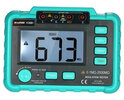
But as to DIY repair, not so sure? I would plug my tester into the socket supplying the dish washer Loop-test.jpg do a loop test, and also RCD test, but most DIY people will not have a meter to do that with. I would also test earth pin to neutral pin on the dish washers (not line as that may be switched off) with this meter VC60B.jpg but same as with loop impedance and RCD tester, how many DIY people have an insulation tester, I would test on 250 volt range, as there may be a filter which could pass on 500 volt range.

Even a low ohm ohmmeter, (must use 200 mA or more for the test) is unlikely to be in the DIY mans tool kit. So yes you can use a long wire and a multi-meter to do some tests, but the point is there must be multiple faults for this to happen.
1) Earth bonding missing.
2) Insulation failure.
3) RCD/RCBO failure.
Fixing just one is not good enough. Reading the regulations we see reference to "installed in a room having a non-conducting floor" and the idea of the floor conducting rings alarm bells. Which returns us to @securespark and is there under floor heating?
 
The RCD did not trip as the current imbalance was not sufficient. Dishwashers, etc, generally have a delta suppressor capacitor, which places low-value (often 0.1uF ) capacitors between L-N, L-E and E-N. If the appliance chassis is not, for some reason, connected to earth, then the chassis will float at Uo/2 - ie. 115V. This will give exactly the effect that the OP has experienced. As the source impedance is very high, the current flowing through the OP's body will be too low to trip a 30mA RCD, but quite high enough for him to feel.
 
Not sure why a floor would conduct? Seen it with operation theatres, but a kitchen, that seems strange, I see the reason for @securespark question on under floor heating, but since same readings to washing machine and sink, it does point to dish washer.

The 115v sounds to me, like the mains input filter of the washing machine, but the machine lacking an earth.
 
I would agree with @davelx and @Harry Bloomfield that it seems likely lacking an earth at the plug/socket, and possibly not enough to trip a 30 mA RCD.

However to test without test equipment is a problem. My dishwasher is powered from a socket in the cupboard next to it, so easy to unplug, but the question is how to test with a multi-meter?

Either the sink, washing machine and floor are not earthed, or the dishwasher is not earthed, we assume it is the dish washer, but how do we work out which is at fault? The meter we assume has a resistance load, and notes the voltage with and without the load, to work out the earth loop impedance, but without the meter, we need a reference point.

So how do we find a reference point, i.e. some thing we are 100% sure is true earth. My parents house, I think was using the water main as an earth, and when this was replaced with plastic, the house was no longer tied to earth, however all was still bonded, so it was like the bird on the electric wire, no one got a shock.

So we expect line to earth to be 230 volt, and neutral to earth to be zero volt, but we are permitted up to 50 volts between neutral and earth, in real terms more like 10 volt maximum. So yes measuring line to earth points, we should be able to see which one is the true earth.

However I am not happy trying to instruct a DIY person on how to safely measure this. Even a plug in tester 1748872308252.png may be enough to work it out, but even they have a £54 price tag, and a proper tester 1748872458543.png only £13.71 more, so seems daft to get a tester which is not rated for use on ring finals.

There is of course the point, if, as it seems likely, one socket is faulty, how many more sockets are faulty around the house? I am all in favour of some DIY, but in this case, to try and detail how to test without test equipment, seems to be asking for problems.
 
Thanks all for the input. I picked up a socket tester on the way home from work, and confirmed that all the kitchen sockets are fine except the dishwasher one, which has an earth fault.

It does rather look like the dishwasher socket was fitted as an afterthought by Uncle Bob rather than a professional; the others are all chased into the wall. In the photo below, the black cable coming out of the conduit is the dishwasher mains; the unit itself is on the other side of the brick pillar the socket is attached to.

socket 2.jpg


Having opened it up, the earth wire is connected, so presumably it's either a break or an ungrounded other end. I can't get to that other end because I haven't worked out how to get the dishwasher out from under the counter without breaking anything. On closer inspection, the insulation on the earth wire stops before it disappears into the main grey sleeve, which is a bit disconcerting.

earth.jpg


For now, I've got the washing machine and dishwasher on the same socket, with instructions to the family not to run both at the same time. I've measured, and there are no unpleasant voltages hanging around any more.
 
Last edited:
On closer inspection, the insulation on the earth wire stops before it disappears into the main grey sleeve, which is a bit disconcerting.
It's not particularly abnormal. In this country "twin and earth" cable has a bare earth wire, and the "done thing" is to sleeve it at terminations to identify it as an earth wire, and to reduce the risk of accidental contact with live parts, but the sleeving and/or the cable often moves around a bit leaving a gap.
 
It does rather look like the dishwasher socket was fitted as an afterthought by Uncle Bob
You should look around the house and see if you can identify any of his other work - it does seem immediately recognisable! (And use your socket tester everywhere.)

I've measured, and there are no unpleasant voltages hanging around any more.
Excellent! Thanks for reporting back.
 

If you need to find a tradesperson to get your job done, please try our local search below, or if you are doing it yourself you can find suppliers local to you.

Select the supplier or trade you require, enter your location to begin your search.


Are you a trade or supplier? You can create your listing free at DIYnot Local

 
Back
Top