• Looking for a smarter way to manage your heating this winter? We’ve been testing the new Aqara Radiator Thermostat W600 to see how quiet, accurate and easy it is to use around the home. Click here read our review.

Black paint on the bricks

Joined
11 Dec 2018
Messages
8
Reaction score
0
Country
United Kingdom
Hello

I've recently moved into a 1910-20 end of tarraced house. The house is build with solid brick walls, and concrete floor on the ground floor.

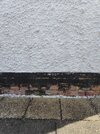
On the outside it's has pebbledash render, and the bottom few rows of the bricks is painted with black paint, presumably bitumen paint or something similar.

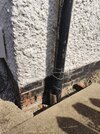
However, as you see on the photos the paint is flaking in many places and mortar is missing in few palces too.

There is also a gutter downpipe going directly into drain. The gutter is cleaned and drain seems to be fine too. However In that corner inside the house there are signs of damp. Probably from the splashback and missing mortar.

I want to repoint the mortar in between the bricks, but not sure what to do about the paint. How to remove it in order to properly repoint.

Thanks in advance for any suggestion.
 

Attachments

  • IMG20240830125350.jpg
    IMG20240830125350.jpg
    680.5 KB · Views: 132
  • IMG20240830125339.jpg
    IMG20240830125339.jpg
    669 KB · Views: 125
You could try a pressure washer. Beyond that sand-blasting will definitely take the paint off, but will also take the surface of the bricks off, leaving them very porous.

It's a shame it was done, it will be as likely to keep damp in as keep it out.
 
Grind or chisel out the joint, you don't need to specifically remove the paint. Then repaint.
 
Peelaway
It's paint remover.
Don't seal the bricks with paint.
 
Take care; I had an asbestos survey done on a building I use, and the surveyor said that a thick line of bitumen-looking paint on the bricks was one thing he would send for asbestos testing if there were plans for it to be disturbed..
If you don't know how long the paint has been there perhaps avoid operations that would see it being reduced to airborne dust unless it's tested to be safe
 
If you leave it, it will erode away in 50 years or so.

It is usually applied to hide (it does not cure) damp at the foot of a wall. Actually it makes it worse, by preventing water evaporating out of the bricks.

The cause is probably nearby, usually a broken or leaking drain or pipe, or incorrectly laid concrete or paving that bridges the DPC and/or slopes making water puddle against the house.

Very noticeably, in your cases there is a old downpipe next to the damp patch, and the paving level looks like it was raised since the house was built.

Digging round the pipe will probably find a drain fault, and you will also be able to find the original DPC.

In old houses, the lime mortar below ground is often washed away by long term leaks. You can clean out the mud and repoint using cement mortar. You do not need to use lime below ground because it will not "breathe."

Do not allow anybody who sells silicone injections near your house.
 
Last edited:
It's very unlikely to contain asbestos. That would be the thick goo that was used under floor tiles or parquet, the asbestos fibres were to strengthen and thicken it.

If there's asbestos then it probably wouldn't have flaked off, and you'd see the fibres poking out if it had.
 
Thanks you all for the messages.

I'm planning to remove the slabs, they are too high and too close to the wall. Expose a bit more bricks and then repoint. Hopefully that will help with the damp patches inside.
 
Doesn't look like they're too high to me, if that injected course is the floor level.

If you've got damp then get a drain survey, find out what's happening underground.

Or start by going for a walk the next time there's sustained heavy rain. You may see drains overflowing, gutters leaking or anything else. People stay inside when it rains, so don't see the issues.
 
It was pouring last few days, so I did go out to check the drain, it wasn't overflowing, water was going smoothly down, the gutter above was fine too.

The soil around though, is very wet and more like clay than soil.
 
If there are no above-ground leaks then there could still be underground issues. Leaking/blocked old clay pipes could be saturating the soil.

A camera survey might be useful.

Also check the gradients of the paving, see what surface water is getting funnelled where. The paving should take water a good distance away from the building.
 
OP,
The blackstuff was traditionally applied as a hopeful barrier to prevent further damp after damp had already appeared inside the house.
It was not "applied to hide damp".
There are no indications in your pics of: "a drain fault".

1. Can you indicate on one of the above pics where your solid floor level is?
2. Was the solid floor concrete laid on a membrane,(a DPM)? Removing a piece of skirting might show plastic?
2. Can you post a pic showing the interior damp?
3. Does the down pipe go into a gulley?
4. Do the bottom courses of painted brick project a little from the brickwork above them? Creating a lip?
Whatever, render should typically end with a Bell Cast.
5. If, for some reason, you want to test your drainage then there are various very simple very cheap, methods of doing it.
 
There are no indications in your pics of: "a drain fault".

It is entirely normal for original clay pipes and gullies in the ground around a 1910 house to be cracked or broken.

Even if this is not visible in the pic.
 
Poster #13,
No its not.
Even if its still not visible in the pic.
FWIW: Professional building workers dont call the original drainage "clay pipe" - its referred to as salt glaze.
 

If you need to find a tradesperson to get your job done, please try our local search below, or if you are doing it yourself you can find suppliers local to you.

Select the supplier or trade you require, enter your location to begin your search.


Are you a trade or supplier? You can create your listing free at DIYnot Local

 
Back
Top