• Looking for a smarter way to manage your heating this winter? We’ve been testing the new Aqara Radiator Thermostat W600 to see how quiet, accurate and easy it is to use around the home. Click here read our review.

Blown brickwork (and damp) (Ed.)

Joined
15 May 2025
Messages
3
Reaction score
0
Country
United Kingdom
In the process of purchasing a detached c1930s property which is in need of some serious TLC.

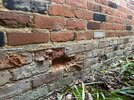
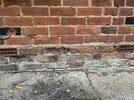
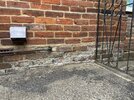
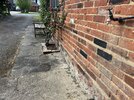
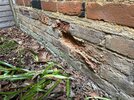
One of our most pressing concerns is the presence of rising dampness internally resulting in dampness to lower internal walls. The DPC is formed in slate which has clearly deteriorated and failed resulting in the presence of the dampness internally. In addition to this, the base course brickwork is exceptionally poor - frost and water damaged with spalled and extensively washed out brickwork. The DPC to all walls is well above 150mm. Pointing appears to be formed in lime cement - although very poor and needing repointed.

Seeking advise on how best to approach the above. As a very rough approach I’m planning on cutting back the adjacent concrete paths and excavating out c.150mm earth/debris and back-filling with pea gravel. I would also propose to install a course of dry rods to the mortar course 1 brick below the present slate DPC. Following this, the dilemma is how to address the cr@p base course brickwork. Cutting out the worst of the brickwork is obviously necessary to secure the longevity of the broader structure. However, 90% of the brickwork has sustained some damage - therefore would a cement plinth be recommend to in effect incapsulate and protect the brickwork and also provide a degree of weather protection to the exposed lower walls?
 

Attachments

  • IMG_6370.jpeg
    IMG_6370.jpeg
    626.8 KB · Views: 34
  • IMG_6371.jpeg
    IMG_6371.jpeg
    753.3 KB · Views: 31
  • IMG_6368.jpeg
    IMG_6368.jpeg
    760.4 KB · Views: 41
  • IMG_6369.jpeg
    IMG_6369.jpeg
    791.6 KB · Views: 44
  • IMG_6367.jpeg
    IMG_6367.jpeg
    756.3 KB · Views: 33
I can't see any failure of the slate itself. It lasts millions of years and does not wear out. It's noticeable that the damage is very bad below the slate, and not above.

The lime mortar is very eroded, this is common when there is a long term leak that washes it away.

Please stand back and take some wide angle shots of the entire walls. There may be an area that is particularly bad. If so, please indicate the position of waterpipes and drains that may be the source of water.

Dry rods do not repair leaking pipes, gutters or drains but I can sell you some magic beans that will be equally effective.
 
Point taken on the dry rods. I’ve read similar. So regarding the poor base course brickwork how would you approach? Thoughts on encapsulating with a lime cement render plinth that would enhance the appearance of the walls at low level?
 

Attachments

  • IMG_6256.jpeg
    IMG_6256.jpeg
    766.5 KB · Views: 26
  • IMG_6255.jpeg
    IMG_6255.jpeg
    727.3 KB · Views: 30
People will tell you that old houses must be repaired with lime mortar so they can breathe. But cement mortar is undamaged by water. Certainly, below ground level, you will probably find a lot of mortar is gone and replaced by mud, you can hose it out and replace with cement mortar, becsuse underground brickwork is not exposed to the air so does not "breathe"

Perished lime mortar will brush away with a stiff brush, and can be repointed more neatly round the slate.

You can patch the damaged bricks with mortar using a powdered red pigment sold for the purpose. Or, better, a good bricklayer can take out the old and replace with new, if you can find matching vintage bricks (modern bricks are a different size) and can probably repoint better than you, and far faster, even if he is an old feller. A plinth is a poor repair, and prevents or slows evaporation, making damp worse.

But first, you need to find and repair the source of water. If you lift the paving beside the wall, I think you will find more eroded mortar, though the bricks will not be frosted. The wall has been very wet, so I would be thinking of a leak. If it was ground water it would be wet all round the house. I do not see splash marks high on the wall so probably not an overflowing gutter. But go outside during and after heavy rain to check is it not running or lying against the wall.

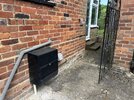
Oh, I see the tap now. Could that be the culprit?

If there is a kitchen on the other side of that wall, there might be an unseen leak in the floor.
 
Last edited:
So to give some further insite, the dampness runs around the entire house - making me think it’s a broader issue as opposed to a specific leak or defect with a drain/or tap. The property is fairly close to a tributary of the river Wey - soils are very rich and moisture heavy - (I think) the water table lies fairly high although the property is not designated as being in a flood risk area. So the problem arises - fairly damp ground conditions, absorbent / saturated bricks and dampness breaching the slate dpc. The base course brickwork will always be wet to a degree, but this surpasses an acceptable level of moisture hense the deteriorating brick surfaces.
 
May be informative to dig a few trial holes close to the house to observe the wetness.
 

If you need to find a tradesperson to get your job done, please try our local search below, or if you are doing it yourself you can find suppliers local to you.

Select the supplier or trade you require, enter your location to begin your search.


Are you a trade or supplier? You can create your listing free at DIYnot Local

 
Back
Top