• Looking for a smarter way to manage your heating this winter? We’ve been testing the new Aqara Radiator Thermostat W600 to see how quiet, accurate and easy it is to use around the home. Click here read our review.

Cables in loft route

Joined
14 Oct 2023
Messages
189
Reaction score
4
Country
United Kingdom
Hey guys

As some ofbyou will know I'm doing an assessment and I have to draw some cables on a diagram.

I have done a basic diagram just for my understanding and hoppe someone can help me.

I'm doing a ring circuit. Cables will go up the wall into the loft . Floor is concrete.

To avoid insulation I will clip them above the joist. If you can see from my diagram . To from socket A to B can I lay the cables and clip them ontop the joist like that? I know i usually have to run it alongside the joist but in this situation I can't. So would this be acceptable ?

P.S I know i can include insulation as a factor in my cable calcs but that would mean I can't use a ring and have to make multiple radials circuits which I don't want. I want to do it like this.

Also if you see from socket C can I take the cable in a diagonal over the joists ?

My diagram is just an example for my understanding and not the work I plan to submit.


Thank you all!
20250425_152729.jpg
 
P.S I know i can include insulation as a factor in my cable calcs but that would mean I can't use a ring and have to make multiple radials circuits which I don't want. I want to do it like this.
You seem to have said that you will 'avoid insulation' (and what you have suggested sounds fine). However, even if the cable had to be under insulation, that would not necessarily mean that you couldn't have a ring circuit, the only requirement being that the current-carrying-capacity (with the installation method used) of the cable must be at least 20A (and at least 2.5mm², if T+E).

For a start, with installation Method 100 ("above a plasterboard ceiling covered by thermal insulation not exceeding 100 mm in thickness"), 2.5mm² cable has a CCC of 21A, so OK. If the conditions for Method 100 were not satisfied, then 4mm² cable could be used - in which case Method 101 ("above a plasterboard ceiling covered by thermal insulation exceeding 100 mm in thickness") cable would have a CCC of 22A, so again OK.

... and, before anyone says anything to the contrary, I would add that I personally find 4mm² T+E cable nicer/easier to work with than 2.5mm² !

Having said all that, there's absolutely nothing wrong with radials!
 
Clipping to the top of the joist is asking for trouble if you ask me unless you can guarantee that nobody will want to board the loft or or walk around in it
 
Omg thanks for all your advice. This seriously has got all the worries out my head. Yes it is a test lol.

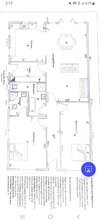
I have added the 2 bed bunglow I'm having to wire for my assessment. So rest assured it is. ..

Ignore the markings as I have to put more on it.

I'm doing

Kitchen RFC 32amp
Whole house RFC for sockets 32amp
Boiler 6a radial
Cooker 6a radial
2 6a circuits for lighting.

I'm trying to do less circuits so I dont have to do too many cable calcs lol

So I can make any justifications really as long as it makes sense. I clipped cables above the joist to avoid insulation. Also it will mean I can have ring final circuits hopefully comes to 4mm cable therefore better balancing of loads. Rather than having to install a radial. As its a bunglow and client adviced no one will go in the loft. I'll put that in my justicfication therefore the dangers were considered.

I hope I'm in the right track here. I'm just hoping I can do the same installation method for the walls too. Rather than keep coming up and down for every socket in the loft I can go across horizontal on accessions on the same level which are on the same wall. Only go back to loft to change wall or go to next room. I'm trying to avoid voltage drop issues too.
 

Attachments

  • Screenshot_20250424_141250_Microsoft 365 (Office).jpg
    Screenshot_20250424_141250_Microsoft 365 (Office).jpg
    127.7 KB · Views: 20
You seem to have said that you will 'avoid insulation' (and what you have suggested sounds fine). However, even if the cable had to be under insulation, that would not necessarily mean that you couldn't have a ring circuit, the only requirement being that the current-carrying-capacity (with the installation method used) of the cable must be at least 20A (and at least 2.5mm², if T+E).

For a start, with installation Method 100 ("above a plasterboard ceiling covered by thermal insulation not exceeding 100 mm in thickness"), 2.5mm² cable has a CCC of 21A, so OK. If the conditions for Method 100 were not satisfied, then 4mm² cable could be used - in which case Method 101 ("above a plasterboard ceiling covered by thermal insulation exceeding 100 mm in thickness") cable would have a CCC of 22A, so again OK.

... and, before anyone says anything to the contrary, I would add that I personally find 4mm² T+E cable nicer/easier to work with than 2.5mm² !

Having said all that, there's absolutely nothing wrong with radials!
This is brilliant thank you so much!!!
 
Kitchen RFC 32amp
Whole house RFC for sockets 32amp
Be aware that RFC also stands for Radial Final Circuit although very few realise it.

Boiler 6a radial
Cooker 6a radial
2 6a circuits for lighting.
6A for cooker???
Capital A for Amp.

I'm trying to do less circuits so I dont have to do too many cable calcs lol
You don't have to actually do any calculations using standard circuits.
('Fewer circuits' but never mind)

So I can make any justifications really as long as it makes sense. I clipped cables above the joist to avoid insulation.
You could run the cables on battens - anywhere..

Also it will mean I can have ring final circuits hopefully comes to 4mm cable therefore better balancing of loads. Rather than having to install a radial.
Those things are not the options.

As its a bunglow and client adviced no one will go in the loft. I'll put that in my justicfication therefore the dangers were considered.
Ok.

I hope I'm in the right track here. I'm just hoping I can do the same installation method for the walls too. Rather than keep coming up and down for every socket in the loft I can go across horizontal on accessions on the same level which are on the same wall. Only go back to loft to change wall or go to next room. I'm trying to avoid voltage drop issues too.
You could just have a Ring in the loft and every socket on a spur drop - which is common in bungalows (with concrete floors).
 
Be aware that RFC also stands for Radial Final Circuit although very few realise it.


6A for cooker???
Capital A for Amp.


You don't have to actually do any calculations using standard circuits.
('Fewer circuits' but never mind)


You could run the cables on battens - anywhere..


Those things are not the options.


Ok.


You could just have a Ring in the loft and every socket on a spur drop - which is common in bungalows (with concrete floors).


Thank you I meant 32amp radial for the cooker.

I'm not that advanced yet lol to do anything elloborate like your suggesting. I've never even done any proper installation as of yet ! Lol. Just bits here and there.

I am just trying to keep it simple for myself to understand atm. In terms of calcs I need to do them for all the circuits as it's the assessment.


I am currently designing my kitchen ring circuit I've put 5 double sockets above the work top. About 3 double on a seperate wall. (This isn't for the cooker)

I understand I have to put a couple of switches for things like washing machine , fridge etc FCU? Are these optional or I have to for regs. Anything optional for my assessment u can disregard. But my question is if I put a and FCU with a switch before the socket let's just say for the washing machine. Would that fcu or switch affect the sockets after the washing machine on the ring? Or not?
 
Thank you I meant 32amp radial for the cooker.
Ok.

I'm not that advanced yet lol to do anything elloborate like your suggesting. I've never even done any proper installation as of yet ! Lol. Just bits here and there.
I am just trying to keep it simple for myself to understand atm. In terms of calcs I need to do them for all the circuits as it's the assessment.
It's not elaborate - very simple.
You just have the length of the ring, whatever that is - 50m ? - and all the 3m spur drops only add one single addition to the length of the ring - 53m.
Have I said that correctly? If you have 10 spurs then each one will make the ring 50m plus 3m; not 50m plus 60m.

I am currently designing my kitchen ring circuit I've put 5 double sockets above the work top. About 3 double on a seperate wall. (This isn't for the cooker)
Ok. but that's not design.
You just run the ring around the kitchen and you can have as many sockets as you want.

I understand I have to put a couple of switches for things like washing machine , fridge etc FCU? Are these optional or I have to for regs.
They are optional.

Anything optional for my assessment u can disregard. But my question is if I put a and FCU with a switch before the socket let's just say for the washing machine. Would that fcu or switch affect the sockets after the washing machine on the ring? Or not?
It won't affect the socket or anything else.
You don't need an FCU for an appliance because there is a fuse in the plug so just a 20A DP switch if you want one.
 

If you need to find a tradesperson to get your job done, please try our local search below, or if you are doing it yourself you can find suppliers local to you.

Select the supplier or trade you require, enter your location to begin your search.


Are you a trade or supplier? You can create your listing free at DIYnot Local

 
Back
Top