
• Looking for a smarter way to manage your heating this winter? We’ve been testing the new Aqara Radiator Thermostat W600 to see how quiet, accurate and easy it is to use around the home. Click here read our review.

Cavity opening after removing doors

Joined
7 Jul 2016
Messages
13
Reaction score
0
Country
United Kingdom
I’m hoping someone can help or offer advice.

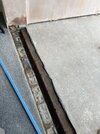
We have recently had an extension built on the back of our house (1940s). French doors were removed to open it up to the extension (they used to lead to outside). When the old doors were removed to reveal the cavity, concrete had been used to fill the cavity. The concrete was damp, so I have taken it out to let the bricks breath.

The question is what should I do about filling the cavity in? Should I fill it in? The brickwork sits about 5mm below the new floor and 15mm below the existing floor. There will be a laminate flooring going on top of the new floor. I thought about lining the cavity with dpm and filling with concrete, cap it off with a cavity closer, then seal it and use self levelling compound to the height of the new floor. Would this work?

My concern is moisture in the bricks. The red brick was damp to the touch when first revealed, although this is now drying out slowly.

Any help or suggestions are much appreciated. Thanks.
 

Attachments

  • IMG_4102.jpeg
    IMG_4102.jpeg
    592.5 KB · Views: 59
Is the extension single story or the same as the house ie. with the same roof covering both. If it's the latter then it becomes an internal wall and I don't think you need to worry about closing the cavity. Not sure, if it is the former but the cavity should be open 6" below the DPC as far as I remember. The dampness should not be a problem if you just put a damp proof membrane across before you level the 2 floors.
 
Last edited:
Is the extension single story or the same as the house ie. with the same roof covering both. If it's the latter then it becomes an internal wall and I don't think you need to worry about closing the cavity. Not sure, if it is the former but the cavity should be open 6" below the DPC as far as I remember. The dampness should not be a problem if you just put a damp proof membrane across before you level the 2 floors.
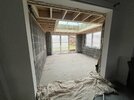
It’s a single storey extension with a flat roof. What was the external wall has now become an internal wall. I’ve attached a photo for reference.

Can I pour levelling compound on top of a damp proof membrane?
 

Attachments

  • IMG_4018.jpeg
    IMG_4018.jpeg
    376 KB · Views: 47
I’m hoping someone can help or offer advice.

We have recently had an extension built on the back of our house (1940s). French doors were removed to open it up to the extension (they used to lead to outside). When the old doors were removed to reveal the cavity, concrete had been used to fill the cavity. The concrete was damp, so I have taken it out to let the bricks breath.

The question is what should I do about filling the cavity in? Should I fill it in? The brickwork sits about 5mm below the new floor and 15mm below the existing floor. There will be a laminate flooring going on top of the new floor. I thought about lining the cavity with dpm and filling with concrete, cap it off with a cavity closer, then seal it and use self levelling compound to the height of the new floor. Would this work?

My concern is moisture in the bricks. The red brick was damp to the touch when first revealed, although this is now drying out slowly.

Any help or suggestions are much appreciated. Thanks.
The bricks need removing so that you can add a thickness of insulation plus concrete/screed etc. We normally remove a couple of courses, line the trough with DPM add insulation and concrete and/or screed.
 
The bricks need removing so that you can add a thickness of insulation plus concrete/screed etc. We normally remove a couple of courses, line the trough with DPM add insulation and concrete and/or screed.
That’s really useful. Thank you.
 

If you need to find a tradesperson to get your job done, please try our local search below, or if you are doing it yourself you can find suppliers local to you.

Select the supplier or trade you require, enter your location to begin your search.


Are you a trade or supplier? You can create your listing free at DIYnot Local

 
Back
Top